RAN Configuration Update is the NG-RAN-to-AMF interface-management message used to transfer updated NG-C application-level configuration such as Supported TA List, paging DRX, Global RAN Node ID, node naming, and TNL association removal information.
Non-UE-associated NGAP signaling / SCTP carried NGAP initiatingMessage followed by successfulOutcome acknowledge or unsuccessfulOutcome failure
Typical trigger
The NG-RAN has already taken revised configuration into operational use and needs the AMF to refresh its stored view of Supported TA List, paging defaults, node identity or name, or TNL association-removal information.
Main purpose
Lets the NG-RAN tell the AMF that updated configuration data is already in operational use and that the AMF should refresh its stored NG-C interface view for tracking-area support, paging parameters, node identity, naming, and optional TNL association removal handling.
NG-C interface maintenance, Tracking-area and slice support refresh, Paging parameter refresh, Global RAN Node ID refresh, TNL association removal handling
What is RAN Configuration Update in simple terms?
RAN Configuration Update is the NG-RAN-to-AMF interface-management message used to transfer updated NG-C application-level configuration such as Supported TA List, paging DRX, Global RAN Node ID, node naming, and TNL association removal information.
Lets the NG-RAN tell the AMF that updated configuration data is already in operational use and that the AMF should refresh its stored NG-C interface view for tracking-area support, paging parameters, node identity, naming, and optional TNL association removal handling.
Why this message matters
RAN Configuration Update is the NG-RAN telling the AMF that node-level N2 configuration has changed and that the AMF should refresh its stored view without touching existing UE contexts.
Where this message appears in the call flow
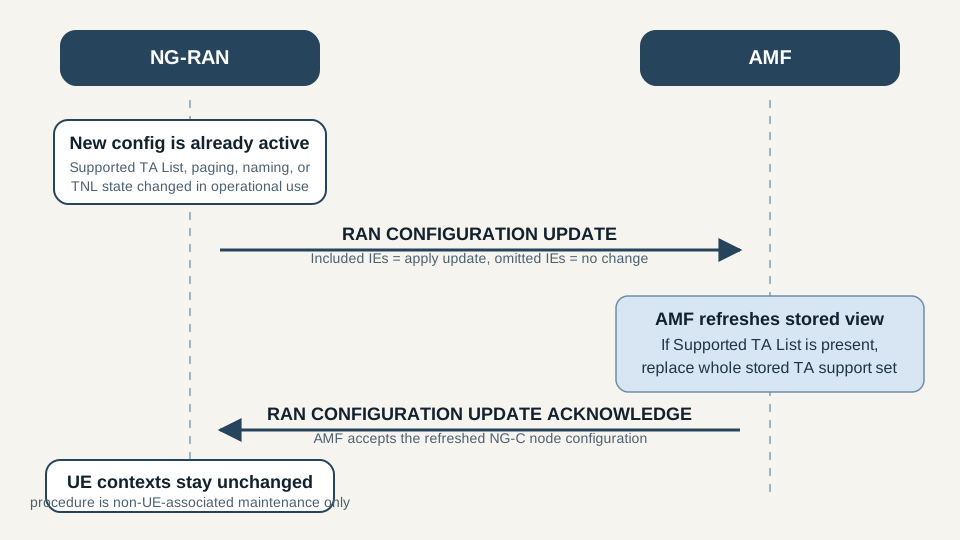
NG-RAN refreshes AMF-side view of node configuration
Refresh branch: the NG-RAN sends updated node-level configuration already in operational use, and the AMF acknowledges after refreshing its stored NG-C interface view.
Call flow position: The NG-C interface instance already exists and the NG-RAN has brought new configuration into operational use.
Typical state: The AMF still holds an older view of the NG-RAN configuration and needs a refresh at the application layer.
Preconditions:
NG Setup has already completed successfully for the AMF relationship.
The NG-RAN has updated configuration that is already active in operation.
The update concerns node-level NG-C information rather than UE-specific context.
Next likely message: RAN Configuration Update Acknowledge
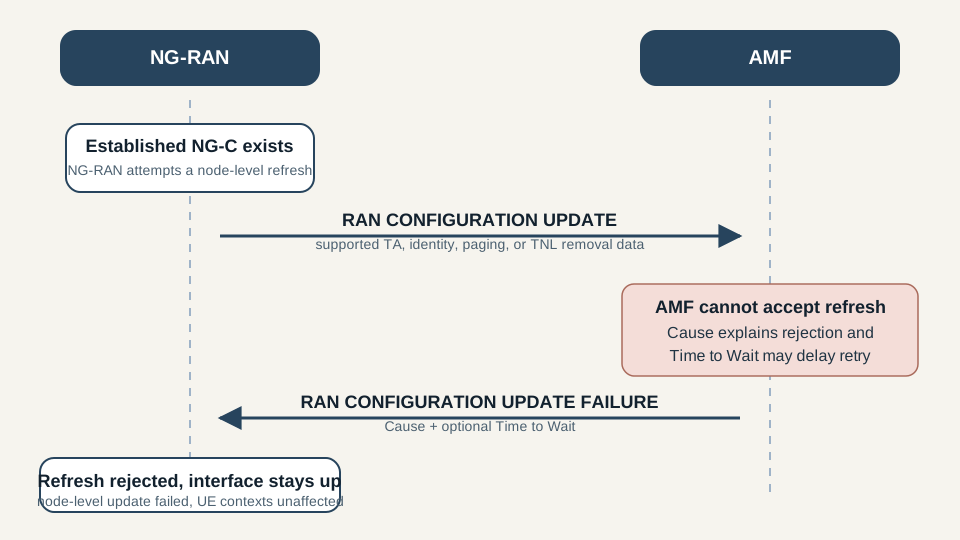
AMF rejects the configuration refresh
Failure branch: the interface remains established, but the AMF rejects the configuration refresh and can delay retry with Time to Wait.
Call flow position: The NG-RAN sends RAN Configuration Update but the AMF cannot accept or apply the advertised update.
Typical state: The interface remains established, but the requested configuration refresh is not accepted.
Preconditions:
The AMF received the initiating message.
The AMF identified a reason to reject the update content.
Next likely message: RAN Configuration Update Failure
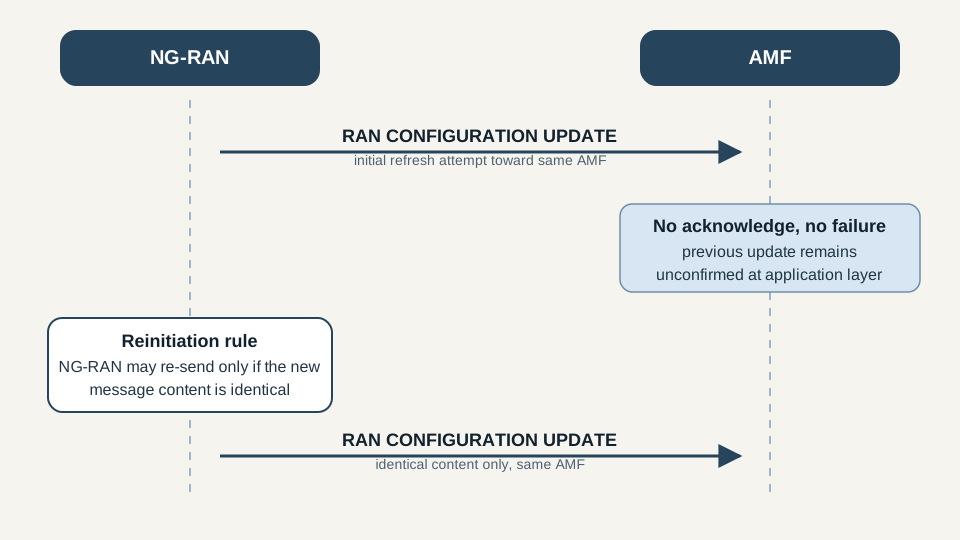
No response and identical reattempt
Abnormal-condition branch: if neither acknowledge nor failure is received, the NG-RAN may reinitiate the procedure only with identical message content toward the same AMF.
Call flow position: The NG-RAN receives neither acknowledge nor failure and may reinitiate the procedure toward the same AMF.
Typical state: The previous update remains unconfirmed.
Preconditions:
No RAN Configuration Update Acknowledge or Failure was received.
The new RAN Configuration Update content is identical to the earlier unacknowledged message.
Next likely message: RAN Configuration Update
Call flow position
Previous message(s):NG Setup Response, Established NG-C interface instance, Local NG-RAN configuration change
Logical channel: SCTP carried NGAP initiatingMessage followed by successfulOutcome acknowledge or unsuccessfulOutcome failure
Transport / encapsulation: NGAP over SCTP/IP between NG-RAN and AMF
Security context: RAN Configuration Update does not create, release, or modify UE-specific security context. The procedure updates node-level NG-C interface information and does not affect existing UE-related contexts.
Message Structure Overview
RAN Configuration Update is a non-UE-associated initiatingMessage in the Interface Management family.
The message only carries the pieces of node-level configuration that changed. If an IE is omitted, the AMF interprets that part as unchanged.
Supported TA List is especially important because when it is present the AMF overwrites the whole stored list and uses the replacement for later registration-area management.
The message can also request removal of NG-RAN TNL associations, making it more than a pure naming or paging refresh.
The procedure does not affect existing UE-related contexts even though it changes the AMF-side stored view of the NG-RAN.
ASN.1 for 5G NGAP - RAN Configuration Update
RANConfigurationUpdate ::= SEQUENCE {
  protocolIEs ProtocolIE-Container { {RANConfigurationUpdateIEs} },
  ...
}

RANConfigurationUpdateIEs NGAP-PROTOCOL-IES ::= {
  { ID id-RANNodeName                    CRITICALITY ignore TYPE RANNodeName                    PRESENCE optional } |
  { ID id-SupportedTAList                CRITICALITY reject TYPE SupportedTAList                PRESENCE optional } |
  { ID id-DefaultPagingDRX               CRITICALITY ignore TYPE PagingDRX                      PRESENCE optional } |
  { ID id-GlobalRANNodeID                CRITICALITY reject TYPE GlobalRANNodeID                PRESENCE optional } |
  { ID id-NG-RANTNLAssociationToRemoveList CRITICALITY ignore TYPE TNLAssociationList           PRESENCE optional } |
  { ID id-NB-IoT-DefaultPagingDRX        CRITICALITY ignore TYPE PagingeDRXInformation          PRESENCE optional } |
  { ID id-ExtendedRANNodeName            CRITICALITY ignore TYPE ExtendedRANNodeName            PRESENCE optional },
  ...
}

SupportedTAList ::= SEQUENCE (SIZE (1..maxnoofTACs)) OF SupportedTAItem
BroadcastPLMNList ::= SEQUENCE (SIZE (1..maxnoofBPLMNs)) OF BroadcastPLMNItem
TNLAssociationList ::= SEQUENCE (SIZE (1..maxnoofTNLAssociations)) OF TNLAssociationItem
How to read this ASN.1
Read the ASN.1 as an update container rather than a complete node profile. The key rule is omission means no change, while inclusion means the AMF should apply the included content according to the procedure semantics.
Treat this as a teaching example based on the spec structure, not as a captured network trace.
If Supported TA List is present, read it as a full replacement on the AMF side rather than as a patch list.
If an IE is omitted, the AMF interprets the corresponding configuration area as unchanged.
Important Information Elements
IE
Presence
Description
Message Type
Mandatory
Identifies the NGAP PDU as RAN Configuration Update within the initiatingMessage branch.
RAN Node Name
Optional
Optional human-readable NG-RAN node name.
Supported TA List
Optional
Optional supported tracking-area list with PLMN, slice, SNPN, NSAG, Configured TAC Indication, and RAT context. If present, the AMF overwrites its previously stored list.
Default Paging DRX
Optional
Optional paging DRX value carried in the update.
Global RAN Node ID
Optional
Optional global NG-RAN identity. If present, the AMF associates the TNLA to the NG-C interface instance using this identity.
NG-RAN TNL Association to Remove List
Optional
Optional list of NG-RAN-side transport-layer associations the AMF should remove if supported.
NB-IoT Default Paging DRX
Optional
Optional NB-IoT paging parameter. If present, it overwrites the previously stored value for the NG-RAN node.
Extended RAN Node Name
Optional
Optional extended human-readable node name. If present, the AMF may use it and ignore RAN Node Name.
Detailed field explanation
Message Type
Identifies the NGAP PDU as RAN Configuration Update within the initiatingMessage branch.
Presence: Mandatory
In practice: In practice, compare this field with the original request and with any later release-dependent optional fields so you can see whether the network accepted the same service model the UE asked for.
RAN Node Name
Optional human-readable NG-RAN node name.
Presence: Optional
In practice: In practice, compare this field with the original request and with any later release-dependent optional fields so you can see whether the network accepted the same service model the UE asked for.
Supported TA List
Optional supported tracking-area list with PLMN, slice, SNPN, NSAG, Configured TAC Indication, and RAT context. If present, the AMF overwrites its previously stored list.
Presence: Optional
In practice: In practice, compare this field with the original request and with any later release-dependent optional fields so you can see whether the network accepted the same service model the UE asked for.
Default Paging DRX
Optional paging DRX value carried in the update.
Presence: Optional
In practice: In practice, compare this field with the original request and with any later release-dependent optional fields so you can see whether the network accepted the same service model the UE asked for.
Global RAN Node ID
Optional global NG-RAN identity. If present, the AMF associates the TNLA to the NG-C interface instance using this identity.
Presence: Optional
In practice: In practice, compare this field with the original request and with any later release-dependent optional fields so you can see whether the network accepted the same service model the UE asked for.
NG-RAN TNL Association to Remove List
Optional list of NG-RAN-side transport-layer associations the AMF should remove if supported.
Presence: Optional
In practice: In practice, compare this field with the original request and with any later release-dependent optional fields so you can see whether the network accepted the same service model the UE asked for.
NB-IoT Default Paging DRX
Optional NB-IoT paging parameter. If present, it overwrites the previously stored value for the NG-RAN node.
Presence: Optional
In practice: In practice, compare this field with the original request and with any later release-dependent optional fields so you can see whether the network accepted the same service model the UE asked for.
Extended RAN Node Name
Optional extended human-readable node name. If present, the AMF may use it and ignore RAN Node Name.
Presence: Optional
In practice: In practice, compare this field with the original request and with any later release-dependent optional fields so you can see whether the network accepted the same service model the UE asked for.
What to check in logs and traces
Confirm the message is sent only after the new node-level configuration is already in operational use.
If Supported TA List is present, validate that it is complete and not accidentally partial because the AMF overwrites the whole stored list.
Check Global RAN Node ID carefully if the update relies on TNLA association using that identity.
Validate NG-RAN TNL Association to Remove List addresses and matching scope before expecting transport-association removal.
If the procedure failed, inspect Cause and honor any Time to Wait before retrying toward the same AMF.
Common Issues and Troubleshooting
The AMF accepts the update, but later registration-area behavior does not match expectations.
Likely cause: Supported TA List may have been sent as an incomplete replacement, causing the AMF to overwrite its previously stored list with unintended content.
What to inspect: Compare the entire Supported TA List in the update with the intended TAC, PLMN, slice, SNPN, and RAT footprint.
Next step: Resend a complete and corrected Supported TA List rather than trying to fix the issue with a partial follow-up list.
TNL association removal affects the wrong endpoint pair or no removal happens.
Likely cause: The removal item may identify endpoints too broadly or too narrowly, especially when AMF-side transport-layer address context is absent or port matching assumptions are wrong.
What to inspect: Review NG-RAN and AMF transport-layer addresses in each removal item and compare them with the deployed TNL association set.
Next step: Adjust the removal list so endpoint matching lines up with the intended transport association scope.
The NG-RAN reinitiates the procedure after silence from the AMF.
Likely cause: This is only aligned with the abnormal-condition rule if the repeated RAN Configuration Update content is identical to the earlier unacknowledged message.
What to inspect: Compare the retransmitted message with the original one field by field.
Next step: If content changed, treat it as a new update attempt after resolving the lack of response rather than as a blind reinitiation.
LTE / 5G / Variant Comparison
Compared with NG Setup Request
NG Setup Request establishes NG-C application-layer setup for a new or recovered AMF relationship. RAN Configuration Update refreshes node-level interface information after setup is already established.
Compared with RAN Configuration Update Acknowledge
RAN Configuration Update is the initiating refresh message from the NG-RAN. The acknowledge is the AMF's successful confirmation that the update was accepted.
Compared with RAN Configuration Update Failure
RAN Configuration Update Failure is the negative branch used when the AMF cannot accept the requested configuration refresh and may include Time to Wait.
FAQ
What is RAN Configuration Update in 5G NGAP?
It is the NG-RAN-to-AMF interface-management message used to refresh node-level NG-C configuration after the new configuration is already in operational use.
Who sends RAN Configuration Update?
The NG-RAN node sends RAN Configuration Update to the AMF.
When is RAN Configuration Update used?
It is used after NG-C setup already exists and the NG-RAN needs the AMF to update its stored view of node-level configuration such as Supported TA List, paging parameters, node identity, or TNL-association removal information.
Does RAN Configuration Update affect existing UE contexts?
No. The procedure uses non-UE-associated signaling and explicitly does not affect existing UE-related contexts.
What happens if Supported TA List is included?
The AMF overwrites the whole stored Supported TA List and the corresponding supported-slice information for each tracking area, then uses the replacement for later registration-area management.
What does the AMF do if an IE is omitted?
The AMF interprets the corresponding configuration area as unchanged.
What is Configured TAC Indication used for?
If set to true for a tracking area, the AMF may take it into account to optimize NG-C signaling toward that NG-RAN node.
What is NG-RAN TNL Association to Remove List?
It is the optional list the NG-RAN uses to request removal of one or more TNL associations identified by transport-layer address information.
What happens if the AMF rejects RAN Configuration Update?
The AMF sends RAN Configuration Update Failure with an appropriate Cause and may include Time to Wait to delay reattempt toward the same AMF.
What happens if the NG-RAN gets no acknowledge and no failure?
The NG-RAN may reinitiate the procedure toward the same AMF, but only if the new RAN Configuration Update message content is identical to the previously unacknowledged one.
Decode this message with the 3GPP Decoder, inspect the related message database, or open the matching call flow to see where this signaling step fits in the full procedure.