NG Setup Response is the AMF-to-NG-RAN successful-outcome message that confirms NG-C setup and returns served AMF identity, PLMN and slice support, relative AMF capacity, optional transport-layer association updates, and optional capability indicators.
Message Fact Sheet
Protocol
ngap
Network
5g
Spec
3GPP TS 38.413
Spec Section
Section 8.7.1.2, section 9.2.6.2, and section 9.3.1.32 (Release 18 baseline)
The AMF accepts the NG Setup Request and returns the identity, support, capacity, and optional capability or transport-association information that defines the successful NG-C peer relationship.
Main purpose
Confirms that the AMF accepts NG-C application-layer setup and provides the NG-RAN with the AMF-side identity, support scope, capacity, optional transport-association management data, and optional capability indicators needed for later N2 operation and AMF selection behavior.
NG Setup successful operation, N2 interface bootstrap, AMF and NG-RAN interworking establishment, AMF selection context delivery, Transport association management
What is NG Setup Response in simple terms?
NG Setup Response is the AMF-to-NG-RAN successful-outcome message that confirms NG-C setup and returns served AMF identity, PLMN and slice support, relative AMF capacity, optional transport-layer association updates, and optional capability indicators.
Confirms that the AMF accepts NG-C application-layer setup and provides the NG-RAN with the AMF-side identity, support scope, capacity, optional transport-association management data, and optional capability indicators needed for later N2 operation and AMF selection behavior.
Why this message matters
NG Setup Response is the AMF saying the NG-C setup is accepted and here is the AMF-side identity, support, capacity, and optional capability data the NG-RAN should store.
Where this message appears in the call flow
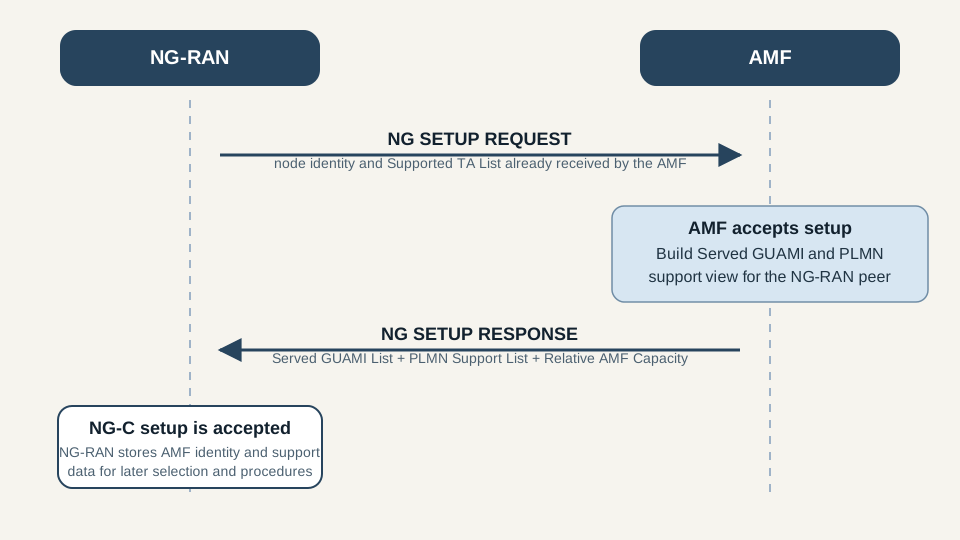
AMF accepts successful NG Setup
Successful-setup branch: the AMF accepts the request and returns the AMF-side identity and support payload that the NG-RAN stores for later NGAP operation.
Call flow position: The NG-RAN has already sent NG Setup Request and the AMF has accepted the advertised node identity, tracking-area scope, and paging defaults.
Typical state: NG-C transport exists and the AMF is ready to confirm successful application-layer setup.
Preconditions:
NG Setup Request reached the AMF successfully.
The AMF accepted the node and TA advertisement in the request.
The AMF has response-side identity and support data ready to return.
Next likely message: Normal non-UE-associated or UE-associated NGAP procedures
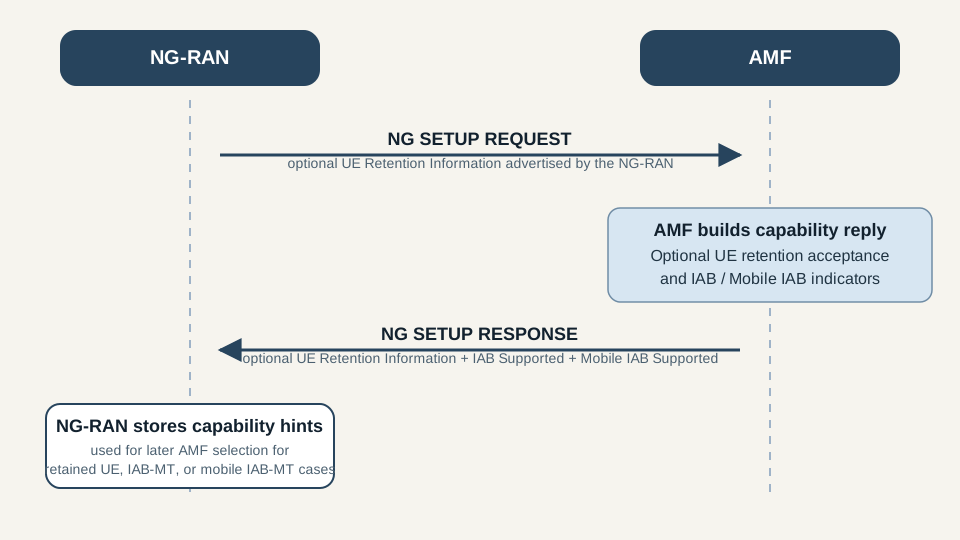
UE retention and IAB capability confirmation
Capability branch: the response can confirm UE retention acceptance and advertise IAB or mobile IAB support for later AMF selection behavior.
Call flow position: The AMF returns optional capability indicators and optional UE retention acceptance after successful setup.
Typical state: The basic setup is accepted and the AMF may add capability hints that influence later AMF selection behavior.
Preconditions:
The setup request or deployment context makes UE retention, IAB, or mobile IAB information relevant.
The AMF supports the optional indicators it chooses to send.
Next likely message: Later AMF selection or IAB-related operation using the stored indicators
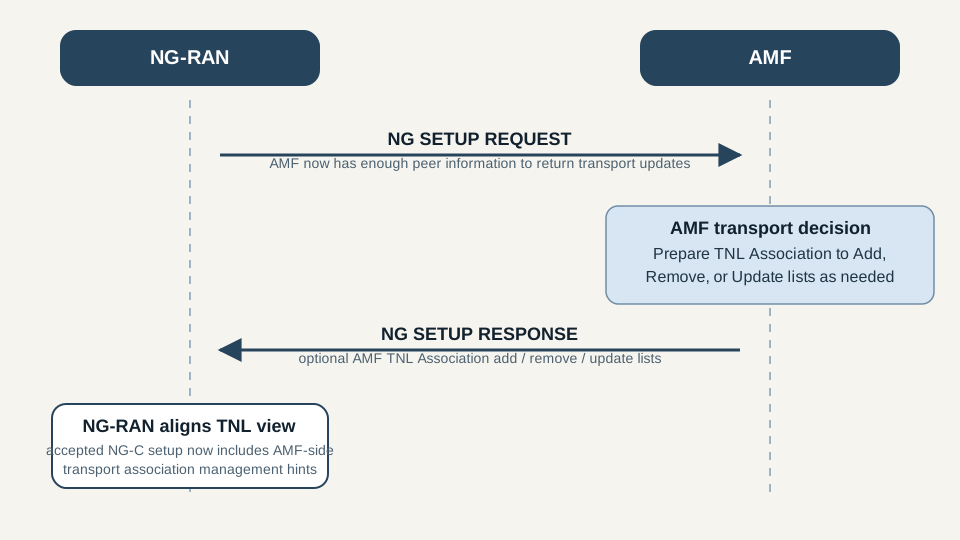
AMF TNL association management during setup success
Transport branch: the response may carry TNL association management information so the NG-RAN can align AMF-side transport association handling with the accepted setup.
Call flow position: The AMF uses the successful response to add, remove, or update control-plane transport association information tied to the accepted NG-C interface instance.
Typical state: The peer relationship is accepted and the AMF may refine the transport association set returned to the NG-RAN.
Preconditions:
The AMF has transport-layer association information relevant to the interface instance.
The response includes one or more AMF TNL Association add, remove, or update list IEs.
Next likely message: Later non-UE-associated maintenance or ordinary NGAP operation using the updated association view
Call flow position
Previous message(s):NG Setup Request, SCTP association establishment, AMF evaluation of setup payload
Transport / encapsulation: NGAP over SCTP/IP between AMF and NG-RAN
Security context: NG Setup Response does not create UE-specific security context. It confirms successful application-layer setup and gives the NG-RAN the AMF-side information needed before later UE-associated NGAP procedures begin.
Message Structure Overview
NG Setup Response is a non-UE-associated successfulOutcome in the Interface Management family.
Unlike the request, the response is mostly optional IE content because the AMF sends only the identity, support, capacity, capability, and transport data that apply to the accepted setup.
Served GUAMI List, PLMN Support List, and Relative AMF Capacity are among the most operationally important response-side outputs because they shape later AMF selection and service-scope interpretation.
AMF TNL Association add, remove, and update lists let the AMF refine transport-layer association handling as part of successful NG-C setup.
Extended AMF Name and Extended Backup AMF Name override their shorter name variants when present for human-readable use.
ASN.1 for 5G NGAP - NG Setup Response
NGSetupResponse ::= SEQUENCE {
  protocolIEs ProtocolIE-Container { {NGSetupResponse-IEs} },
  ...
}

NGSetupResponse-IEs NGAP-PROTOCOL-IES ::= {
  { ID id-AMFName                      CRITICALITY ignore TYPE AMFName                      PRESENCE optional } |
  { ID id-ServedGUAMIList              CRITICALITY reject TYPE ServedGUAMIList              PRESENCE optional } |
  { ID id-RelativeAMFCapacity          CRITICALITY ignore TYPE RelativeAMFCapacity          PRESENCE optional } |
  { ID id-PLMNSupportList              CRITICALITY reject TYPE PLMNSupportList              PRESENCE optional } |
  { ID id-AMFTNLAssociationToAddList   CRITICALITY reject TYPE AMFTNLAssociationToAddList   PRESENCE optional } |
  { ID id-AMFTNLAssociationToRemoveList CRITICALITY reject TYPE AMFTNLAssociationToRemoveList PRESENCE optional } |
  { ID id-AMFTNLAssociationToUpdateList CRITICALITY reject TYPE AMFTNLAssociationToUpdateList PRESENCE optional } |
  { ID id-ExtendedAMFName              CRITICALITY ignore TYPE ExtendedAMFName              PRESENCE optional },
  ...
}

ServedGUAMIList ::= SEQUENCE (SIZE (1..maxnoofServedGUAMIs)) OF ServedGUAMIItem
PLMNSupportList ::= SEQUENCE (SIZE (1..maxnoofPLMNs)) OF PLMNSupportItem
AMFTNLAssociationToAddList ::= SEQUENCE (SIZE (1..maxnoofTNLAssociations)) OF AMFTNLAssociationItem
How to read this ASN.1
The response has no mandatory service-content IEs beyond the message identity carried by the successfulOutcome itself, so the AMF returns only the information relevant to the accepted setup. In practice, Served GUAMI List, PLMN Support List, and Relative AMF Capacity are the highest-value decode points.
Treat this as a logical teaching example based on the spec structure, not as a captured network trace.
When reading the response, focus on which optional lists are present rather than assuming every deployment includes every identity, capacity, or TNL-association IE.
Compare response-side support information directly with the earlier request and with later behavior on the interface.
Important Information Elements
IE
Presence
Description
Message Type
Mandatory
Identifies the NGAP PDU as NG Setup Response in the successfulOutcome branch.
AMF Name
Optional
Optional human-readable AMF name.
Served GUAMI List
Optional
Optional list of GUAMIs served by the AMF, including backup naming and GUAMI-type context where present.
Relative AMF Capacity
Optional
Optional relative processing-capacity indicator for load balancing inside the AMF Set.
PLMN Support List
Optional
Optional AMF-side advertisement of supported PLMNs, slice support, and related NPN or onboarding context.
AMF TNL Association to Add List
Optional
Optional list of new AMF transport-layer associations to establish for the accepted interface instance.
AMF TNL Association to Remove List
Optional
Optional list of existing AMF transport-layer associations to remove.
AMF TNL Association to Update List
Optional
Optional list used to update existing AMF transport-layer association usage or weight values.
Extended AMF Name
Optional
Optional extended human-readable AMF name. If present, the NG-RAN may use it and ignore AMF Name for display purposes.
UE Retention Information
Optional
Optional confirmation that the AMF accepted UE retention behavior proposed by the NG-RAN.
IAB Supported
Optional
Optional indicator that the AMF supports IAB and that the NG-RAN should store this for later AMF selection for the IAB-MT.
Mobile IAB Supported
Optional
Optional indicator that the AMF supports mobile IAB and that the NG-RAN should store this for later AMF selection for the mobile IAB-MT.
Detailed field explanation
Message Type
Identifies the NGAP PDU as NG Setup Response in the successfulOutcome branch.
Presence: Mandatory
In practice: In practice, compare this field with the original request and with any later release-dependent optional fields so you can see whether the network accepted the same service model the UE asked for.
AMF Name
Optional human-readable AMF name.
Presence: Optional
In practice: In practice, compare this field with the original request and with any later release-dependent optional fields so you can see whether the network accepted the same service model the UE asked for.
Served GUAMI List
Optional list of GUAMIs served by the AMF, including backup naming and GUAMI-type context where present.
Presence: Optional
In practice: In practice, compare this field with the original request and with any later release-dependent optional fields so you can see whether the network accepted the same service model the UE asked for.
Relative AMF Capacity
Optional relative processing-capacity indicator for load balancing inside the AMF Set.
Presence: Optional
In practice: In practice, compare this field with the original request and with any later release-dependent optional fields so you can see whether the network accepted the same service model the UE asked for.
PLMN Support List
Optional AMF-side advertisement of supported PLMNs, slice support, and related NPN or onboarding context.
Presence: Optional
In practice: In practice, compare this field with the original request and with any later release-dependent optional fields so you can see whether the network accepted the same service model the UE asked for.
AMF TNL Association to Add List
Optional list of new AMF transport-layer associations to establish for the accepted interface instance.
Presence: Optional
In practice: In practice, compare this field with the original request and with any later release-dependent optional fields so you can see whether the network accepted the same service model the UE asked for.
AMF TNL Association to Remove List
Optional list of existing AMF transport-layer associations to remove.
Presence: Optional
In practice: In practice, compare this field with the original request and with any later release-dependent optional fields so you can see whether the network accepted the same service model the UE asked for.
AMF TNL Association to Update List
Optional list used to update existing AMF transport-layer association usage or weight values.
Presence: Optional
In practice: In practice, compare this field with the original request and with any later release-dependent optional fields so you can see whether the network accepted the same service model the UE asked for.
Extended AMF Name
Optional extended human-readable AMF name. If present, the NG-RAN may use it and ignore AMF Name for display purposes.
Presence: Optional
In practice: In practice, compare this field with the original request and with any later release-dependent optional fields so you can see whether the network accepted the same service model the UE asked for.
UE Retention Information
Optional confirmation that the AMF accepted UE retention behavior proposed by the NG-RAN.
Presence: Optional
In practice: In practice, compare this field with the original request and with any later release-dependent optional fields so you can see whether the network accepted the same service model the UE asked for.
IAB Supported
Optional indicator that the AMF supports IAB and that the NG-RAN should store this for later AMF selection for the IAB-MT.
Presence: Optional
In practice: In practice, compare this field with the original request and with any later release-dependent optional fields so you can see whether the network accepted the same service model the UE asked for.
Mobile IAB Supported
Optional indicator that the AMF supports mobile IAB and that the NG-RAN should store this for later AMF selection for the mobile IAB-MT.
Presence: Optional
In practice: In practice, compare this field with the original request and with any later release-dependent optional fields so you can see whether the network accepted the same service model the UE asked for.
What to check in logs and traces
Confirm NG Setup Request preceded the response on the same non-UE-associated interface path.
Verify Served GUAMI List matches the AMF deployment and expected selection scope.
Check Relative AMF Capacity if load-balancing behavior matters in the observed deployment.
Expand PLMN Support List and compare PLMN, S-NSSAI, NPN, and onboarding fields with the intended AMF service scope.
Inspect any AMF TNL association add, remove, or update lists if control-plane transport behavior changes after setup.
Common Issues and Troubleshooting
NG Setup succeeded, but AMF selection or reselection later behaves differently than expected.
Likely cause: Served GUAMI List, GUAMI Type, backup AMF naming, or Relative AMF Capacity in NG Setup Response may not match the intended AMF-side selection profile.
What to inspect: Check Served GUAMI List, backup naming fields, GUAMI Type, and Relative AMF Capacity together rather than in isolation.
Next step: Treat NG Setup Response as the AMF-side selection baseline and compare later behavior against the exact response content.
The NG-RAN and AMF appear connected, but slice or PLMN support looks mismatched after setup.
Likely cause: PLMN Support List in the response may not align with the expected AMF deployment, slice support, or SNPN onboarding configuration.
What to inspect: Expand PLMN Support List and validate PLMN Identity, Slice Support List, Extended Slice Support List, NPN Support, and Onboarding Support.
Next step: Correct the AMF-advertised support scope before treating later failures as unrelated procedure problems.
Transport association handling changes after setup and the peer view looks inconsistent.
Likely cause: The response may contain AMF TNL Association add, remove, or update lists that change how the NG-RAN should treat the accepted NG-C association set.
What to inspect: Read the TNL association lists carefully, including AMF transport addresses, usage, weight factor, and any NG-RAN transport-layer address context.
Next step: Validate the association change set against the deployed N2 transport design rather than assuming the response is identity-only.
LTE / 5G / Variant Comparison
Compared with NG Setup Request
NG Setup Request is the NG-RAN advertisement that starts setup. NG Setup Response is the AMF acceptance payload that returns AMF-side identity, support, and optional transport or capability information.
Compared with NG Setup Failure
NG Setup Failure is the negative branch when setup is rejected. NG Setup Response exists only when the AMF accepted the setup request.
Compared with AMF Configuration Update
NG Setup Response confirms the initial or repeated NG-C setup itself, while AMF Configuration Update later refreshes AMF-side interface data after setup is already established.
FAQ
What is NG Setup Response in 5G NGAP?
It is the AMF-to-NG-RAN successful-outcome message used to confirm that NG Setup was accepted and to return AMF-side identity, support, capacity, and optional capability or transport-association information.
Who sends NG Setup Response?
The AMF sends NG Setup Response to the NG-RAN node.
When is NG Setup Response sent?
It is sent after the AMF accepts the NG Setup Request and decides that NG-C application-layer setup can succeed.
What is the difference between NG Setup Response and NG Setup Failure?
NG Setup Response is the successful branch and confirms accepted setup, while NG Setup Failure is the rejection branch and provides Cause and optional Time to Wait.
What is Served GUAMI List in NG Setup Response?
It is the AMF-side list of GUAMIs served by the AMF, optionally including backup naming and GUAMI-type information that the NG-RAN stores for later AMF selection behavior.
What is Relative AMF Capacity used for?
It indicates the relative processing capacity of an AMF with respect to other AMFs in the AMF Set and is used for load-balancing decisions.
What is PLMN Support List in NG Setup Response?
It is the AMF advertisement of supported PLMNs and S-NSSAIs, with optional NPN and onboarding information where applicable.
Can NG Setup Response include AMF transport-layer association updates?
Yes. It can include optional AMF TNL Association to Add, Remove, or Update lists.
What do IAB Supported and Mobile IAB Supported mean in NG Setup Response?
They indicate AMF support for IAB or mobile IAB, and the NG-RAN stores them for later AMF selection behavior for IAB-MT or mobile IAB-MT cases.
What is the role of Extended AMF Name and Backup AMF Name?
They provide human-readable AMF naming. Extended naming fields take precedence over the shorter name variants when present.
Decode this message with the 3GPP Decoder, inspect the related message database, or open the matching call flow to see where this signaling step fits in the full procedure.