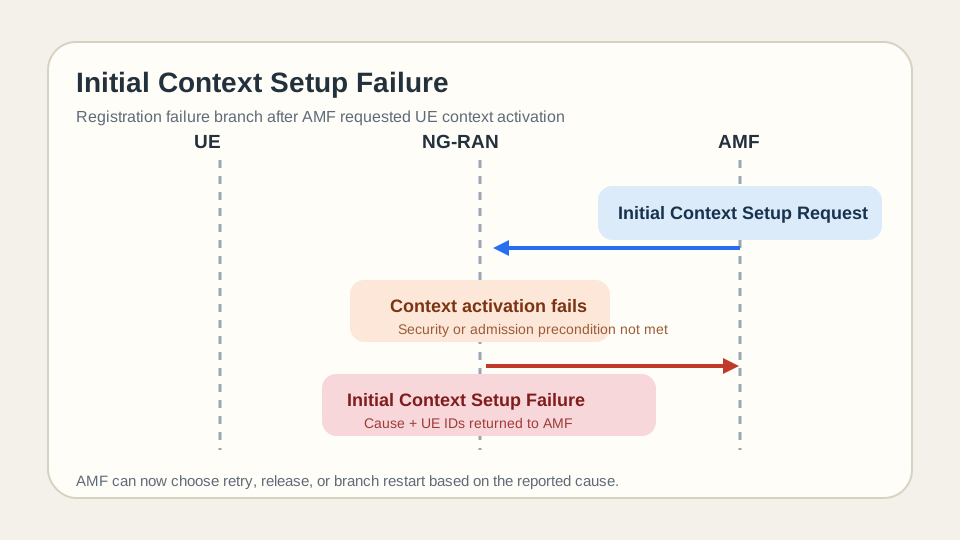
Initial Context Setup Failure is the NGAP message the NG-RAN sends to AMF when the Initial Context Setup Request cannot be completed for the UE context or its requested setup state.
NG-RAN cannot complete Initial Context Setup Request because of identity mismatch, security failure, admission/resource limitation, transport dependency failure, or invalid request conditions.
Main purpose
Reports that NG-RAN could not complete the requested initial UE context activation, allowing AMF to decide whether to retry, downgrade, release, or abort the setup branch.
What is Initial Context Setup Failure in simple terms?
Initial Context Setup Failure is the NGAP message the NG-RAN sends to AMF when the Initial Context Setup Request cannot be completed for the UE context or its requested setup state.
Reports that NG-RAN could not complete the requested initial UE context activation, allowing AMF to decide whether to retry, downgrade, release, or abort the setup branch.
Why this message matters
Initial Context Setup Failure means the gNB could not complete the UE context activation requested by AMF and is explicitly reporting the failure reason back.
Where this message appears in the call flow
5G Initial Registration failure branch
Registration failure branch: NG-RAN cannot activate initial UE context and reports failure back to AMF.
Call flow position: NG-RAN negative outcome after AMF requested initial UE context setup as part of registration completion.
Typical state: NAS-level access may have progressed, but access-side UE context activation failed before usable service state could be reached.
Preconditions:
Initial Context Setup Request was received from AMF.
NG-RAN determined setup could not be completed under current conditions.
Next likely message: AMF retry, release, or fallback handling
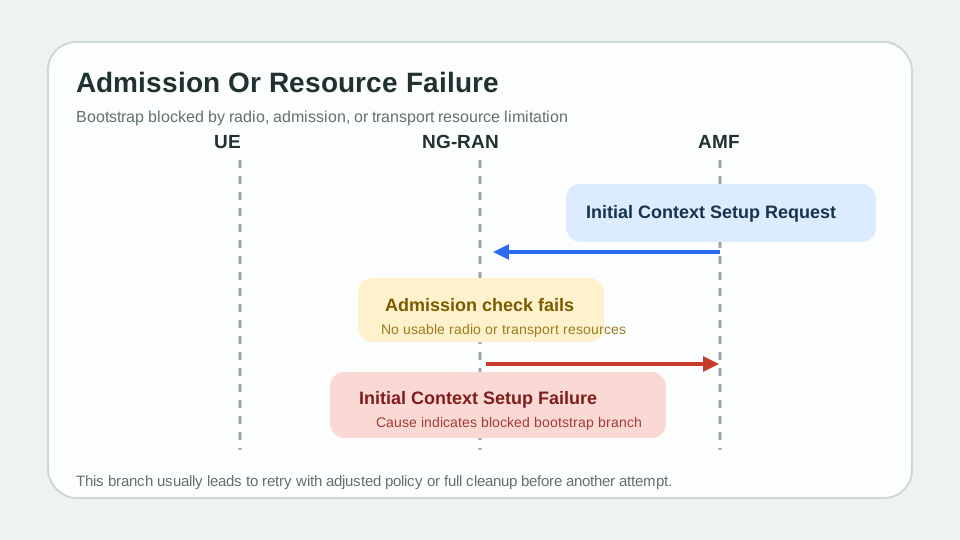
Admission or resource failure during bootstrap
Resource/admission branch: failure is driven by missing capacity or bootstrap constraints at NG-RAN side.
Call flow position: Failure branch when UE context or required PDU session bootstrap resources cannot be admitted at NG-RAN.
Typical state: AMF requested context activation, but radio or transport-side constraints blocked setup before a valid response could be returned.
Preconditions:
Admission/resource evaluation completed at NG-RAN.
At least one blocking condition prevented setup completion.
Next likely message: Retry with adjusted policy or explicit release
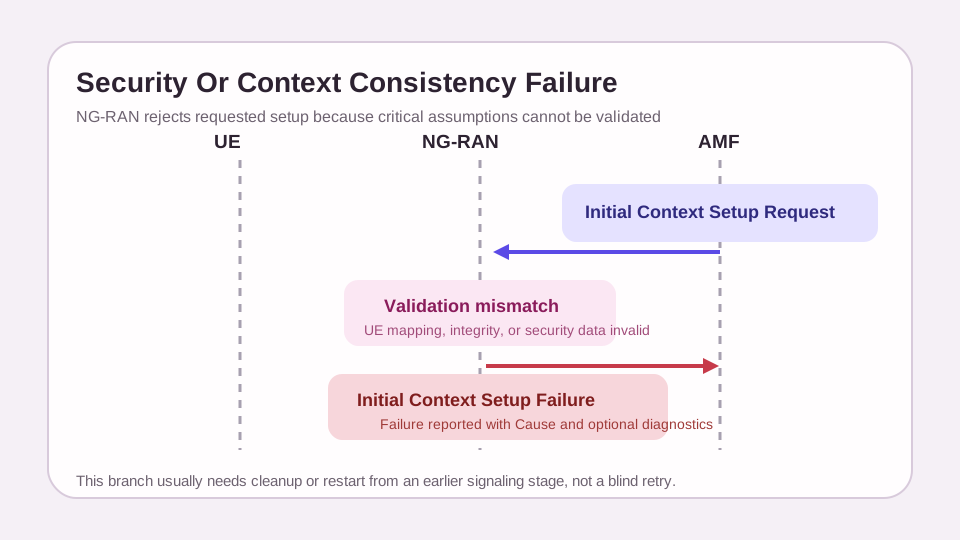
Security or context consistency failure
Security/context branch: invalid identity or security assumptions block setup completion and force explicit failure reporting.
Call flow position: Failure branch when security anchors, UE mapping, or critical request semantics are invalid or inconsistent for setup.
Typical state: NG-RAN cannot safely apply the requested context because identity or security assumptions do not validate.
Preconditions:
Identity/security processing was attempted at NG-RAN.
Critical inconsistency or rejection was detected.
Next likely message: Release or clean restart from earlier signaling stage
Transport / encapsulation: NGAP over SCTP/IP between NG-RAN and AMF
Security context: Failure often reflects unsuccessful application of security, admission, or context establishment parameters carried in Initial Context Setup Request.
Message Structure Overview
Initial Context Setup Failure is the NGAP unsuccessfulOutcome for Initial Context Setup procedure.
AMF UE NGAP ID, RAN UE NGAP ID, and Cause form the practical mandatory core.
Optional failed-session and criticality diagnostic IEs help narrow the exact blocking reason for setup failure.
ASN.1 for 5G NGAP - Initial Context Setup Failure
InitialContextSetupFailure ::= SEQUENCE {
  protocolIEs ProtocolIE-Container { {InitialContextSetupFailure-IEs} },
  ...
}

InitialContextSetupFailure-IEs NGAP-PROTOCOL-IES ::= {
  { ID id-AMF-UE-NGAP-ID                            CRITICALITY reject TYPE AMF-UE-NGAP-ID                           PRESENCE mandatory } |
  { ID id-RAN-UE-NGAP-ID                            CRITICALITY reject TYPE RAN-UE-NGAP-ID                           PRESENCE mandatory } |
  { ID id-Cause                                     CRITICALITY ignore TYPE Cause                                     PRESENCE mandatory } |
  { ID id-PDUSessionResourceFailedToSetupListCxtFail CRITICALITY ignore TYPE PDUSessionResourceFailedToSetupListCxtFail PRESENCE optional } |
  { ID id-CriticalityDiagnostics                    CRITICALITY ignore TYPE CriticalityDiagnostics                    PRESENCE optional  },
  ...
}
How to read this ASN.1
Read this as the explicit negative outcome of Initial Context Setup. Start with Cause, then inspect whether failure was global for UE context or partially localized to requested session resources.
5G NGAP - Initial Context Setup Failure - Example Dump
Cause is the first field to interpret because it sets the root-cause domain for the failure branch.
If failed-session list is present, determine whether the failure is UE-context-wide or driven by session bootstrap specifics.
Always compare this message against the triggering Initial Context Setup Request before retrying.
Important Information Elements
IE
Presence
Description
AMF UE NGAP ID
Mandatory
AMF-side UE identifier used to correlate the failure with the originating setup request.
RAN UE NGAP ID
Mandatory
NG-RAN-side UE identifier used to bind the failure to the affected UE context.
Cause
Mandatory
Mandatory NGAP cause that explains why the requested setup could not be completed.
PDU Session Resource Failed to Setup List CxtFail
Optional
Lists PDU session resource items that failed during initial context setup, when session-specific failure detail is available.
Criticality Diagnostics
Optional
Optional diagnostics that help explain IE-level or decoding/processing issues in the rejected setup path.
Detailed field explanation
AMF UE NGAP ID
AMF-side UE identifier used to correlate the failure with the originating setup request.
Presence: Mandatory
In practice: In practice, compare this field with the original request and with any later release-dependent optional fields so you can see whether the network accepted the same service model the UE asked for.
RAN UE NGAP ID
NG-RAN-side UE identifier used to bind the failure to the affected UE context.
Presence: Mandatory
In practice: In practice, compare this field with the original request and with any later release-dependent optional fields so you can see whether the network accepted the same service model the UE asked for.
Cause
Mandatory NGAP cause that explains why the requested setup could not be completed.
Presence: Mandatory
In practice: In practice, compare this field with the original request and with any later release-dependent optional fields so you can see whether the network accepted the same service model the UE asked for.
PDU Session Resource Failed to Setup List CxtFail
Lists PDU session resource items that failed during initial context setup, when session-specific failure detail is available.
Presence: Optional
In practice: In practice, compare this field with the original request and with any later release-dependent optional fields so you can see whether the network accepted the same service model the UE asked for.
Criticality Diagnostics
Optional diagnostics that help explain IE-level or decoding/processing issues in the rejected setup path.
Presence: Optional
In practice: In practice, compare this field with the original request and with any later release-dependent optional fields so you can see whether the network accepted the same service model the UE asked for.
What to check in logs and traces
Correlate failure with the exact Initial Context Setup Request using AMF and RAN UE NGAP IDs.
Read Cause first and classify whether problem is radio, transport, protocol, or misc domain.
Inspect failed session list when present to see if session bootstrap detail triggered the overall failure.
Check whether AMF response after failure is retry, release, or branch restart.
Verify whether security anchors and UE mapping were valid at the time of failure.
Common Issues and Troubleshooting
Initial Context Setup Failure happens immediately after request every time.
Likely cause: The request may contain deterministic blockers such as invalid security context, UE mapping mismatch, or unsupported setup parameters.
What to inspect: Check Cause, UE identity correlation, security key/capability assumptions, and any criticality diagnostics.
Next step: Fix the blocking request semantics before retrying; repeated identical requests will keep failing.
Failure appears only under load or for some sessions.
Likely cause: Admission or transport-side constraints may only block setup intermittently or for higher-demand session configurations.
What to inspect: Compare failed session list and cause values across good and bad traces, especially resource/admission conditions.
Next step: Adjust session/resource policy or stage bootstrap more gradually instead of requesting all resources at once.
AMF restarts procedure but UE still does not become service-ready.
Likely cause: The real failure domain may be persistent at NG-RAN side, and AMF retries are not correcting the underlying constraint.
What to inspect: Review repeated failure causes, context lifecycle behavior, and whether UE context release/cleanup actually happened between retries.
Next step: Stabilize context cleanup and remove persistent root-cause before reattempting setup.
LTE / 5G / Variant Comparison
Compared with Initial Context Setup Response
Response reports success or partial success. Failure is the explicit negative branch when setup cannot complete under current conditions.
Compared with UE Context Release Command
Initial Context Setup Failure reports the failed attempt. UE Context Release Command is a later cleanup/control action that AMF may choose after failure.
Compared with PDU Session Resource Setup Response
This message reports failure of the initial combined context activation branch, while dedicated PDU Session Resource messages handle later session transactions separately.
FAQ
What is Initial Context Setup Failure in 5G NGAP?
It is the NG-RAN-to-AMF unsuccessful outcome message sent when Initial Context Setup Request cannot be completed for the UE.
What should I inspect first in this message?
Start with the top-level Cause, then compare the failure against the triggering request and any failed session list details.
Can this message include session-specific failure detail?
Yes. The failed PDU session setup list can provide item-level failure context when available.
How is it different from Initial Context Setup Response?
Response is the successful outcome branch and may include partial success. Failure is the explicit negative outcome when setup cannot complete.
Decode this message with the 3GPP Decoder, inspect the related message database, or open the matching call flow to see where this signaling step fits in the full procedure.