Initial Context Setup Request is the NGAP message the AMF sends to NG-RAN to establish UE context, security, and initial PDU session resources after successful NAS entry and core-side authentication steps.
AMF completed required registration/authentication steps and is ready to establish initial UE context and requested PDU session resources at NG-RAN.
Main purpose
Commands the gNB to create the UE's initial N2 context and apply security and bearer/session setup instructions so access and core procedures can move from pure NAS signaling into service-ready state.
What is Initial Context Setup Request in simple terms?
Initial Context Setup Request is the NGAP message the AMF sends to NG-RAN to establish UE context, security, and initial PDU session resources after successful NAS entry and core-side authentication steps.
Commands the gNB to create the UE's initial N2 context and apply security and bearer/session setup instructions so access and core procedures can move from pure NAS signaling into service-ready state.
Why this message matters
Initial Context Setup Request is AMF telling the gNB to create full UE context and initial service resources after NAS-level entry succeeds.
Where this message appears in the call flow
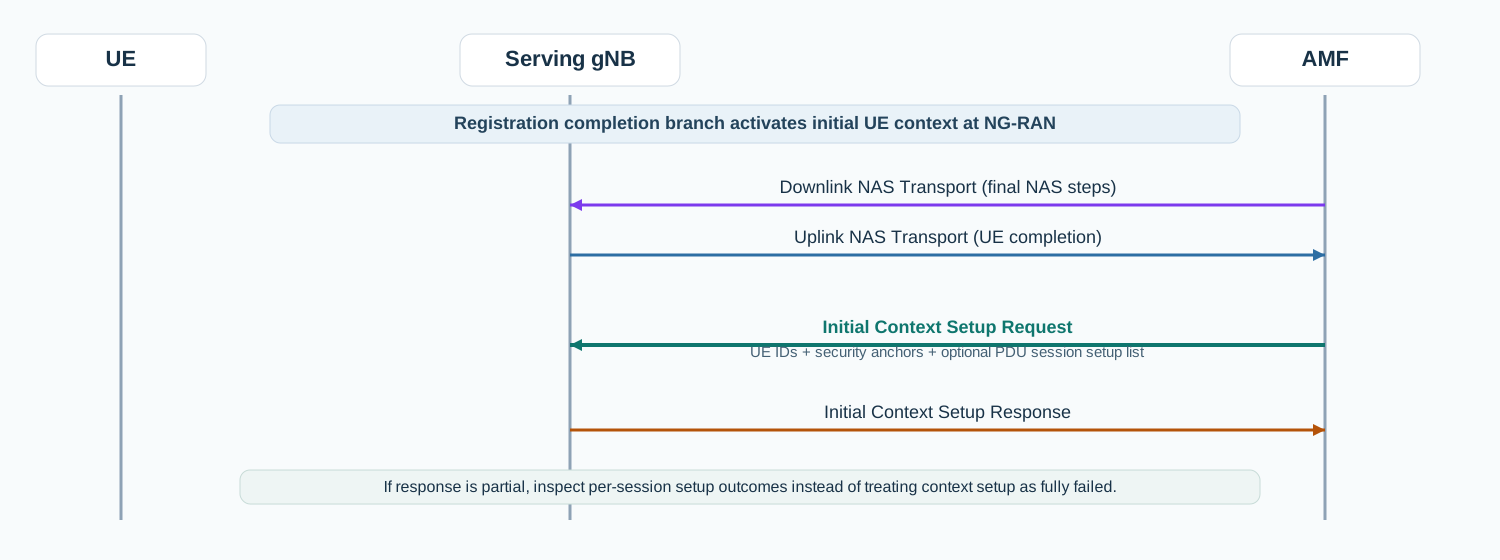
5G Initial Registration completion branch
Registration completion branch: AMF triggers initial UE context activation at NG-RAN after NAS security steps complete.
Call flow position: AMF setup command sent after NAS authentication/security completion to make NG-RAN establish UE context and continue registration toward service-ready state.
Typical state: UE is NAS-validated and AMF has context, but NG-RAN still needs full UE context activation and resource setup confirmation.
Preconditions:
Initial UE Message and NAS exchanges were successfully processed by AMF.
AMF UE NGAP ID and RAN UE NGAP ID are available.
Security context and allowed slice/session policy are decided.
Next likely message: Initial Context Setup Response
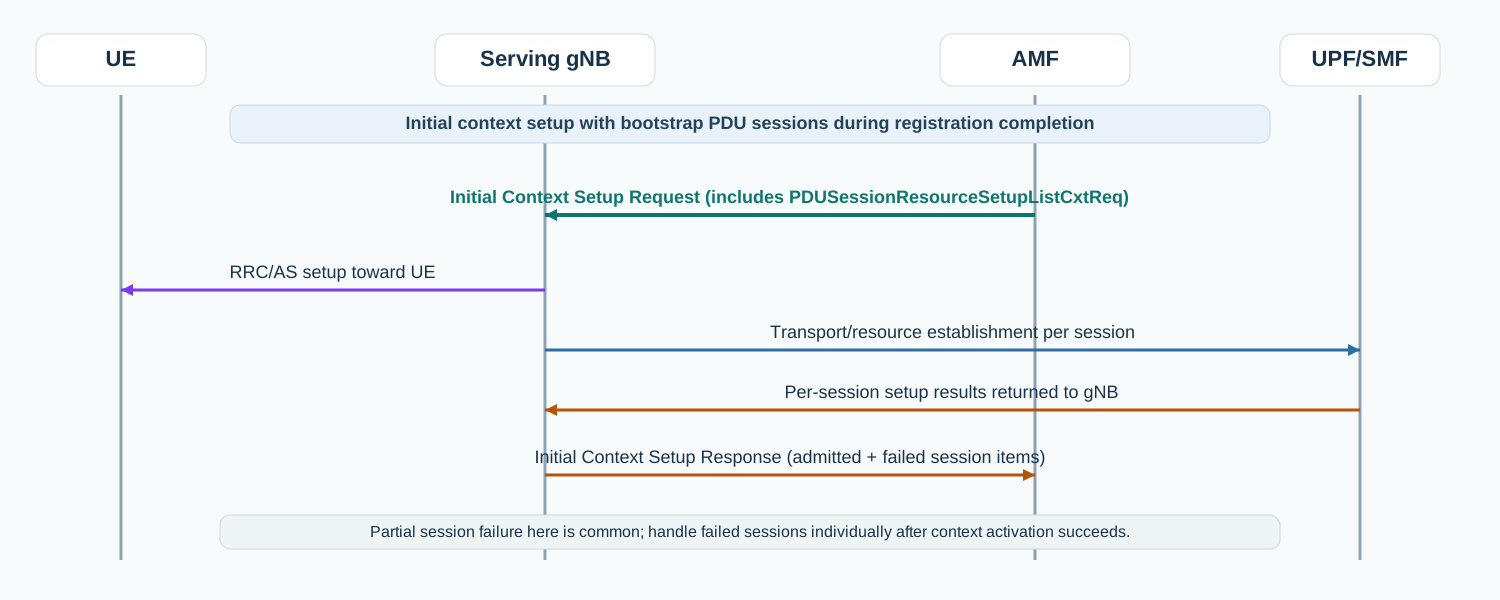
PDU Session bootstrap during registration
Session bootstrap branch: request includes initial PDU session resources and response reports admitted vs failed items.
Call flow position: AMF setup command includes PDU Session Resource Setup List so NG-RAN can establish data path resources as part of initial context activation.
Typical state: UE context setup and one or more initial PDU sessions are prepared together in one coordinated setup step.
Preconditions:
Target PDU session setup parameters are available from core side.
NG-RAN can allocate radio and transport resources for requested sessions.
Next likely message: Initial Context Setup Response with per-session setup outcomes
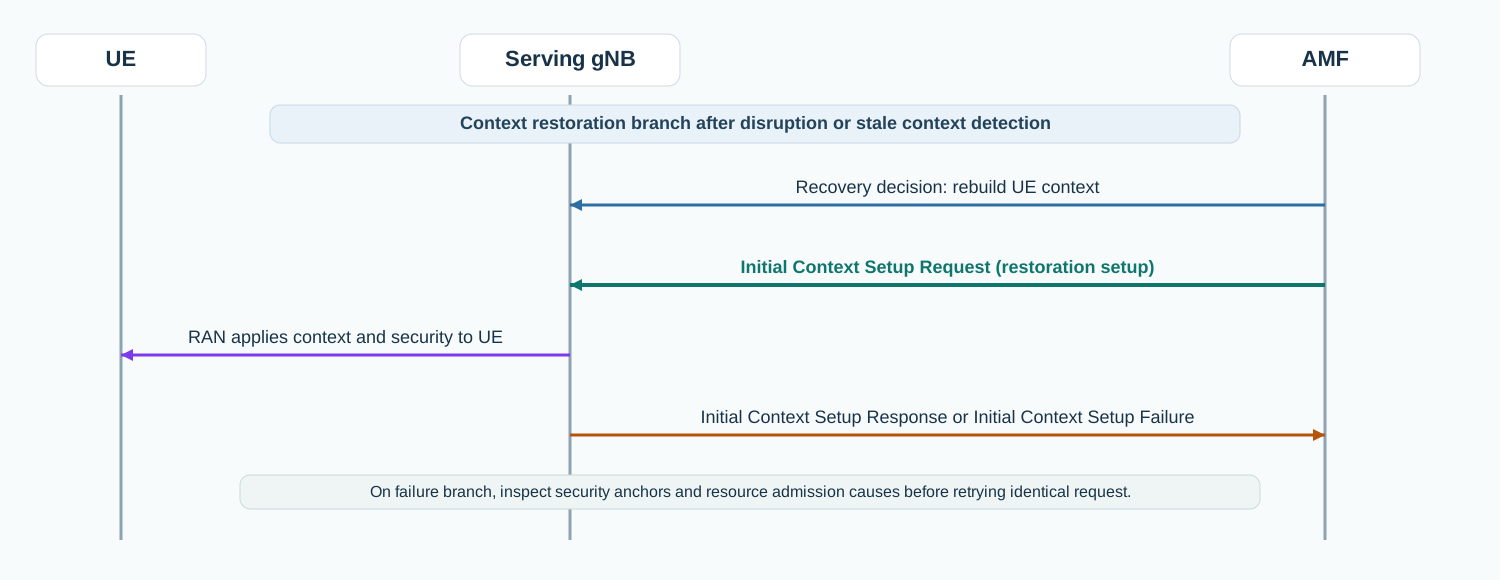
Service restoration after temporary disruption
Restoration branch: AMF uses setup request to rebuild UE context when prior context was lost or invalidated.
Call flow position: AMF may re-use initial-context-style setup to rebuild UE context when prior context is unavailable but UE can continue with refreshed setup state.
Typical state: UE can proceed only after NG-RAN recreates context and confirms setup status back to AMF.
Preconditions:
AMF determined context rebuild is required.
UE and NG-RAN are reachable for setup execution.
Next likely message: Initial Context Setup Response or Initial Context Setup Failure
Transport / encapsulation: NGAP over SCTP/IP between AMF and NG-RAN
Security context: Includes UE security capabilities and security keying material so NG-RAN can activate AS security aligned with AMF-selected NAS context.
Message Structure Overview
Initial Context Setup Request is an NGAP initiating message from AMF to NG-RAN for UE context activation.
Core mandatory anchors are UE identities plus security/slice context used to create a stable service-capable UE context.
Optional PDU session and mobility fields define whether setup is pure context activation or combined context-plus-session bootstrap.
ASN.1 for 5G NGAP - Initial Context Setup Request
InitialContextSetupRequest ::= SEQUENCE {
  protocolIEs ProtocolIE-Container { {InitialContextSetupRequest-IEs} },
  ...
}

InitialContextSetupRequest-IEs NGAP-PROTOCOL-IES ::= {
  { ID id-AMF-UE-NGAP-ID                       CRITICALITY reject TYPE AMF-UE-NGAP-ID                      PRESENCE mandatory } |
  { ID id-RAN-UE-NGAP-ID                       CRITICALITY reject TYPE RAN-UE-NGAP-ID                      PRESENCE mandatory } |
  { ID id-GUAMI                                CRITICALITY reject TYPE GUAMI                               PRESENCE mandatory } |
  { ID id-AllowedNSSAI                         CRITICALITY reject TYPE AllowedNSSAI                        PRESENCE mandatory } |
  { ID id-UESecurityCapabilities               CRITICALITY reject TYPE UESecurityCapabilities              PRESENCE mandatory } |
  { ID id-SecurityKey                          CRITICALITY reject TYPE SecurityKey                         PRESENCE mandatory } |
  { ID id-PDUSessionResourceSetupListCxtReq    CRITICALITY reject TYPE PDUSessionResourceSetupListCxtReq   PRESENCE optional  } |
  { ID id-NAS-PDU                              CRITICALITY reject TYPE NAS-PDU                             PRESENCE optional  } |
  { ID id-UEAggregateMaximumBitRate            CRITICALITY ignore TYPE UEAggregateMaximumBitRate           PRESENCE optional  } |
  { ID id-MobilityRestrictionList              CRITICALITY ignore TYPE MobilityRestrictionList             PRESENCE optional  },
  ...
}
How to read this ASN.1
Read this message as AMF instruction set for UE context activation. In decode practice, verify identity/security anchors first, then inspect optional session lists for partial-success troubleshooting.
5G NGAP - Initial Context Setup Request - Example Dump
Confirm identity pair first; all later setup result reporting depends on this correlation.
Security capability and key fields are high impact because mismatches often cause immediate setup failure.
For session issues, decode per-item outcomes against requested PDUSessionResourceSetupListCxtReq entries.
Important Information Elements
IE
Presence
Description
AMF UE NGAP ID
Mandatory
AMF-side UE identity used to correlate setup command and subsequent response/failure reporting.
RAN UE NGAP ID
Mandatory
NG-RAN-side UE identity that binds this setup command to the target UE radio context.
GUAMI
Mandatory
Identifies the serving AMF context for UE association and consistency checks at NG-RAN side.
Allowed NSSAI
Mandatory
Provides slice authorization context that constrains resource and session handling during setup.
UESecurityCapabilities
Mandatory
Supplies UE-supported integrity and ciphering capabilities needed for AS security configuration.
Security Key
Mandatory
Carries key material used by NG-RAN to derive and activate access stratum security for the UE.
PDU Session Resource Setup List CxtReq
Optional
Lists PDU sessions the AMF requests NG-RAN to set up during initial context activation.
NAS-PDU
Optional
Optional NAS payload that may accompany setup command in procedure-specific branches.
UE Aggregate Maximum Bit Rate
Optional
UE-level throughput limit context for radio-side enforcement and admission handling.
Mobility Restriction List
Optional
Conveys mobility restrictions that NG-RAN should enforce while activating UE context.
Detailed field explanation
AMF UE NGAP ID
AMF-side UE identity used to correlate setup command and subsequent response/failure reporting.
Presence: Mandatory
In practice: In practice, compare this field with the original request and with any later release-dependent optional fields so you can see whether the network accepted the same service model the UE asked for.
RAN UE NGAP ID
NG-RAN-side UE identity that binds this setup command to the target UE radio context.
Presence: Mandatory
In practice: In practice, compare this field with the original request and with any later release-dependent optional fields so you can see whether the network accepted the same service model the UE asked for.
GUAMI
Identifies the serving AMF context for UE association and consistency checks at NG-RAN side.
Presence: Mandatory
In practice: In practice, compare this field with the original request and with any later release-dependent optional fields so you can see whether the network accepted the same service model the UE asked for.
Allowed NSSAI
Provides slice authorization context that constrains resource and session handling during setup.
Presence: Mandatory
In practice: In practice, compare this field with the original request and with any later release-dependent optional fields so you can see whether the network accepted the same service model the UE asked for.
UESecurityCapabilities
Supplies UE-supported integrity and ciphering capabilities needed for AS security configuration.
Presence: Mandatory
In practice: In practice, compare this field with the original request and with any later release-dependent optional fields so you can see whether the network accepted the same service model the UE asked for.
Security Key
Carries key material used by NG-RAN to derive and activate access stratum security for the UE.
Presence: Mandatory
In practice: In practice, compare this field with the original request and with any later release-dependent optional fields so you can see whether the network accepted the same service model the UE asked for.
PDU Session Resource Setup List CxtReq
Lists PDU sessions the AMF requests NG-RAN to set up during initial context activation.
Presence: Optional
In practice: In practice, compare this field with the original request and with any later release-dependent optional fields so you can see whether the network accepted the same service model the UE asked for.
NAS-PDU
Optional NAS payload that may accompany setup command in procedure-specific branches.
Presence: Optional
In practice: In practice, compare this field with the original request and with any later release-dependent optional fields so you can see whether the network accepted the same service model the UE asked for.
UE Aggregate Maximum Bit Rate
UE-level throughput limit context for radio-side enforcement and admission handling.
Presence: Optional
In practice: In practice, compare this field with the original request and with any later release-dependent optional fields so you can see whether the network accepted the same service model the UE asked for.
Mobility Restriction List
Conveys mobility restrictions that NG-RAN should enforce while activating UE context.
Presence: Optional
In practice: In practice, compare this field with the original request and with any later release-dependent optional fields so you can see whether the network accepted the same service model the UE asked for.
What to check in logs and traces
Correlate Initial Context Setup Request with preceding NAS authentication/security completion.
Verify AMF UE NGAP ID and RAN UE NGAP ID continuity across request and response/failure messages.
Check security capability/key presence and compatibility with UE profile.
Inspect PDU Session Resource Setup List CxtReq for each requested session and compare with response outcomes.
If failure occurs, map cause domain to security, resource, transport, or policy constraints.
Common Issues and Troubleshooting
Initial Context Setup Response returns partial success with some sessions failed.
Likely cause: NG-RAN could activate UE context but lacked resources or matching constraints for one or more requested PDU sessions.
What to inspect: Compare each requested PDU session item in setup list against per-session outcome and cause in response/failure transfer.
Next step: Retry failed sessions with corrected policy/QoS/resource constraints instead of rebuilding full UE context unnecessarily.
Initial Context Setup Failure occurs immediately after request.
Likely cause: Critical setup anchors such as security context, UE identity mapping, or admission constraints may be invalid or rejected by NG-RAN.
What to inspect: Inspect security capability/key consistency, identity pairing, and NGAP cause domain in failure message.
Next step: Resolve root cause domain first; avoid repeated identical setup retries that will fail for deterministic configuration reasons.
UE appears registered but no usable data path after context setup branch.
Likely cause: Context may have been created but PDU session resource setup was incomplete or failed silently at transfer level.
What to inspect: Correlate request session list with response admitted sessions and verify tunnel/resource details in transfer payloads.
Next step: Re-run targeted PDU session setup and validate end-to-end data path activation after context setup completion.
LTE / 5G / Variant Comparison
Compared with Initial Context Setup Response
Request carries AMF setup intent and resource ask. Response reports what NG-RAN actually established, including accepted and failed session items.
Compared with Initial Context Setup Failure
Failure is the negative branch when context setup cannot continue under current request conditions.
Compared with UE Context Modification Request
Initial Context Setup Request creates initial context baseline. UE Context Modification Request adjusts an already established context later.
FAQ
What is Initial Context Setup Request in 5G NGAP?
It is the AMF-to-NG-RAN command that establishes UE context, security, and optional initial session resources after NAS entry succeeds.
Does Initial Context Setup Request always include PDU session setup list?
Not always. It can be present when AMF wants immediate session bootstrap, but context setup can also occur without initial session list.
What should I inspect first when setup fails?
Start with UE identity correlation, security capability/key consistency, and then inspect cause details for resource or policy issues.
Can Initial Context Setup be partially successful?
Yes. UE context may succeed while some requested PDU sessions fail; analyze per-session outcomes in response transfers.
Decode this message with the 3GPP Decoder, inspect the related message database, or open the matching call flow to see where this signaling step fits in the full procedure.