AMF needs UE location information or area-presence reporting for regulatory, mobility, service, or troubleshooting reasons.
Main purpose
Requests UE location reporting, configures reporting conditions, supports location or area-presence monitoring, allows AMF to receive later Location Report messages, and helps AMF track UE location state without relying only on normal mobility procedures.
Main specification
3GPP TS 38.413, Location reporting procedures and Location Reporting Control message
Release added
Release 15
Procedures where used
Location Reporting Control, Area presence reporting, Emergency or priority service support, Mobility troubleshooting, Regulatory location reporting
What is Location Reporting Control in simple terms?
Location Reporting Control is the NGAP location reporting message sent by the AMF to the NG-RAN node to configure UE location reporting.
Requests UE location reporting, configures reporting conditions, supports location or area-presence monitoring, allows AMF to receive later Location Report messages, and helps AMF track UE location state without relying only on normal mobility procedures.
Why this message matters
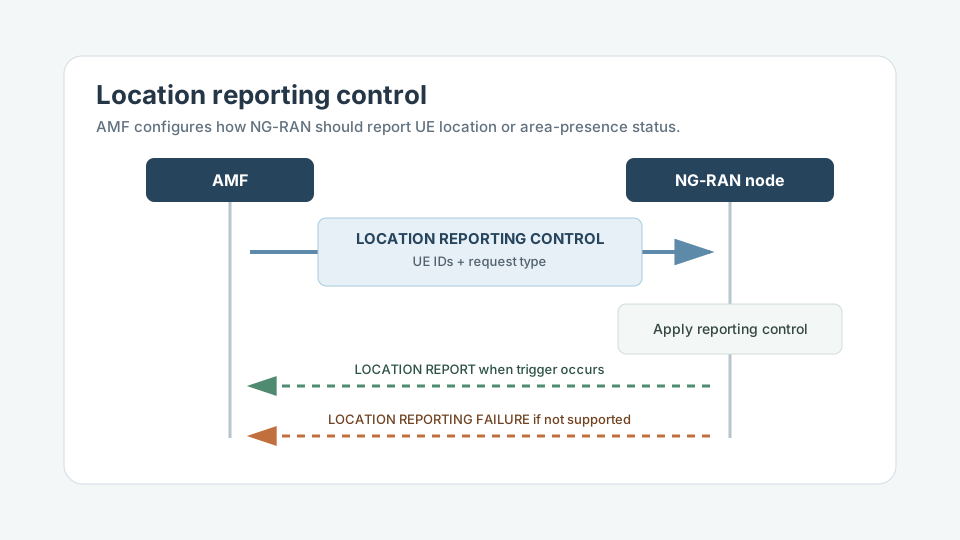
Location Reporting Control is the AMF telling the gNB when and how to report UE location. The actual location result comes later in Location Report.
Where this message appears in the call flow
Location Reporting Control
AMF configures reporting; NG-RAN later reports location or failure.
Call flow position: AMF sends this UE-associated initiatingMessage to configure location reporting behavior at NG-RAN.
Typical state: NG-RAN applies the requested reporting type and later reports location or area presence when required.
Preconditions:
UE-associated NGAP context exists.
AMF UE NGAP ID and RAN UE NGAP ID identify the correct UE context.
Location Reporting Request Type is present and supported.
Next likely message: Location Report or Location Reporting Failure Indication
Location Reporting Request Type handling
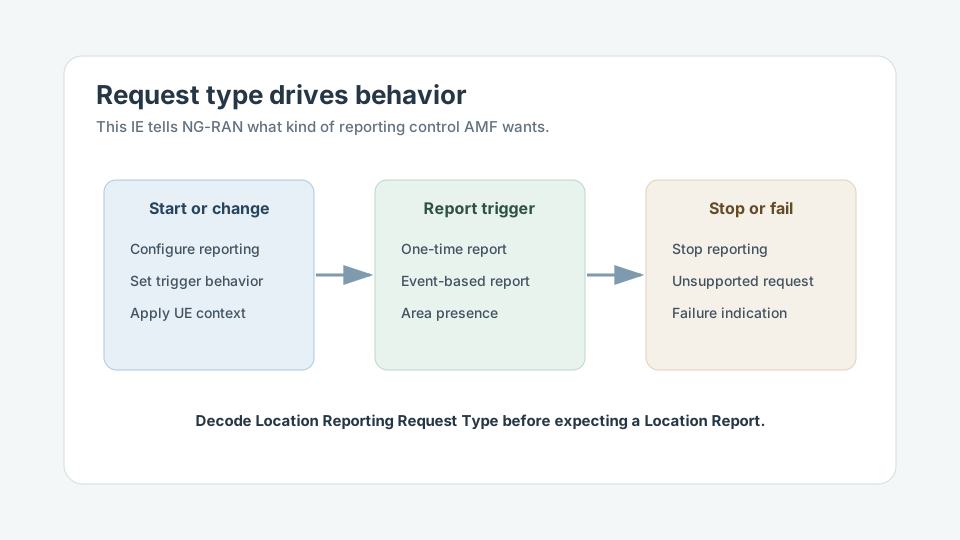
Location Reporting Request Type determines how NG-RAN handles the request.
Call flow position: Location Reporting Request Type defines the report behavior, such as event-based or area-presence reporting.
Typical state: NG-RAN uses the request type to decide whether to start, stop, or update reporting.
Preconditions:
Request type is decoded correctly.
Requested area or reporting mode is supported by NG-RAN.
Next likely message: Configured location reporting behavior
Configured reporting versus embedded location IE
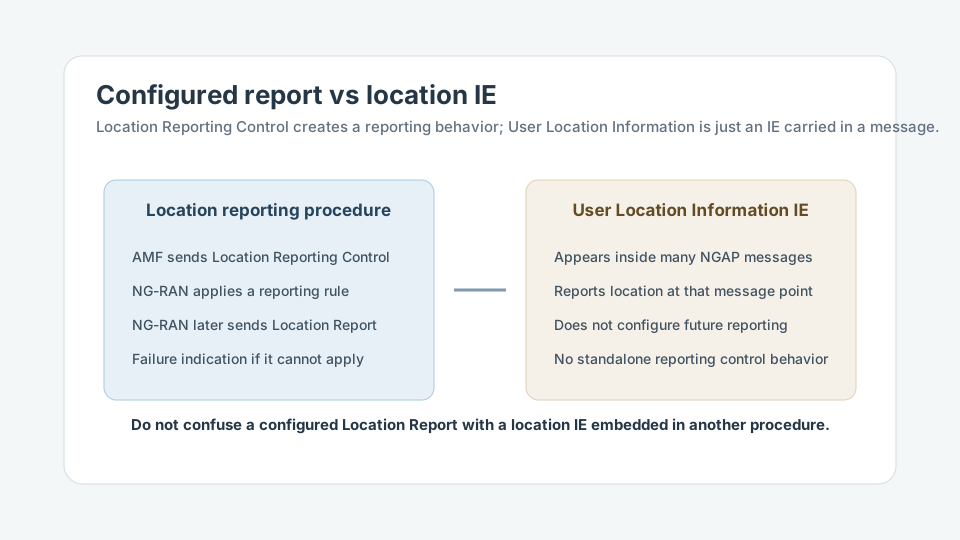
Configured reporting is different from a location IE embedded in another NGAP message.
Call flow position: Location Reporting Control creates a later reporting behavior; User Location Information is an IE included in other NGAP messages.
Typical state: Trace analysis separates standalone Location Report messages from ordinary location fields in unrelated procedures.
Preconditions:
Message type and reporting context are checked before interpreting location data.
Next likely message: Correct location-reporting interpretation
Transport / encapsulation: NGAP over SCTP/IP between AMF and NG-RAN
Security context: Location Reporting Control configures UE-specific location reporting. Location information can be sensitive and should be handled according to operator policy, lawful basis, emergency-service requirements, and privacy controls.
Message Structure Overview
Location Reporting Control is an AMF-to-NG-RAN UE-associated initiatingMessage.
AMF UE NGAP ID and RAN UE NGAP ID bind the request to the correct UE context.
Location Reporting Request Type is the key payload.
NG-RAN later sends Location Report when the configured condition is met.
Location Reporting Failure Indication reports that the requested reporting could not be applied.
ASN.1 for 5G NGAP - Location Reporting Control
LocationReportingControl ::= SEQUENCE {
  protocolIEs ProtocolIE-Container { {LocationReportingControl-IEs} },
  ...
}

LocationReportingControl-IEs NGAP-PROTOCOL-IES ::= {
  { ID id-AMF-UE-NGAP-ID                  CRITICALITY reject TYPE AMF-UE-NGAP-ID                  PRESENCE mandatory } |
  { ID id-RAN-UE-NGAP-ID                  CRITICALITY reject TYPE RAN-UE-NGAP-ID                  PRESENCE mandatory } |
  { ID id-LocationReportingRequestType    CRITICALITY reject TYPE LocationReportingRequestType    PRESENCE mandatory },
  ...
}
How to read this ASN.1
Decode the UE identity pair first, then Location Reporting Request Type. The request type determines whether NG-RAN should start, stop, or change location reporting behavior.
5G NGAP - Location Reporting Control - Example Dump
Treat this as a teaching example based on the expected message structure, not as a captured network trace.
Location Reporting Request Type is the operational payload.
Correlate later Location Report or failure messages using UE identifiers and reporting context.
Important Information Elements
IE
Presence
Description
Message Type
Mandatory
Identifies the NGAP PDU as LOCATION REPORTING CONTROL.
AMF UE NGAP ID
Mandatory
Mandatory UE identity at the AMF.
RAN UE NGAP ID
Mandatory
Mandatory UE identity at the NG-RAN node.
Location Reporting Request Type
Mandatory
Mandatory field defining the requested reporting type, trigger, or area-presence behavior.
Detailed field explanation
Message Type
Identifies the NGAP PDU as LOCATION REPORTING CONTROL.
Presence: Mandatory
In practice: In practice, compare this field with the original request and with any later release-dependent optional fields so you can see whether the network accepted the same service model the UE asked for.
AMF UE NGAP ID
Mandatory UE identity at the AMF.
Presence: Mandatory
In practice: In practice, compare this field with the original request and with any later release-dependent optional fields so you can see whether the network accepted the same service model the UE asked for.
RAN UE NGAP ID
Mandatory UE identity at the NG-RAN node.
Presence: Mandatory
In practice: In practice, compare this field with the original request and with any later release-dependent optional fields so you can see whether the network accepted the same service model the UE asked for.
Location Reporting Request Type
Mandatory field defining the requested reporting type, trigger, or area-presence behavior.
Presence: Mandatory
In practice: In practice, compare this field with the original request and with any later release-dependent optional fields so you can see whether the network accepted the same service model the UE asked for.
What to check in logs and traces
Confirm Location Reporting Control is sent after UE context exists.
Match AMF UE NGAP ID and RAN UE NGAP ID to the UE.
Decode Location Reporting Request Type correctly.
Check that the requested area or reporting mode is supported by NG-RAN.
Look for expected Location Report when the trigger occurs.
Look for Location Reporting Failure Indication if reporting does not start.
Do not confuse User Location Information IE with a standalone Location Report message.
Common Issues and Troubleshooting
No Location Report appears after Location Reporting Control.
Likely cause: The configured trigger may not have occurred, reporting may be unsupported, or NG-RAN may have rejected the request.
What to inspect: Decode Location Reporting Request Type and search for Location Reporting Failure Indication.
Next step: Validate trigger conditions and NG-RAN support for the requested reporting mode.
Location reporting is tied to the wrong UE.
Likely cause: AMF UE NGAP ID or RAN UE NGAP ID correlation may be wrong.
What to inspect: Compare UE identifiers with Initial Context Setup, UE Context Modification, handover, or path switch messages.
Next step: Rebuild UE context correlation before interpreting location data.
Analyzer shows User Location Information but no Location Report.
Likely cause: A location IE embedded in another NGAP message may be confused with the Location Report procedure.
What to inspect: Check the actual NGAP message type and procedure.
Next step: Separate ordinary location IEs from configured reporting messages.
Reporting stops unexpectedly.
Likely cause: A later Location Reporting Control may have changed or stopped reporting, or the UE context may have changed.
What to inspect: Search for later controls, UE release, mobility, or failure indication.
Next step: Correlate reporting state across the full UE context timeline.
Location Reporting Failure Indication appears.
Likely cause: NG-RAN could not support or apply the requested reporting behavior.
What to inspect: Decode the failure cause and compare it with the requested type or area.
Next step: Use a supported request type or correct the reporting scope.
LTE / 5G / Variant Comparison
Compared with Location Report
Location Reporting Control configures reporting. Location Report carries the actual location or area-presence result.
Compared with Location Reporting Failure Indication
Failure Indication reports that NG-RAN could not perform the requested location reporting.
Compared with User Location Information IE
User Location Information is a field inside many NGAP messages. Location Reporting Control creates a standalone reporting behavior.
FAQ
What is Location Reporting Control in NGAP?
Location Reporting Control is the AMF-to-NG-RAN message used to configure UE location reporting.
Who sends Location Reporting Control?
The AMF sends Location Reporting Control to the NG-RAN node.
What does Location Reporting Request Type mean?
It defines how NG-RAN should perform location reporting, such as event-based reporting, area-presence reporting, or stop/change behavior depending on the request.
What message carries the actual location result?
Location Report carries the actual UE location or area-presence result.
What happens if NG-RAN cannot configure location reporting?
NG-RAN may send Location Reporting Failure Indication.
Is Location Reporting Control UE-associated?
Yes. It is UE-associated and carries AMF UE NGAP ID and RAN UE NGAP ID.
How is this different from User Location Information IE?
Location Reporting Control configures future reporting behavior. User Location Information is a location field carried inside another NGAP message.
How do you troubleshoot missing Location Report messages?
Check UE ID correlation, decode Location Reporting Request Type, verify trigger conditions, confirm NG-RAN support, and look for Location Reporting Failure Indication.
Decode this message with the 3GPP Decoder, inspect the related message database, or open the matching call flow to see where this signaling step fits in the full procedure.