UE Context Modification Request is the NGAP message the AMF sends to NG-RAN to partly modify an already established UE context without rebuilding it from scratch.
AMF decides the established UE context needs targeted changes because security, policy, mobility, bitrate, or reachability handling parameters have changed.
Main purpose
Adjusts an existing UE-associated NG connection when AMF needs to update selected context parameters such as security material, paging priority, RFSP policy, or UE aggregate bitrate without performing full initial context setup again.
What is UE Context Modification Request in simple terms?
UE Context Modification Request is the NGAP message the AMF sends to NG-RAN to partly modify an already established UE context without rebuilding it from scratch.
Adjusts an existing UE-associated NG connection when AMF needs to update selected context parameters such as security material, paging priority, RFSP policy, or UE aggregate bitrate without performing full initial context setup again.
Why this message matters
UE Context Modification Request is the AMF telling the gNB to change parts of an already existing UE context rather than creating a new one.
Where this message appears in the call flow
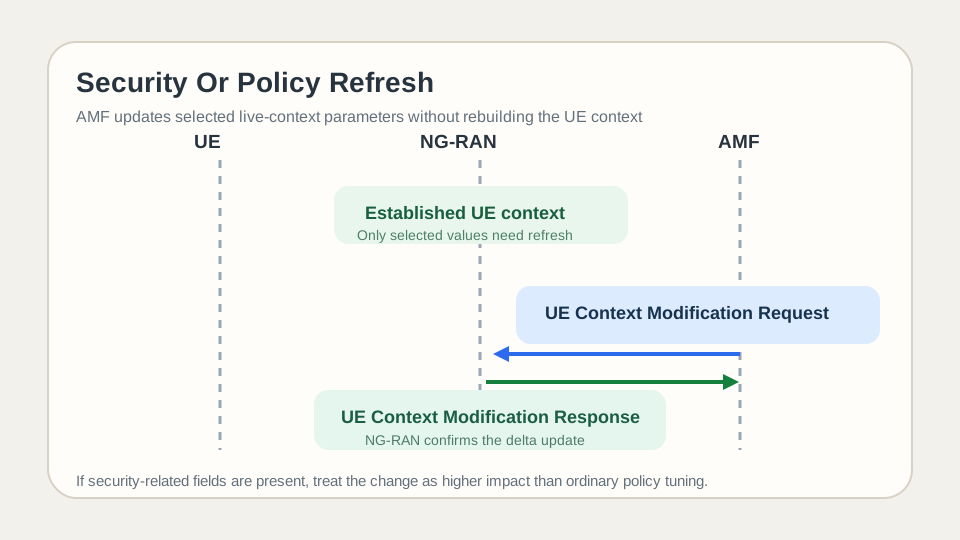
Security or policy refresh on active context
Security or policy refresh branch: AMF updates selected context parameters without rebuilding the full UE context.
Call flow position: AMF updates an existing UE context after the initial setup phase when security anchors or policy-related context must be refreshed in place.
Typical state: UE remains associated, but NG-RAN must apply selected parameter changes to keep the context aligned with core decisions.
Preconditions:
UE context is already established at NG-RAN.
AMF has new context parameters that should replace or supplement the current ones.
Next likely message: UE Context Modification Response
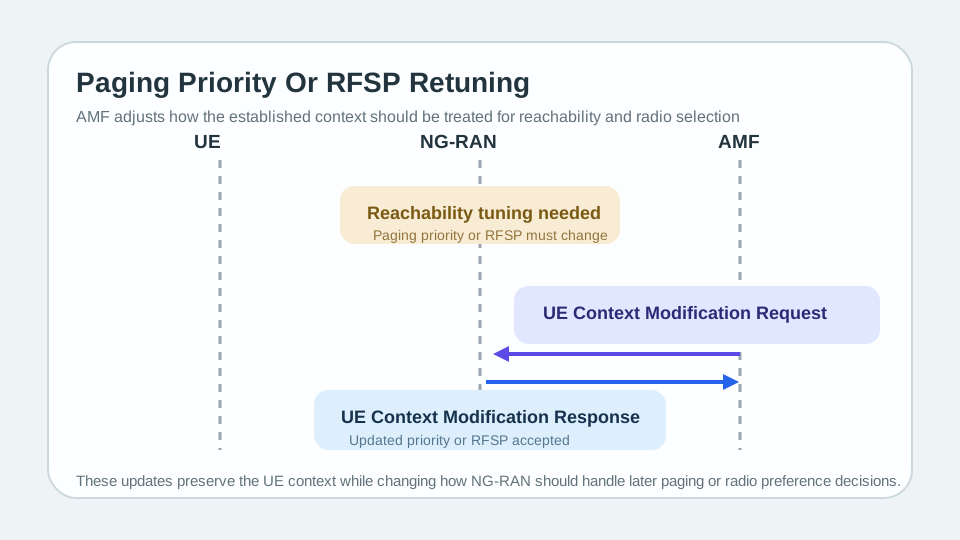
Paging priority or RFSP retuning
Reachability tuning branch: AMF adjusts paging priority or RFSP policy for an already established context.
Call flow position: AMF tunes reachability or access-selection behavior for an existing UE without rebuilding the full context.
Typical state: The UE context stays alive, but NG-RAN should change paging or radio selection behavior for later traffic and mobility handling.
Preconditions:
AMF determined updated reachability or RFSP policy is needed.
The UE remains valid on the current UE-associated NG connection.
Next likely message: UE Context Modification Response
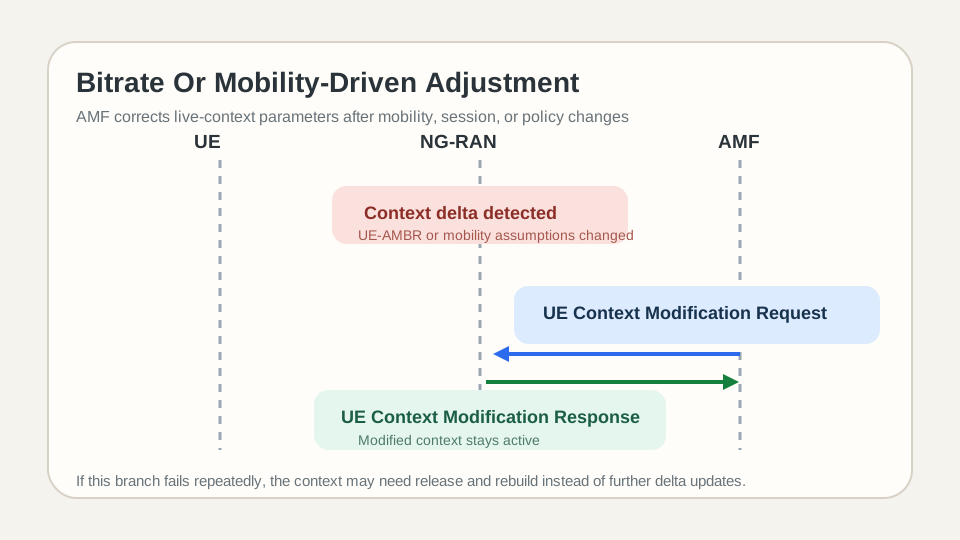
Bitrate or mobility-driven context adjustment
Operational tuning branch: AMF modifies UE-level context parameters after mobility, session, or policy changes.
Call flow position: AMF updates UE-level aggregate bitrate or other selected context values after session, mobility, or policy changes.
Typical state: The context is still service-capable, but one or more operational parameters are outdated and need AMF-driven correction.
Preconditions:
A context-affecting change occurred after initial setup.
AMF decided a targeted modification is sufficient instead of release and rebuild.
Next likely message: UE Context Modification Response or failure handling
Transport / encapsulation: NGAP over SCTP/IP between AMF and NG-RAN
Security context: The message can refresh or update access-side security-related parameters for an existing UE context rather than creating a new context baseline.
Message Structure Overview
UE Context Modification Request is the AMF-to-NG-RAN initiating message for partial modification of an already established UE context.
AMF UE NGAP ID and RAN UE NGAP ID are the mandatory context anchors.
Common optional changes include paging priority, security key refresh, RFSP policy updates, and UE aggregate bitrate updates.
ASN.1 for 5G NGAP - UE Context Modification Request
UEContextModificationRequest ::= SEQUENCE {
  protocolIEs ProtocolIE-Container { {UEContextModificationRequest-IEs} },
  ...
}

UEContextModificationRequest-IEs NGAP-PROTOCOL-IES ::= {
  { ID id-AMF-UE-NGAP-ID             CRITICALITY reject TYPE AMF-UE-NGAP-ID             PRESENCE mandatory } |
  { ID id-RAN-UE-NGAP-ID             CRITICALITY reject TYPE RAN-UE-NGAP-ID             PRESENCE mandatory } |
  { ID id-RANPagingPriority          CRITICALITY ignore TYPE RANPagingPriority          PRESENCE optional  } |
  { ID id-SecurityKey                CRITICALITY reject TYPE SecurityKey                PRESENCE optional  } |
  { ID id-IndexToRFSP                CRITICALITY ignore TYPE IndexToRFSP                PRESENCE optional  } |
  { ID id-UEAggregateMaximumBitRate  CRITICALITY ignore TYPE UEAggregateMaximumBitRate  PRESENCE optional  },
  ...
}
How to read this ASN.1
Decode the mandatory UE identifiers first so you know which live context is being modified. Then inspect only the optional IEs present, because this message is usually a targeted delta rather than a full context snapshot.
5G NGAP - UE Context Modification Request - Example Dump
Unlike Initial Context Setup Request, this message often carries only the fields AMF wants to change.
If Security Key is present, treat the modification as high-impact and verify the corresponding response path carefully.
RFSP, paging priority, and UE-AMBR updates are easy to miss in traces because the message can otherwise look very small.
Important Information Elements
IE
Presence
Description
AMF UE NGAP ID
Mandatory
Mandatory AMF-side UE identifier used to correlate the modification request with the established UE context.
RAN UE NGAP ID
Mandatory
Mandatory NG-RAN-side UE identifier used to apply the changes to the correct existing radio-side context.
RAN Paging Priority
Optional
Optional paging-related priority update that adjusts how NG-RAN should handle reachability urgency for the UE.
Security Key
Optional
Optional updated key material for the established context when AMF needs NG-RAN to refresh security-related handling.
Index To RFSP
Optional
Optional radio access selection and frequency selection priority indicator used to tune radio-side behavior for the UE.
UE Aggregate Maximum Bit Rate
Optional
Optional UE-level bitrate update that changes radio-side enforcement or admission expectations for the established context.
Detailed field explanation
AMF UE NGAP ID
Mandatory AMF-side UE identifier used to correlate the modification request with the established UE context.
Presence: Mandatory
In practice: In practice, compare this field with the original request and with any later release-dependent optional fields so you can see whether the network accepted the same service model the UE asked for.
RAN UE NGAP ID
Mandatory NG-RAN-side UE identifier used to apply the changes to the correct existing radio-side context.
Presence: Mandatory
In practice: In practice, compare this field with the original request and with any later release-dependent optional fields so you can see whether the network accepted the same service model the UE asked for.
RAN Paging Priority
Optional paging-related priority update that adjusts how NG-RAN should handle reachability urgency for the UE.
Presence: Optional
In practice: In practice, compare this field with the original request and with any later release-dependent optional fields so you can see whether the network accepted the same service model the UE asked for.
Security Key
Optional updated key material for the established context when AMF needs NG-RAN to refresh security-related handling.
Presence: Optional
In practice: In practice, compare this field with the original request and with any later release-dependent optional fields so you can see whether the network accepted the same service model the UE asked for.
Index To RFSP
Optional radio access selection and frequency selection priority indicator used to tune radio-side behavior for the UE.
Presence: Optional
In practice: In practice, compare this field with the original request and with any later release-dependent optional fields so you can see whether the network accepted the same service model the UE asked for.
UE Aggregate Maximum Bit Rate
Optional UE-level bitrate update that changes radio-side enforcement or admission expectations for the established context.
Presence: Optional
In practice: In practice, compare this field with the original request and with any later release-dependent optional fields so you can see whether the network accepted the same service model the UE asked for.
What to check in logs and traces
Correlate AMF UE NGAP ID and RAN UE NGAP ID with the currently established UE context before interpreting the update.
List exactly which optional IEs are present; absent fields are usually not being changed.
Check whether the modification is tied to mobility, policy, reachability, or security refresh logic elsewhere in the trace.
Verify NG-RAN returns UE Context Modification Response and that subsequent behavior matches the new parameters.
If the modification fails, determine whether the issue is invalid delta content or an unstable underlying UE context.
Common Issues and Troubleshooting
UE Context Modification Request is sent, but observed behavior does not change.
Likely cause: The requested delta may not have been accepted or applied by NG-RAN, or the field you expected to change was never present in the message.
What to inspect: Check which optional IEs are actually included and correlate with UE Context Modification Response or failure.
Next step: Validate the message content first, then verify whether the response confirms application of the update.
Modification works for some UEs but fails after mobility or re-establishment.
Likely cause: AMF may be targeting an outdated UE context mapping after a change in the active UE-associated NG connection.
What to inspect: Compare AMF UE NGAP ID and RAN UE NGAP ID continuity across mobility, release, and re-entry branches.
Next step: Fix identity correlation before retrying modification on what may already be a replaced context.
Security or policy refresh is followed by release instead of normal continuation.
Likely cause: The requested delta may have exposed inconsistent context state, causing AMF or NG-RAN to abandon modification and fall back to cleanup.
What to inspect: Review the modification content, the response or failure branch, and any immediate UE Context Release Command that follows.
Next step: If the context is no longer trustworthy, use release-and-rebuild logic instead of repeated modification attempts.
LTE / 5G / Variant Comparison
Compared with Initial Context Setup Request
Initial Context Setup Request creates the original context baseline. UE Context Modification Request adjusts selected parts of that baseline later.
Compared with UE Context Modification Response
Request carries the AMF-side delta. Response confirms whether NG-RAN accepted and applied the requested context changes.
Compared with UE Context Release Command
Modification tries to preserve and tune an existing context. Release Command abandons that context and removes it entirely.
FAQ
What is UE Context Modification Request in 5G NGAP?
It is the AMF-to-NG-RAN message used to partly modify an already established UE context.
What are the mandatory IEs in UE Context Modification Request?
AMF UE NGAP ID and RAN UE NGAP ID are mandatory so NG-RAN knows exactly which live context to update.
Does this message always carry every context field again?
No. It usually carries only the specific optional IEs that AMF wants NG-RAN to change.
When should engineers prefer modification over release and rebuild?
Use modification when the context is still valid and only selected parameters need adjustment; use release and rebuild when the context itself is no longer trustworthy.
Decode this message with the 3GPP Decoder, inspect the related message database, or open the matching call flow to see where this signaling step fits in the full procedure.