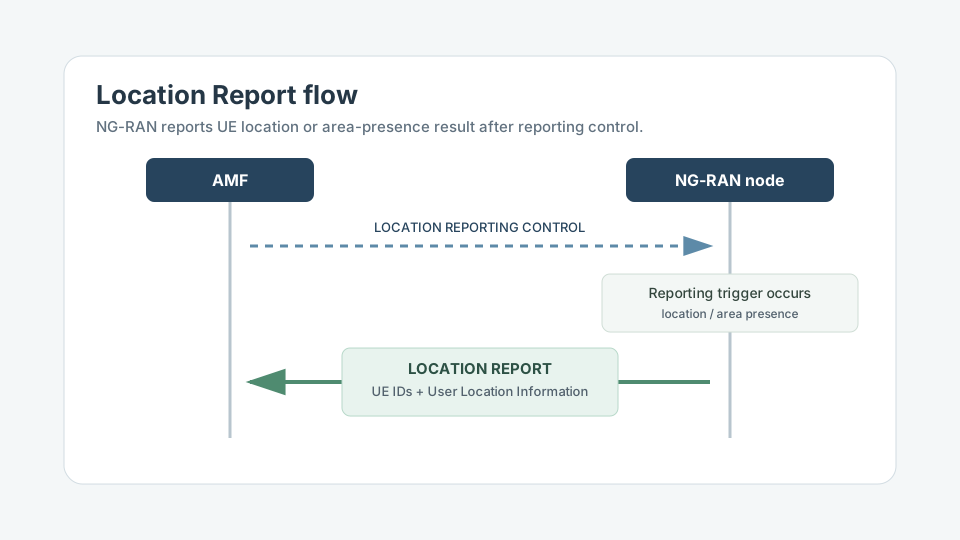
A reporting condition configured by Location Reporting Control occurs at NG-RAN.
Main purpose
Reports UE location to AMF, reports area-presence status when configured, confirms that the requested reporting condition occurred, supports regulatory, emergency, mobility, or service-area use cases, and complements Location Reporting Control.
Main specification
3GPP TS 38.413, Location reporting procedures and Location Report message
Release added
Release 15
Procedures where used
Location Report, Area presence reporting, Emergency or priority service support, Mobility validation, Regulatory location reporting
What is Location Report in simple terms?
Location Report is the NGAP location reporting message sent by the NG-RAN node to the AMF to report UE location information or area-presence status.
Reports UE location to AMF, reports area-presence status when configured, confirms that the requested reporting condition occurred, supports regulatory, emergency, mobility, or service-area use cases, and complements Location Reporting Control.
Why this message matters
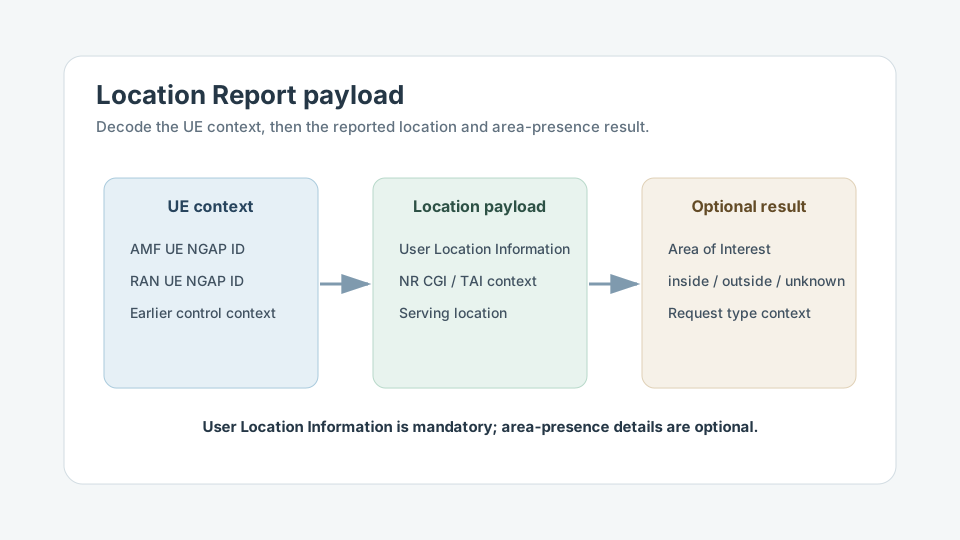
Location Report is the gNB reporting the UE's location back to the AMF. User Location Information is the main payload, and optional area-presence fields say whether the UE is inside configured areas.
Where this message appears in the call flow
Location Report
Location Report is sent by NG-RAN after the configured reporting condition occurs.
Call flow position: NG-RAN sends this UE-associated initiatingMessage to report location or area-presence result to AMF.
Typical state: AMF updates its view of the UE location state.
Preconditions:
A matching Location Reporting Control was sent, or location reporting context exists.
AMF UE NGAP ID and RAN UE NGAP ID identify the correct UE context.
User Location Information is present and decodable.
Next likely message: AMF location-state update or follow-up service handling
Area presence reporting
User Location Information is mandatory; area-presence result is optional.
Call flow position: UE Presence in Area of Interest List can report whether the UE is inside, outside, or unknown relative to configured areas.
Typical state: AMF uses area-presence results for service-area, emergency, regulatory, or mobility decisions.
Preconditions:
Area-of-interest reporting was configured.
Area presence list is decoded correctly.
Next likely message: AMF policy or service handling
Location payload interpretation
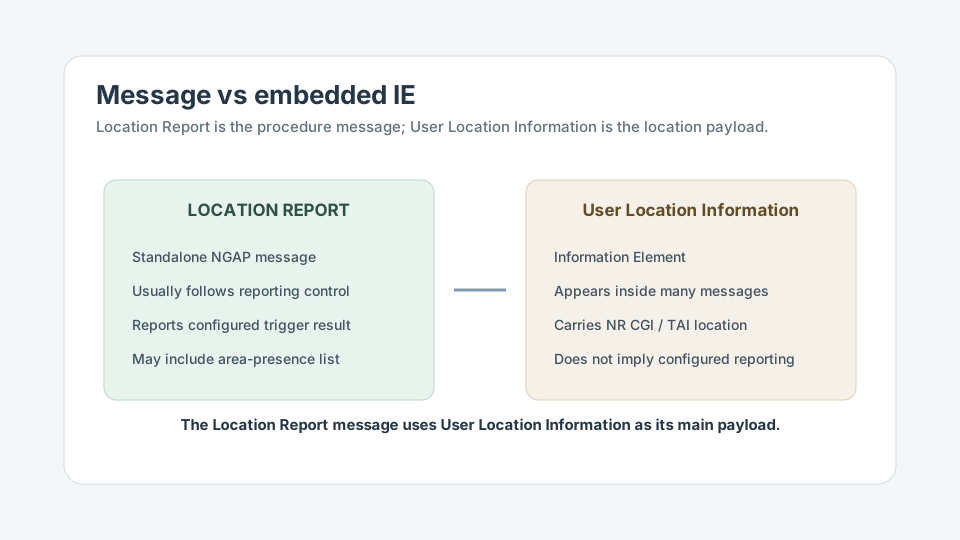
Do not confuse the Location Report message with the location IE that appears inside many NGAP messages.
Call flow position: User Location Information is mandatory in Location Report and carries the location payload.
Typical state: Engineers distinguish a standalone Location Report from User Location Information embedded in unrelated messages.
Preconditions:
The actual NGAP message type is checked before interpreting the location data.
Next likely message: Correct location-reporting analysis
Call flow position
Previous message(s):Location Reporting Control, NG-RAN applied the reporting request, Reporting condition or trigger occurred
Transport / encapsulation: NGAP over SCTP/IP between NG-RAN and AMF
Security context: Location Report carries UE-specific location information. It should be handled according to operator policy, lawful basis, emergency-service requirements, and privacy controls.
Message Structure Overview
Location Report is an NG-RAN-to-AMF UE-associated initiatingMessage.
AMF UE NGAP ID and RAN UE NGAP ID bind the report to the UE context and earlier control.
User Location Information is the mandatory location payload.
UE Presence in Area of Interest List can report area-presence result when configured.
Location Reporting Failure Indication is the failure path when reporting cannot be performed.
ASN.1 for 5G NGAP - Location Report
LocationReport ::= SEQUENCE {
  protocolIEs ProtocolIE-Container { {LocationReport-IEs} },
  ...
}

LocationReport-IEs NGAP-PROTOCOL-IES ::= {
  { ID id-AMF-UE-NGAP-ID                       CRITICALITY reject TYPE AMF-UE-NGAP-ID                       PRESENCE mandatory } |
  { ID id-RAN-UE-NGAP-ID                       CRITICALITY reject TYPE RAN-UE-NGAP-ID                       PRESENCE mandatory } |
  { ID id-UserLocationInformation              CRITICALITY ignore TYPE UserLocationInformation              PRESENCE mandatory } |
  { ID id-UEPresenceInAreaOfInterestList       CRITICALITY ignore TYPE UEPresenceInAreaOfInterestList       PRESENCE optional } |
  { ID id-LocationReportingRequestType         CRITICALITY ignore TYPE LocationReportingRequestType         PRESENCE optional },
  ...
}
How to read this ASN.1
Decode UE identifiers first, then User Location Information. If area presence reporting was configured, inspect UE Presence in Area of Interest List.
Treat this as a teaching example based on the expected message structure, not as a captured network trace.
User Location Information is the main payload.
Correlate the report with Location Reporting Control and any area-of-interest configuration.
Important Information Elements
IE
Presence
Description
Message Type
Mandatory
Identifies the NGAP PDU as LOCATION REPORT.
AMF UE NGAP ID
Mandatory
Mandatory UE identity at the AMF.
RAN UE NGAP ID
Mandatory
Mandatory UE identity at the NG-RAN node.
User Location Information
Mandatory
Mandatory UE location payload, such as NR CGI and TAI-based location context depending on access and scenario.
UE Presence in Area of Interest List
Optional
Optional area-presence result for configured areas of interest.
Location Reporting Request Type
Optional
Optional context for the reporting type or trigger configured earlier.
Detailed field explanation
Message Type
Identifies the NGAP PDU as LOCATION REPORT.
Presence: Mandatory
In practice: In practice, compare this field with the original request and with any later release-dependent optional fields so you can see whether the network accepted the same service model the UE asked for.
AMF UE NGAP ID
Mandatory UE identity at the AMF.
Presence: Mandatory
In practice: In practice, compare this field with the original request and with any later release-dependent optional fields so you can see whether the network accepted the same service model the UE asked for.
RAN UE NGAP ID
Mandatory UE identity at the NG-RAN node.
Presence: Mandatory
In practice: In practice, compare this field with the original request and with any later release-dependent optional fields so you can see whether the network accepted the same service model the UE asked for.
User Location Information
Mandatory UE location payload, such as NR CGI and TAI-based location context depending on access and scenario.
Presence: Mandatory
In practice: In practice, compare this field with the original request and with any later release-dependent optional fields so you can see whether the network accepted the same service model the UE asked for.
UE Presence in Area of Interest List
Optional area-presence result for configured areas of interest.
Presence: Optional
In practice: In practice, compare this field with the original request and with any later release-dependent optional fields so you can see whether the network accepted the same service model the UE asked for.
Location Reporting Request Type
Optional context for the reporting type or trigger configured earlier.
Presence: Optional
In practice: In practice, compare this field with the original request and with any later release-dependent optional fields so you can see whether the network accepted the same service model the UE asked for.
What to check in logs and traces
Confirm Location Report follows matching Location Reporting Control or a valid reporting context.
Match AMF UE NGAP ID and RAN UE NGAP ID to the configured UE context.
Decode User Location Information correctly.
Decode UE Presence in Area of Interest List if present.
Check Location Reporting Request Type if included.
Confirm no Location Reporting Failure Indication exists for the same request.
Verify AMF follow-up behavior matches the reported location.
Common Issues and Troubleshooting
Location Report is missing after the configured trigger.
Likely cause: Trigger may not have occurred, reporting may have failed, or the original control was not applied.
What to inspect: Check Location Reporting Control, request type, trigger conditions, and Location Reporting Failure Indication.
Next step: Validate NG-RAN support and replay the UE context timeline.
Location Report appears for the wrong UE.
Likely cause: UE ID correlation may be stale or incorrect after mobility.
What to inspect: Compare AMF UE NGAP ID and RAN UE NGAP ID against handover, path switch, and UE context messages.
Next step: Rebuild UE context mapping before using the location result.
Area-of-interest result is misunderstood.
Likely cause: UE Presence in Area of Interest List may be decoded without the original area configuration.
What to inspect: Compare the list with the reporting control and configured areas.
Next step: Interpret inside, outside, or unknown only against the configured area context.
User Location Information is not decoded correctly.
Likely cause: Analyzer may not decode the access-specific location container or release-specific fields.
What to inspect: Check NR CGI, TAI, and decoder release support.
Next step: Use a decoder that supports the relevant NGAP release and location container.
Location information is confused with another procedure.
Likely cause: User Location Information IE inside another NGAP message may be mistaken for a Location Report.
What to inspect: Check the top-level NGAP message type.
Next step: Separate configured Location Report messages from incidental location IEs.
LTE / 5G / Variant Comparison
Compared with Location Reporting Control
Location Reporting Control configures reporting. Location Report carries the resulting location or area-presence information.
Compared with Location Reporting Failure Indication
Location Report is the successful path. Failure Indication reports that NG-RAN cannot perform or continue reporting.
Compared with User Location Information IE
Location Report is a full NGAP message; User Location Information is the main location IE carried by this and other messages.
FAQ
What is Location Report in NGAP?
Location Report is the NG-RAN-to-AMF message used to report UE location or area-presence information.
Who sends Location Report?
The NG-RAN node sends Location Report to the AMF.
What triggers Location Report?
It is normally triggered by a prior Location Reporting Control message and the configured reporting condition.
What does User Location Information contain?
User Location Information carries the UE serving location, such as NR CGI and TAI context depending on access and scenario.
What is UE Presence in Area of Interest List?
It is an optional list reporting whether the UE is inside, outside, or unknown relative to configured areas of interest.
How is Location Report different from User Location Information IE?
Location Report is a full NGAP message dedicated to location reporting. User Location Information is an IE carried inside Location Report and many other NGAP messages.
What happens if location reporting fails?
NG-RAN may send Location Reporting Failure Indication instead of Location Report.
How do you troubleshoot missing Location Report messages?
Check matching Location Reporting Control, UE ID correlation, request type, trigger conditions, failure indication, and decoder support for User Location Information.
Decode this message with the 3GPP Decoder, inspect the related message database, or open the matching call flow to see where this signaling step fits in the full procedure.