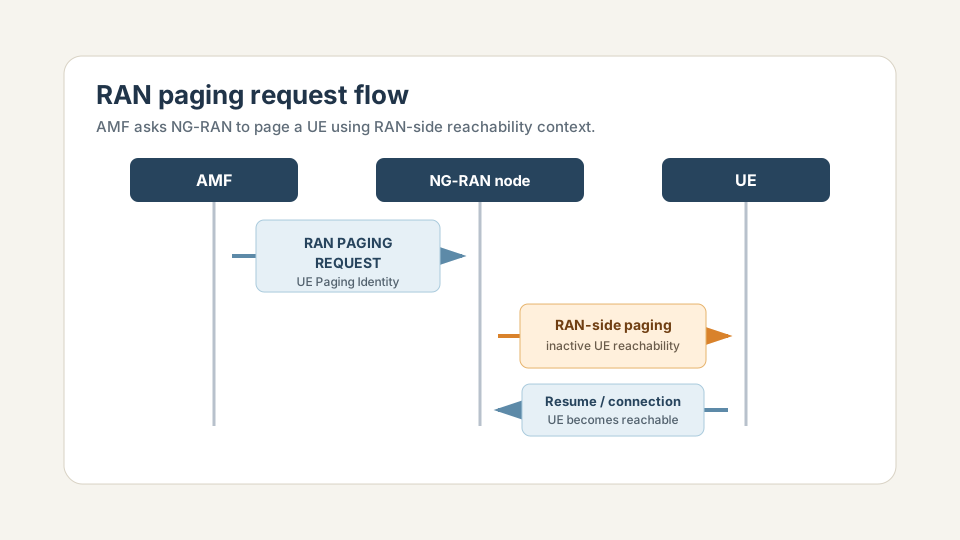
RAN Paging Request is an NGAP paging-related message used to support RAN-side paging in 5G. It is used when the network needs the NG-RAN to page a UE in a RAN-managed state, especially around RRC Inactive handling and UE reachability.
Message Fact Sheet
Protocol
ngap
Network
5g
Spec
3GPP TS 38.413
Spec Section
Paging procedures and RRC Inactive related NGAP procedures (Release 18 baseline)
AMF needs NG-RAN to page a UE using RAN-side context, commonly when the UE may be in RRC Inactive or when RAN-managed reachability is expected.
Main purpose
Asks NG-RAN to page the UE using RAN-side reachability context, supports RRC Inactive reachability, helps avoid full UE context recreation where possible, and links paging with resume or connection establishment procedures.
Main specification
3GPP TS 38.413, Paging procedures and RRC Inactive related NGAP procedures (Release 18 baseline)
RAN Paging Request is an NGAP paging-related message used to support RAN-side paging in 5G. It is used when the network needs the NG-RAN to page a UE in a RAN-managed state, especially around RRC Inactive handling and UE reachability.
Asks NG-RAN to page the UE using RAN-side reachability context, supports RRC Inactive reachability, helps avoid full UE context recreation where possible, and links paging with resume or connection establishment procedures.
Why this message matters
RAN Paging Request is AMF asking NG-RAN to page a UE using RAN-side context, often around RRC Inactive reachability.
Where this message appears in the call flow
RAN-side paging trigger
RAN-side reachability: AMF asks NG-RAN to page the UE using RAN-managed context, and the UE may then resume or establish signaling.
Call flow position: AMF sends RAN Paging Request toward NG-RAN when the UE should be reached through RAN-side paging rather than only normal tracking-area paging.
Typical state: The UE is not actively connected for data or signaling, but NG-RAN may retain context or have useful RAN-side paging information.
Preconditions:
AMF has a valid UE Paging Identity.
The target NG-RAN node or paging scope is known.
RAN-side paging or inactive-state reachability is applicable.
Next likely message: UE Context Resume Request, Connection Establishment Indication, or Initial UE Message depending on UE response
Relationship with RRC Inactive
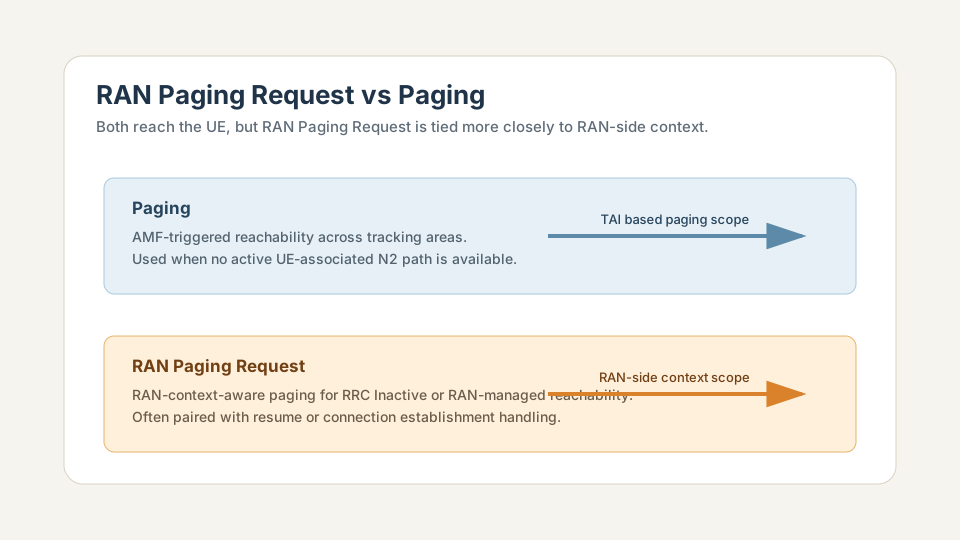
Paging distinction: normal Paging is broader tracking-area reachability, while RAN Paging Request is more closely tied to RAN-side context and inactive-state handling.
Call flow position: RAN Paging Request is commonly analyzed around RRC Inactive, where UE context may be retained partly in NG-RAN.
Typical state: The network attempts to reach the UE without treating the case exactly like a full idle-mode rebuild.
Preconditions:
RRC Inactive or RAN-managed reachability behavior is in use.
Trace analysis includes RRC Inactive Transition Report or related context-state messages when available.
Next likely message: Resume or connection establishment handling after UE response
Normal Paging comparison
Call flow position: This page documents RAN Paging Request separately from normal Paging because the RAN-side context and resume relationship are different.
Typical state: Both messages are reachability triggers, but the troubleshooting questions differ.
Preconditions:
Engineer distinguishes TAI-based normal Paging from RAN-context-aware RAN paging.
Next likely message: UE reachability response or paging expiry handling
Transport / encapsulation: NGAP over SCTP/IP between AMF and NG-RAN
Security context: RAN Paging Request is a reachability trigger. It does not by itself authenticate the UE, activate security, or complete UE context resume.
Message Structure Overview
RAN Paging Request is an AMF-to-NG-RAN initiatingMessage used for RAN-side paging.
UE Paging Identity is the key mandatory field because it identifies the UE that NG-RAN should page.
Optional DRX, tracking area, recommended-cell, priority, and assistance data refine how paging is attempted.
The message is closely related to RRC Inactive and RAN-managed reachability scenarios.
Do not read it as identical to normal Paging; RAN Paging Request is more RAN-context-aware.
ASN.1 for RAN Paging Request
RANPagingRequest ::= SEQUENCE {
  protocolIEs ProtocolIE-Container { {RANPagingRequest-IEs} },
  ...
}

RANPagingRequest-IEs NGAP-PROTOCOL-IES ::= {
  { UE Paging Identity, mandatory } |
  { Paging DRX, optional } |
  { TAI List for RAN Paging, optional } |
  { Recommended Cells for Paging, optional } |
  { Paging Priority, optional } |
  { Assistance Data for RAN Paging, optional },
  ...
}
How to read this ASN.1
Use this as a practical decode model: identify the UE first, then inspect paging scope, recommended cells, priority, DRX, and any assistance data.
Treat this as a teaching example based on the practical page-level structure, not as a captured network trace.
UE Paging Identity is the first field to verify in unreachable-UE cases.
Recommended cells and assistance data can explain why paging was targeted narrowly or broadly.
Correlate with later resume or connection establishment messages to confirm whether paging succeeded.
Important Information Elements
IE
Presence
Description
Message Type
Mandatory
Identifies the NGAP PDU as RAN PAGING REQUEST.
UE Paging Identity
Mandatory
Mandatory UE identity used by NG-RAN to determine which UE should be paged.
Paging DRX
Optional
Optional paging DRX information used to align paging timing with UE paging cycle behavior.
TAI List for RAN Paging
Optional
Optional tracking area scope where RAN-side paging may apply.
Recommended Cells for Paging
Optional
Optional list of suggested cells that can help NG-RAN perform more targeted paging.
Paging Priority
Optional
Optional priority information for paging handling, including urgent or priority service cases.
Assistance Data for RAN Paging
Optional
Optional assistance information that can improve paging efficiency or scope selection.
Detailed field explanation
Message Type
Identifies the NGAP PDU as RAN PAGING REQUEST.
Presence: Mandatory
In practice: In practice, compare this field with the original request and with any later release-dependent optional fields so you can see whether the network accepted the same service model the UE asked for.
UE Paging Identity
Mandatory UE identity used by NG-RAN to determine which UE should be paged.
Presence: Mandatory
In practice: In practice, compare this field with the original request and with any later release-dependent optional fields so you can see whether the network accepted the same service model the UE asked for.
Paging DRX
Optional paging DRX information used to align paging timing with UE paging cycle behavior.
Presence: Optional
In practice: In practice, compare this field with the original request and with any later release-dependent optional fields so you can see whether the network accepted the same service model the UE asked for.
TAI List for RAN Paging
Optional tracking area scope where RAN-side paging may apply.
Presence: Optional
In practice: In practice, compare this field with the original request and with any later release-dependent optional fields so you can see whether the network accepted the same service model the UE asked for.
Recommended Cells for Paging
Optional list of suggested cells that can help NG-RAN perform more targeted paging.
Presence: Optional
In practice: In practice, compare this field with the original request and with any later release-dependent optional fields so you can see whether the network accepted the same service model the UE asked for.
Paging Priority
Optional priority information for paging handling, including urgent or priority service cases.
Presence: Optional
In practice: In practice, compare this field with the original request and with any later release-dependent optional fields so you can see whether the network accepted the same service model the UE asked for.
Assistance Data for RAN Paging
Optional assistance information that can improve paging efficiency or scope selection.
Presence: Optional
In practice: In practice, compare this field with the original request and with any later release-dependent optional fields so you can see whether the network accepted the same service model the UE asked for.
What to check in logs and traces
Confirm RAN Paging Request is sent toward the expected NG-RAN node.
Verify the UE Paging Identity is correct.
Check paging area, TAI scope, and recommended-cell information if present.
Check Paging Priority when emergency, priority, or repeated paging behavior matters.
Confirm the UE later resumes or establishes connection.
Do not confuse RAN Paging Request with normal Paging.
Correlate with RRC Inactive Transition Report and Connection Establishment Indication when present.
Common Issues and Troubleshooting
UE remains unreachable after RAN Paging Request.
Likely cause: The UE paging identity, RAN paging scope, or selected NG-RAN/cell area may be wrong or stale.
What to inspect: Check UE Paging Identity, TAI List for RAN Paging, Recommended Cells for Paging, and later UE response messages.
Next step: Correct reachability context before repeating the same RAN paging attempt.
Paging is sent to the wrong RAN node or area.
Likely cause: RAN-managed reachability context or inactive-state location information may be stale.
What to inspect: Compare RAN Paging Request with earlier RRC Inactive Transition Report, suspend/resume context, and last known RAN area.
Next step: Refresh or correct the RAN paging scope.
RAN Paging Request is mistaken for normal Paging.
Likely cause: The trace is being analyzed only as generic AMF-to-RAN paging.
What to inspect: Check message name, procedure context, and whether RRC Inactive or RAN-managed reachability applies.
Next step: Use normal Paging checks for TAI-based idle reachability and RAN Paging Request checks for RAN-context-aware paging.
Recommended cells are missing or ineffective.
Likely cause: AMF may lack useful cell assistance data, or the UE moved away from the recommended cell set.
What to inspect: Check Recommended Cells for Paging and Assistance Data for RAN Paging if present.
Next step: Broaden or refresh paging assistance when repeated targeted pages fail.
UE responds, but the following procedure is unclear.
Likely cause: RAN paging success can lead into resume, connection establishment, or fresh initial access depending on context.
What to inspect: Look for UE Context Resume Request, Connection Establishment Indication, or Initial UE Message after the page.
Next step: Continue analysis on the follow-up procedure rather than treating paging as the final state.
LTE / 5G / Variant Comparison
Compared with Paging
Paging is the general AMF-triggered reachability message. RAN Paging Request is tied more closely to RAN-side context, RRC Inactive, and resume behavior.
Relationship with RRC Inactive
RRC Inactive allows context to be retained partly in NG-RAN. RAN paging can reach the UE without starting from a full idle-mode context rebuild.
Relationship with Connection Establishment Indication
After RAN paging, NG-RAN may report connection establishment or the UE may resume through a related context procedure.
FAQ
What is RAN Paging Request in NGAP?
RAN Paging Request is an AMF-to-NG-RAN message used to trigger RAN-side paging for a UE, commonly around RRC Inactive or RAN-managed reachability.
Who sends RAN Paging Request?
The AMF sends RAN Paging Request to the NG-RAN node.
How is RAN Paging Request different from Paging?
Paging is the general AMF-triggered reachability message. RAN Paging Request is more RAN-context-aware and is commonly associated with RRC Inactive or RAN-managed paging.
Is RAN Paging Request related to RRC Inactive?
Yes. It is often analyzed with RRC Inactive because NG-RAN may retain context that helps reach the UE without a full idle-mode setup path.
What identifies the UE in RAN Paging Request?
UE Paging Identity identifies the UE that NG-RAN should page.
What is Recommended Cells for Paging?
Recommended Cells for Paging is optional information that helps NG-RAN target paging toward cells where the UE is more likely to be reachable.
What happens after RAN Paging Request?
NG-RAN performs paging toward the UE. If successful, the UE may resume context or trigger connection establishment.
How do you troubleshoot failed RAN paging?
Check UE Paging Identity, paging scope, recommended cells, priority, and whether follow-up resume or connection establishment messages appear.
Decode this message with the 3GPP Decoder, inspect the related message database, or open the matching call flow to see where this signaling step fits in the full procedure.