gNB-DU Configuration Update Acknowledge is the F1AP successful outcome sent by the gNB-CU to the gNB-DU to confirm successful processing of a DU configuration update.
Message Fact Sheet
Protocol
f1ap
Network
5g
Spec
3GPP TS 38.473
Spec Section
gNB-DU Configuration Update Acknowledge message and gNB-DU Configuration Update procedure
Direction
gNB-CU -> gNB-DU
Message Type
gNB-DU Configuration / F1 Interface Management Message
The gNB-CU receives a gNB-DU Configuration Update, validates the DU-side configuration changes, and accepts the update procedure.
Main purpose
Confirms acceptance of DU configuration updates, completes the update procedure, synchronizes DU/CU configuration state, confirms that updated cells or resources were accepted by the CU, and prevents unnecessary retries or rollback handling.
DU-side configuration synchronization, gNB-DU Configuration Update successful outcome, Served cell update acceptance, Partial cell activation troubleshooting, Transaction ID correlation
What is gNB-DU Configuration Update Acknowledge in simple terms?
gNB-DU Configuration Update Acknowledge is the F1AP successful outcome sent by the gNB-CU to the gNB-DU to confirm successful processing of a DU configuration update.
Confirms acceptance of DU configuration updates, completes the update procedure, synchronizes DU/CU configuration state, confirms that updated cells or resources were accepted by the CU, and prevents unnecessary retries or rollback handling.
Why this message matters
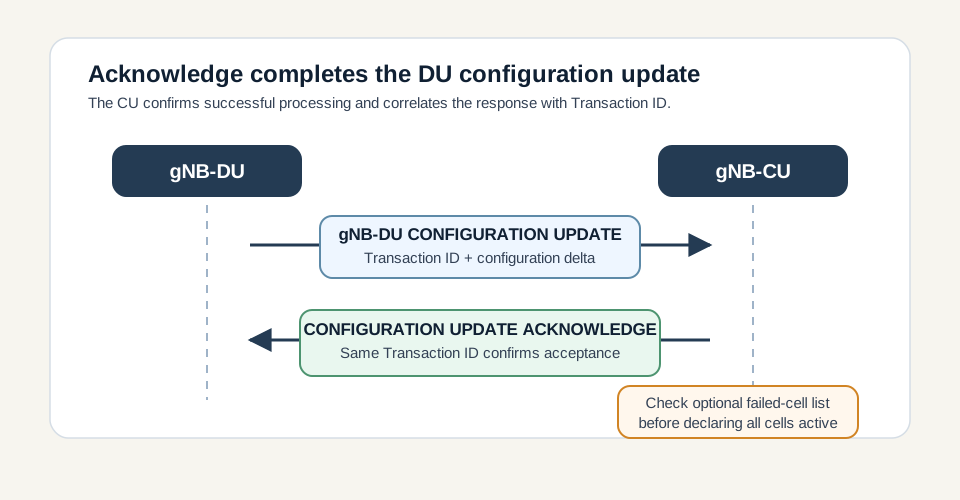
gNB-DU Configuration Update Acknowledge means the CU accepted the DU configuration update. Match Transaction ID first, then check whether any cells are listed as failed to activate.
Where this message appears in the call flow
gNB-DU Configuration Update
Procedure close: the ACK completes the update procedure and must match the original Transaction ID.
Call flow position: The gNB-CU sends Acknowledge after accepting the gNB-DU Configuration Update.
Typical state: The update procedure is complete and the CU/DU configuration view should be synchronized.
Preconditions:
The DU sent gNB-DU Configuration Update.
The CU validated the update and did not reject it with Failure.
Transaction ID is available for correlation.
Next likely message: Normal F1AP operation using the accepted DU configuration
Partial cell activation handling
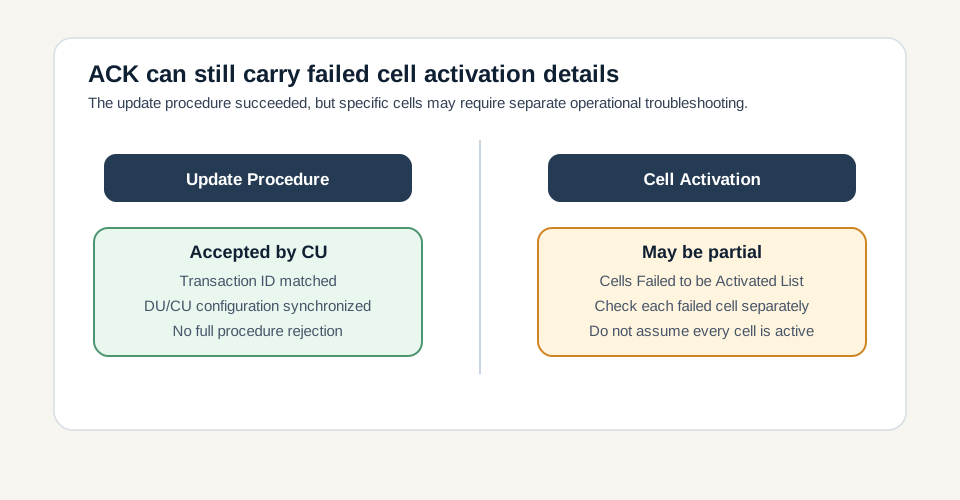
Operational nuance: successfulOutcome can still include cells that did not activate.
Call flow position: The Acknowledge can still identify cells that failed activation even though the update procedure succeeded.
Typical state: The procedure is accepted, but selected cells may require separate operational troubleshooting.
Preconditions:
The original update included cell changes or activation-relevant information.
The CU accepted the update but could not activate one or more cells.
Next likely message: Cell-level correction, later configuration update, or operational recovery
Transaction correlation
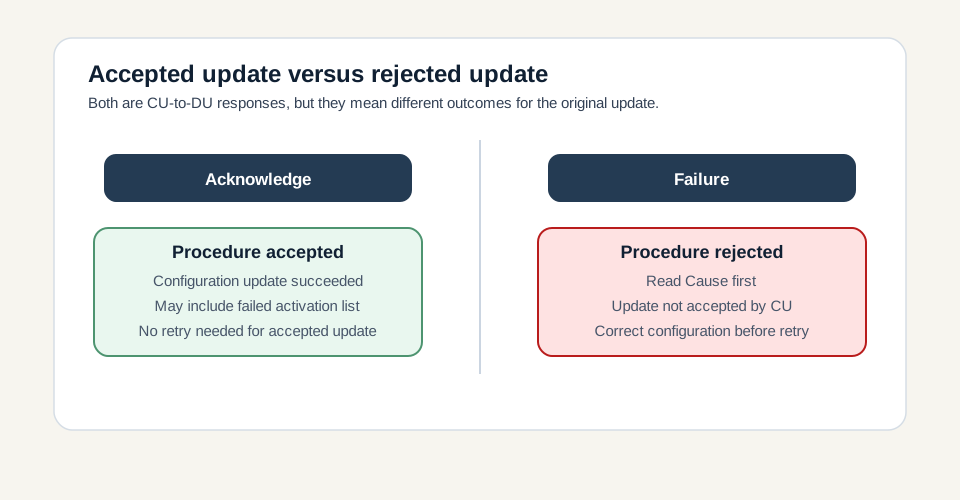
Outcome distinction: ACK accepts the update; Failure rejects it with cause.
Call flow position: Transaction ID links the acknowledge to the original gNB-DU Configuration Update.
Typical state: The ACK must be interpreted with the exact update request it confirms.
Preconditions:
Multiple configuration updates may occur close together.
Trace analysis needs to match request and response safely.
Next likely message: No retry for the accepted transaction unless later state changes
Transport / encapsulation: F1AP over SCTP/IP between gNB-CU and gNB-DU
Security context: gNB-DU Configuration Update Acknowledge does not establish a UE security context. It is a non-UE-associated successful outcome confirming the CU accepted a DU-side configuration update procedure.
Message Structure Overview
gNB-DU Configuration Update Acknowledge is the successfulOutcome for the DU configuration update procedure.
It is sent from gNB-CU to gNB-DU.
Transaction ID is mandatory and ties the ACK to the original update.
Cells Failed to be Activated List means the procedure succeeded, but some cells still require separate activation troubleshooting.
Failure is the alternative response when the CU rejects the update procedure.
The main decode path is Transaction ID for correlation, then Cells Failed to be Activated List for partial-success interpretation, and Criticality Diagnostics if present.
gNB-DU Configuration Update Acknowledge - Example Dump
Treat this as a teaching example based on the expected message structure, not as a captured network trace.
Acknowledge means the update procedure was accepted, not that every requested cell is necessarily active.
Always correlate Transaction ID with the original gNB-DU Configuration Update.
If Cells Failed to be Activated List is present, troubleshoot each listed cell separately.
Important Information Elements
IE
Presence
Description
Message Type
Mandatory
Identifies the F1AP PDU as gNB-DU CONFIGURATION UPDATE ACKNOWLEDGE.
Transaction ID
Mandatory
Correlates the acknowledge message with the original gNB-DU Configuration Update request.
Cells Failed to be Activated List
Optional
Optional list of cells that could not be activated even though the configuration update procedure succeeded.
Criticality Diagnostics
Optional
Optional protocol-level diagnostics for IE handling or non-fatal procedure issues.
Detailed field explanation
Message Type
Identifies the F1AP PDU as gNB-DU CONFIGURATION UPDATE ACKNOWLEDGE.
Presence: Mandatory
In practice: In practice, compare this field with the original request and with any later release-dependent optional fields so you can see whether the network accepted the same service model the UE asked for.
Transaction ID
Correlates the acknowledge message with the original gNB-DU Configuration Update request.
Presence: Mandatory
In practice: In practice, compare this field with the original request and with any later release-dependent optional fields so you can see whether the network accepted the same service model the UE asked for.
Cells Failed to be Activated List
Optional list of cells that could not be activated even though the configuration update procedure succeeded.
Presence: Optional
In practice: In practice, compare this field with the original request and with any later release-dependent optional fields so you can see whether the network accepted the same service model the UE asked for.
Criticality Diagnostics
Optional protocol-level diagnostics for IE handling or non-fatal procedure issues.
Presence: Optional
In practice: In practice, compare this field with the original request and with any later release-dependent optional fields so you can see whether the network accepted the same service model the UE asked for.
What to check in logs and traces
Confirm the ACK follows a matching gNB-DU Configuration Update.
Check that Transaction ID matches the original update.
Verify served cell changes are reflected correctly after the ACK.
Inspect Cells Failed to be Activated List before assuming all cells are active.
Decode Criticality Diagnostics if present.
Confirm no Failure appears for the same transaction.
Likely cause: The update procedure may have succeeded while the cell appeared in Cells Failed to be Activated List or remained unavailable operationally.
What to inspect: Check Cells Failed to be Activated List, cell status, NR CGI, PLMN/TAC, OAM state, and later admission or mobility decisions.
Next step: Troubleshoot the listed cell separately instead of treating the whole update as rejected.
The ACK cannot be matched to the original update.
Likely cause: Transaction ID mismatch, missing trace messages, or overlapping DU configuration procedures may be confusing correlation.
What to inspect: Compare Transaction ID, timestamps, SCTP stream/order, and the immediately preceding gNB-DU Configuration Update.
Next step: Do not infer acceptance until the ACK is matched to the correct update transaction.
The DU repeats the same configuration update after ACK.
Likely cause: The DU may not have processed the ACK, a partial activation issue may remain, or OAM may keep sending the same configuration delta.
What to inspect: Check Transaction ID sequence, duplicate list content, failed activation list, DU logs, and any SCTP interruption.
Next step: Separate transport/ACK delivery issues from real remaining cell activation failures.
Engineers confuse ACK with F1 Setup Response.
Likely cause: Both are CU-to-DU success messages, but they belong to different lifecycle stages.
What to inspect: Check procedureCode and preceding message: F1 Setup Request versus gNB-DU Configuration Update.
Next step: Use setup-response logic only for initial DU onboarding; use ACK logic for post-setup configuration updates.
LTE / 5G / Variant Comparison
ACK with partial cell activation
The update procedure can succeed while selected cells are still reported in Cells Failed to be Activated List.
Compared with Failure
Acknowledge accepts the update procedure. Failure rejects the update and should be interpreted through its Cause.
Compared with F1 Setup Response
F1 Setup Response accepts initial DU onboarding. gNB-DU Configuration Update Acknowledge confirms post-setup configuration synchronization.
FAQ
What is gNB-DU Configuration Update Acknowledge in F1AP?
It is the F1AP successful outcome sent by the gNB-CU to the gNB-DU to confirm that a gNB-DU Configuration Update was successfully processed.
Who sends this message?
The gNB-CU sends gNB-DU Configuration Update Acknowledge to the gNB-DU.
What does Transaction ID do?
Transaction ID links the acknowledge message to the original gNB-DU Configuration Update request.
Does ACK always mean all cells activated successfully?
No. ACK means the update procedure succeeded, but the message may include Cells Failed to be Activated List for individual cells that did not activate.
What is Cells Failed to be Activated List?
It is an optional IE that identifies cells that could not be activated even though the configuration update was accepted overall.
How is this different from gNB-DU Configuration Update Failure?
Acknowledge means the CU accepted the update procedure. Failure means the CU rejected the update and provides a failure cause.
How is this different from F1 Setup Response?
F1 Setup Response accepts initial DU onboarding. gNB-DU Configuration Update Acknowledge confirms a post-setup DU configuration update.
How do you troubleshoot configuration update acknowledgement issues?
Match Transaction ID with the original update, inspect Cells Failed to be Activated List, decode Criticality Diagnostics if present, verify no Failure exists for the same transaction, and check later CU/DU cell state.
Decode this message with the 3GPP Decoder, inspect the related message database, or open the matching call flow to see where this signaling step fits in the full procedure.