System Information Delivery Command is the F1AP non-UE-associated message the gNB-CU sends to the gNB-DU to request broadcast of one or more requested NR system information messages.
Message Fact Sheet
Protocol
f1ap
Network
5g
Spec
3GPP TS 38.473
Spec Section
Sections 8.5.1 and 9.2.5.1
Direction
gNB-CU -> gNB-DU initiatingMessage
Message Type
System information delivery command
Full message name
System Information Delivery Command
Protocol
F1AP
Technology
5G
Direction
gNB-CU -> gNB-DU initiatingMessage
Interface
F1-C
Signaling bearer / channel
Non-UE-associated F1AP signaling with NR cell and confirmed UE context information / SCTP carried F1AP initiatingMessage
Typical trigger
The CU needs the DU to broadcast requested other system information for a target NR cell, often after UE-triggered or CU-controlled system-information handling.
Main purpose
Requests the gNB-DU to broadcast indicated system information, identifies the target NR cell, correlates the delivery procedure with Transaction ID, and lets the CU coordinate on-demand other-SI handling while the DU performs radio broadcast.
Main specification
3GPP TS 38.473, Sections 8.5.1 and 9.2.5.1
Release added
Release 15
Procedures where used
Requested other-SI broadcast, SIB update delivery, Cell-specific SI broadcast coordination, UE-triggered system information acquisition, NR cell configuration visibility, SI synchronization after CU decision
What is System Information Delivery Command in simple terms?
System Information Delivery Command is the F1AP non-UE-associated message the gNB-CU sends to the gNB-DU to request broadcast of one or more requested NR system information messages.
Requests the gNB-DU to broadcast indicated system information, identifies the target NR cell, correlates the delivery procedure with Transaction ID, and lets the CU coordinate on-demand other-SI handling while the DU performs radio broadcast.
Why this message matters
System Information Delivery Command is the CU telling the DU which requested SI to broadcast in a target NR cell. Check NR CGI and SIType List first.
Where this message appears in the call flow
System Information Delivery
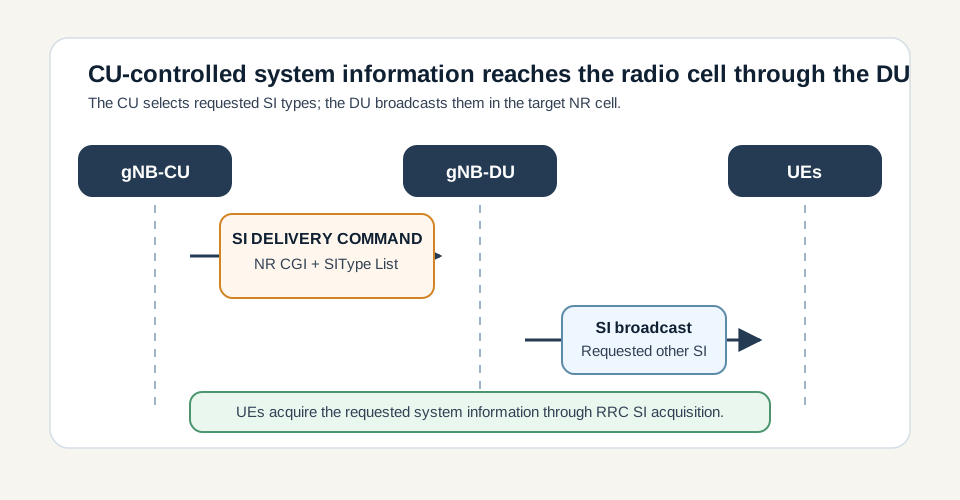
Delivery branch: the CU selects requested SI types and the DU broadcasts them in the target NR cell.
Call flow position: The CU sends System Information Delivery Command after deciding that the DU should broadcast one or more requested system information messages in a target cell.
Typical state: The DU receives a non-UE-associated F1AP command and uses the NR CGI and SIType List to broadcast the requested SI over the radio interface.
Preconditions:
The F1 interface is established.
The target NR cell is known by both CU and DU.
The CU has determined which SI types should be broadcast.
Next likely message: DU-side radio broadcast of requested SI, or Error Indication if the command cannot be handled
SI request context handling
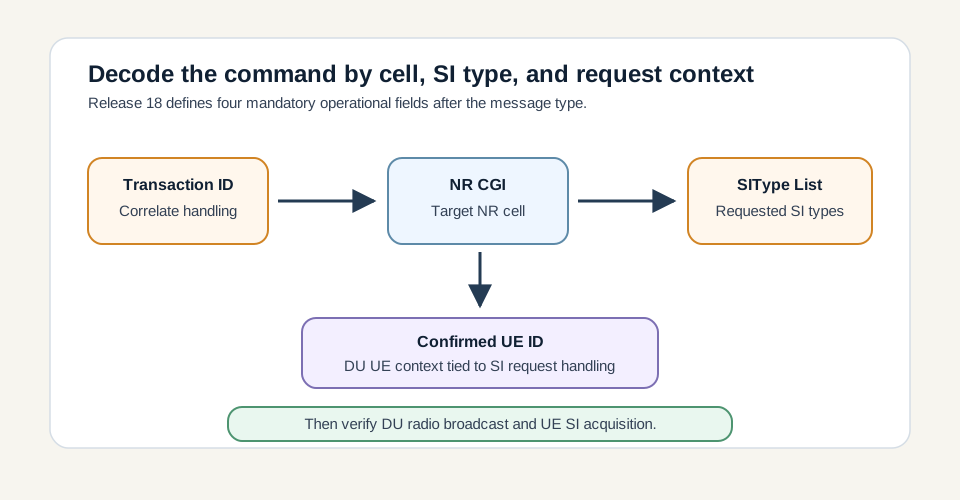
Decode branch: verify target cell, requested SI types, and confirmed DU UE context before checking radio broadcast.
Call flow position: The message includes Confirmed UE ID even though the F1AP procedure itself is non-UE-associated.
Typical state: The DU can correlate the SI delivery command with the UE-side SI request context that led to the broadcast need.
Preconditions:
A DU UE identifier is available for the confirmed UE context.
The SI request handling path has produced a valid SIType List.
Next likely message: Radio SI broadcast or cleanup of SI request context depending on UE state
SI versus paging and DU configuration
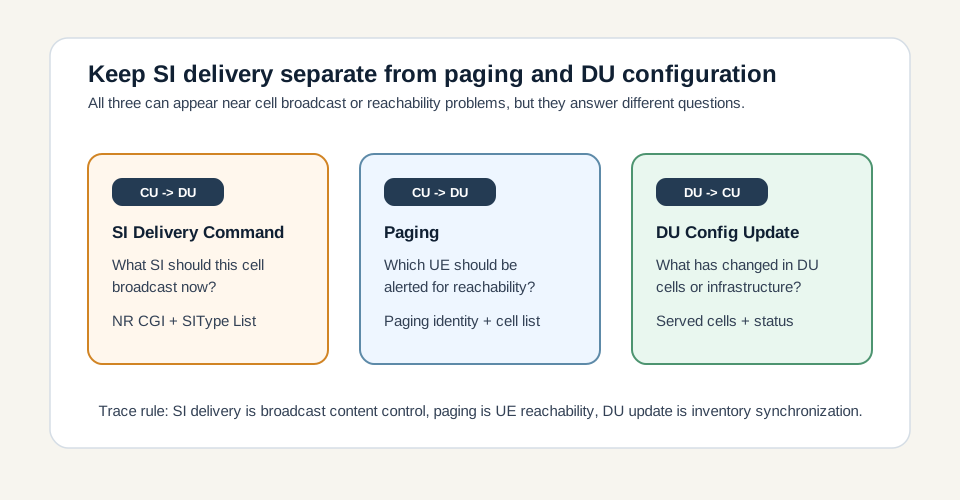
Scope branch: separate broadcast SI delivery from UE paging and DU inventory synchronization.
Call flow position: System Information Delivery Command controls requested SI broadcast, not UE reachability and not broad DU inventory synchronization.
Typical state: Paging wakes a UE; gNB-DU Configuration Update updates DU/CU operational configuration; SI delivery tells the DU what requested SI to broadcast.
Preconditions:
Trace analysis separates F1AP SI delivery from RRC SI decoding, Paging, and gNB-DU Configuration Update.
Next likely message: UE SI acquisition over radio or later DU configuration update if dedicated SI handling is required
Call flow position
Previous message(s): CU prepares requested other SI, UE or CU SI demand exists, F1 interface is operational
Transport / encapsulation: F1AP over SCTP/IP between gNB-CU and gNB-DU
Security context: System Information Delivery Command does not create AS or NAS security. It coordinates broadcast of requested system information over the radio interface.
Message Structure Overview
System Information Delivery Command is a non-UE-associated initiatingMessage from gNB-CU to gNB-DU.
Transaction ID, NR CGI, SIType List, and Confirmed UE ID are mandatory in the Release 18 message table.
The practical decode path is target cell first, then requested SI types, then the confirmed DU UE context.
The message requests DU broadcast of indicated system information; it does not itself describe UE RRC decoding behavior.
If later dedicated SI delivery handling is needed, the DU may use gNB-DU Configuration Update to report Dedicated SI Delivery Needed UE List.
This page follows the Release 18 TS 38.473 ASN.1 shape. Simplified summaries sometimes describe a generic System Information container, but the F1AP command identifies requested SI through SIType List and target cell through NR CGI.
System Information Delivery Command - Example Dump
Treat this as a teaching example based on the expected message structure, not as a captured network trace.
Start with NR CGI to verify the target cell.
Decode SIType List to understand which requested system information messages the DU should broadcast.
Use Confirmed UE ID to correlate the SI request context, but do not treat the procedure as a normal UE-associated F1AP message.
Important Information Elements
IE
Presence
Description
Message Type
Mandatory
Identifies the F1AP PDU as SYSTEM INFORMATION DELIVERY COMMAND.
Transaction ID
Mandatory
Correlates the SI delivery command handling.
NR CGI
Mandatory
Identifies the target NR cell for the requested system information broadcast.
SIType List
Mandatory
Lists the requested system information message types that the DU should broadcast, including other SI.
Confirmed UE ID
Mandatory
Carries the gNB-DU UE F1AP ID used to correlate the confirmed UE-side SI request context.
Detailed field explanation
Message Type
Identifies the F1AP PDU as SYSTEM INFORMATION DELIVERY COMMAND.
Presence: Mandatory
In practice: In practice, compare this field with the original request and with any later release-dependent optional fields so you can see whether the network accepted the same service model the UE asked for.
Transaction ID
Correlates the SI delivery command handling.
Presence: Mandatory
In practice: In practice, compare this field with the original request and with any later release-dependent optional fields so you can see whether the network accepted the same service model the UE asked for.
NR CGI
Identifies the target NR cell for the requested system information broadcast.
Presence: Mandatory
In practice: In practice, compare this field with the original request and with any later release-dependent optional fields so you can see whether the network accepted the same service model the UE asked for.
SIType List
Lists the requested system information message types that the DU should broadcast, including other SI.
Presence: Mandatory
In practice: In practice, compare this field with the original request and with any later release-dependent optional fields so you can see whether the network accepted the same service model the UE asked for.
Confirmed UE ID
Carries the gNB-DU UE F1AP ID used to correlate the confirmed UE-side SI request context.
Presence: Mandatory
In practice: In practice, compare this field with the original request and with any later release-dependent optional fields so you can see whether the network accepted the same service model the UE asked for.
What to check in logs and traces
Confirm message direction is gNB-CU to gNB-DU.
Check Transaction ID and CU/DU procedure logs around the same value.
Verify NR CGI matches the intended DU cell.
Decode SIType List and confirm the requested SI types are valid for the target cell.
Check Confirmed UE ID against the DU UE context involved in the SI request handling.
Confirm the DU broadcasts the requested SI over the NR radio interface.
Check whether a gNB-DU Configuration Update follows for dedicated SI delivery needed handling.
Confirm UE-side SI acquisition succeeds after broadcast.
Common Issues and Troubleshooting
UE still cannot acquire the requested system information.
Likely cause: The DU may not have broadcast the requested SI, the SIType List may be wrong, or the UE may be monitoring the wrong cell or SI window.
What to inspect: Check NR CGI, SIType List, DU broadcast logs, RRC SI scheduling, and UE SI acquisition traces.
Next step: Correct SI type selection or DU broadcast scheduling before debugging higher-layer access behavior.
System information appears on the wrong cell.
Likely cause: The NR CGI may map to the wrong DU cell or stale cell inventory may be present.
What to inspect: Compare NR CGI with DU served-cell configuration, OAM inventory, and gNB-DU Configuration Update history.
Next step: Fix cell mapping and confirm the DU advertises the intended served cell.
Trace analysis treats this as paging.
Likely cause: Both messages are CU-to-DU non-UE-associated commands, but their radio behavior is different.
What to inspect: Paging carries UE paging identity and cell paging scope; System Information Delivery Command carries NR CGI, SIType List, and Confirmed UE ID.
Next step: Separate UE reachability paging from broadcast SI delivery in the call-flow timeline.
LTE / 5G / Variant Comparison
Compared with Paging
Paging alerts a specific UE identity for reachability. System Information Delivery Command requests broadcast of indicated SI for a target cell.
Compared with gNB-DU Configuration Update
gNB-DU Configuration Update synchronizes DU operational configuration. System Information Delivery Command is a CU-to-DU instruction to broadcast requested SI.
Compared with RRC system information
F1AP carries the CU-to-DU control instruction. The UE-facing SI acquisition and SIB decoding behavior belongs to RRC.
FAQ
What is System Information Delivery Command in F1AP?
It is the F1AP message the gNB-CU sends to the gNB-DU to request broadcast of indicated system information in a target NR cell.
Who sends this message?
The gNB-CU sends System Information Delivery Command to the gNB-DU over F1-C.
What is SIType List used for?
SIType List identifies which requested system information message types the DU should broadcast.
Does this message target a specific UE?
The F1AP procedure is non-UE-associated, but the message includes Confirmed UE ID to correlate the DU-side UE context involved in SI request handling.
What type of SIB information can it relate to?
It relates to requested system information, especially other SI that the DU should broadcast for the target NR cell.
How is this different from Paging?
Paging alerts a UE for reachability. System Information Delivery Command requests broadcast of indicated SI in a cell.
How is this different from gNB-DU Configuration Update?
gNB-DU Configuration Update synchronizes DU configuration and served-cell state, while System Information Delivery Command is a CU instruction to broadcast requested SI.
How do you troubleshoot SI delivery issues?
Check message direction, Transaction ID, NR CGI, SIType List, Confirmed UE ID, DU radio broadcast logs, and UE-side SI acquisition traces.
Decode this message with the 3GPP Decoder, inspect the related message database, or open the matching call flow to see where this signaling step fits in the full procedure.