UE Context Modification Request is the UE-associated F1AP message the gNB-CU sends to the gNB-DU to change an already established UE context by adding, modifying, or releasing SRBs, DRBs, SCells, relay channels, multicast resources, or sidelink resources, updating CU-to-DU RRC information, and optionally stopping or restarting transmission for mobility before the DU replies with UE Context Modification Response or UE Context Modification Failure.
Message Fact Sheet
Protocol
f1ap
Network
5g
Spec
3GPP TS 38.473
Spec Section
Section 8.3.4 and sections 9.2.2.7 to 9.2.2.9 (Release 18 baseline)
Direction
gNB-CU -> gNB-DU initiatingMessage
Message Type
UE-associated context change, bearer modification, and mobility control
Full message name
5G F1AP - UE Context Modification Request
Protocol
F1AP
Technology
5G
Direction
gNB-CU -> gNB-DU initiatingMessage
Interface
F1-C between gNB-CU and gNB-DU
Signaling bearer / channel
UE-associated F1AP signaling / SCTP carried F1AP initiatingMessage followed by successfulOutcome or unsuccessfulOutcome
Typical trigger
The gNB-CU needs to change an active UE context after setup, such as adding or modifying DRBs or SRBs, releasing resources, updating measurement or gap behavior, changing the SpCell, preparing conditional mobility, or instructing the DU to stop or restart transmission for mobility handling.
Main purpose
Requests changes to an already established DU-side UE context, including radio-resource updates, bearer additions or modifications, bearer releases, sidelink or relay resource changes, measurement or RRC updates, and mobility-related transmission control.
Main specification
3GPP TS 38.473, Section 8.3.4 and sections 9.2.2.7 to 9.2.2.9 (Release 18 baseline)
Release added
Release 15
Procedures where used
Post-setup bearer changes over F1, DRB add, modify, or release, SRB, SCell, and DRX reconfiguration, Conditional mobility and LTM preparation, Transmission stop or restart for mobility, Relay, IAB, sidelink, and multicast resource changes
What is UE Context Modification Request in simple terms?
UE Context Modification Request is the UE-associated F1AP message the gNB-CU sends to the gNB-DU to change an already established UE context by adding, modifying, or releasing SRBs, DRBs, SCells, relay channels, multicast resources, or sidelink resources, updating CU-to-DU RRC information, and optionally stopping or restarting transmission for mobility before the DU replies with UE Context Modification Response or UE Context Modification Failure.
Requests changes to an already established DU-side UE context, including radio-resource updates, bearer additions or modifications, bearer releases, sidelink or relay resource changes, measurement or RRC updates, and mobility-related transmission control.
Why this message matters
UE Context Modification Request is the CU-to-DU command used after setup to change the live UE context instead of rebuilding it from scratch.
Where this message appears in the call flow
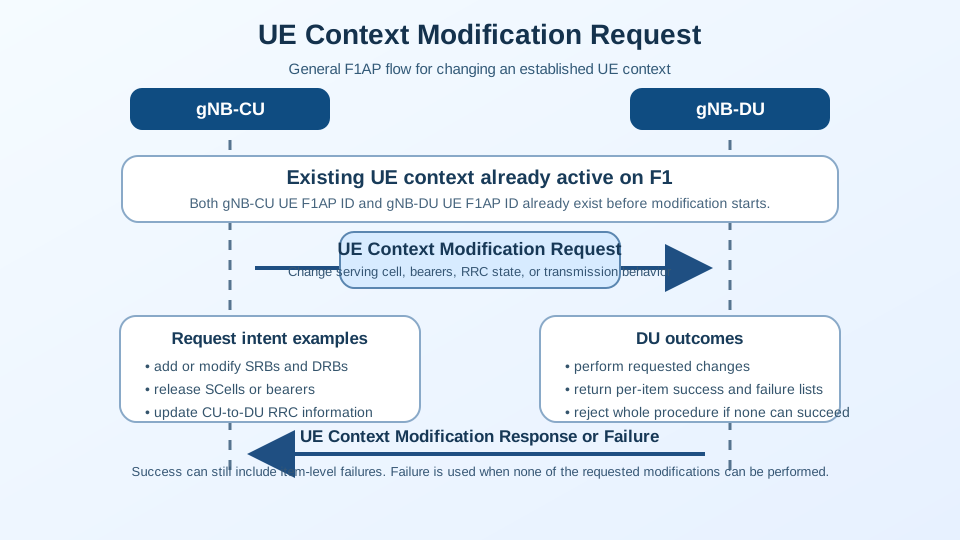
Active UE context evolution
General path: the CU updates an already established UE context instead of creating a new one from scratch.
Call flow position: The UE context already exists at the gNB-DU and the gNB-CU needs to change that context without releasing and recreating it.
Typical state: The procedure maintains one UE-associated signaling relationship while updating serving-cell, bearer, RRC, or lower-layer details in place.
Preconditions:
The F1 interface is operational.
Both gNB-CU UE F1AP ID and gNB-DU UE F1AP ID are already known.
The CU has determined which existing or new resources must be changed at the DU.
Next likely message: UE Context Modification Response
Bearer and transport reconfiguration
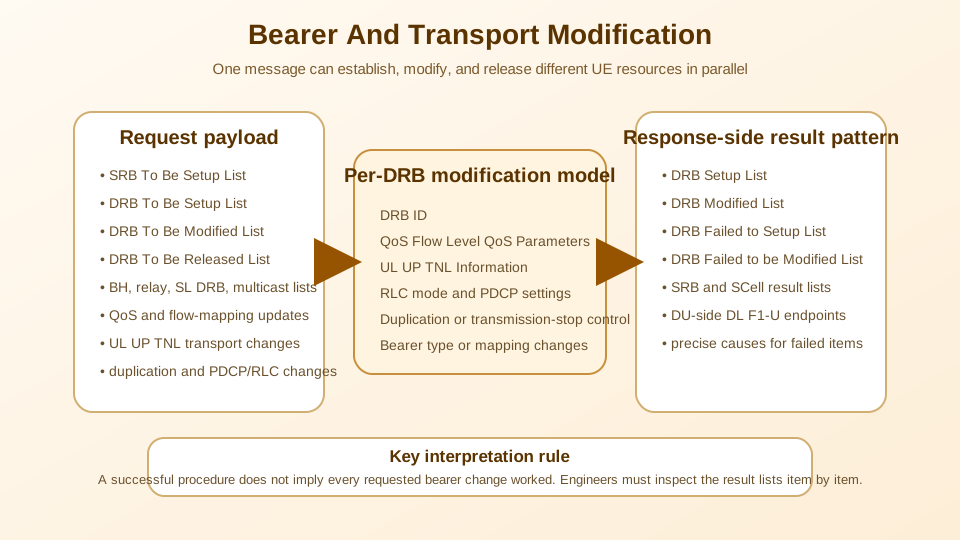
Bearer path: the request can add, modify, or release radio bearers and change the uplink F1-U or lower-layer behavior for specific DRBs.
Call flow position: The gNB-CU needs to add, modify, or release SRBs, DRBs, BH RLC channels, relay channels, multicast MRBs, or sidelink resources within the existing UE context.
Typical state: The DU may return successful setup lists, successful modified lists, and separate failed-to-setup or failed-to-modify lists in the response.
Preconditions:
The CU has prepared the new QoS, tunnel, RLC, duplication, or mapping parameters for the affected bearers.
The requested resource changes fit the DU capabilities and current UE context.
Next likely message: UE Context Modification Response with per-resource result lists, or UE Context Modification Failure if none of the requested changes can be performed
Mobility and transmission control
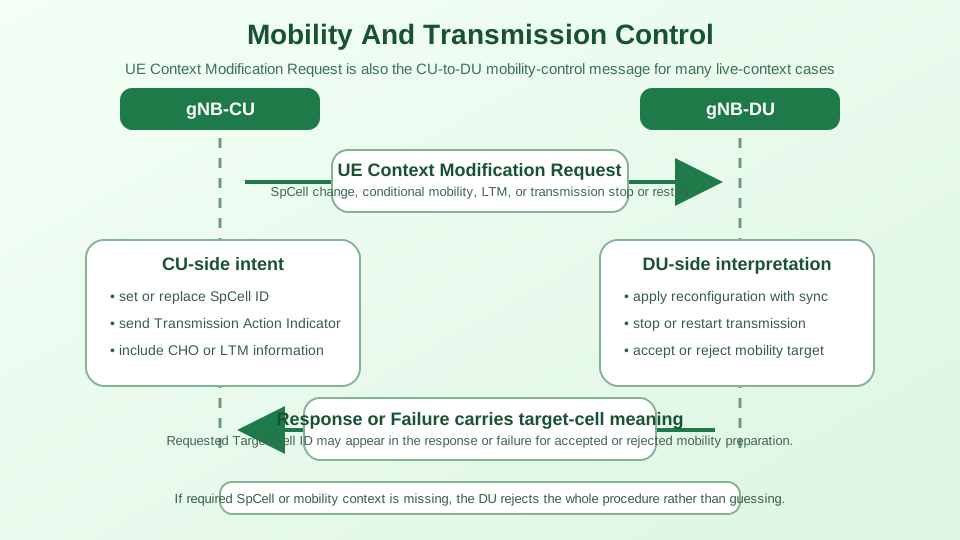
Mobility path: the same request family can carry SpCell changes, mobility preparation, and UE or DRB transmission-stop instructions.
Call flow position: The request is used to prepare conditional mobility, LTM, CPAC, path switching, or to stop or restart transmission during mobility handling.
Typical state: A single request may alter the SpCell, carry conditional mobility information, and instruct the DU to stop or restart UE or DRB transmission.
Preconditions:
The CU has selected the target cell, path change, or mobility trigger.
Any required SpCell ID or candidate-cell context is present when mobility options demand it.
Next likely message: UE Context Modification Response or UE Context Modification Failure with Requested Target Cell handling when applicable
Sender and receiver: gNB-CU -> gNB-DU initiatingMessage
Interface: F1-C between gNB-CU and gNB-DU
Domain: CU-DU UE context maintenance, bearer evolution, and mobility preparation
Signaling bearer: UE-associated F1AP signaling
Logical channel: SCTP carried F1AP initiatingMessage followed by successfulOutcome or unsuccessfulOutcome
Transport / encapsulation: F1AP over SCTP/IP between gNB-CU and gNB-DU
Security context: UE Context Modification Request does not create NAS security. It updates the radio, bearer, and lower-layer UE state already held at the gNB-DU and can carry RRC content or mobility instructions that affect how the DU continues serving the UE.
Message Structure Overview
UE Context Modification Request changes an existing UE context rather than creating a new one, so both UE F1AP IDs are mandatory from the start.
The message can mix several categories of change in one request: serving-cell updates, RRC payload refresh, SRB and DRB changes, release lists, and mobility or transmission-control instructions.
Bearer handling is broader than setup alone: the request can add new DRBs, modify existing ones, or release them, and the same pattern applies to SRBs, BH RLC channels, relay channels, SL DRBs, and multicast resources.
Transmission control exists at two levels: Transmission Action Indicator can stop or restart data transmission for the UE, while Transmission Stop Indicator can stop data transmission for a specific DRB.
The same request family also carries advanced conditional mobility, LTM, CPAC, path-switch, relay, IAB, sidelink, ProSe, and multicast variants, which is why the message table is large.
If none of the requested modifications can be successfully performed, or if required mobility context is inconsistent, the DU returns UE Context Modification Failure instead of a successful response.
ASN.1 for 5G F1AP - UE Context Modification Request
The complete ASN.1 is extensive because modification can touch almost every previously established per-UE resource. For most trace work, the important reading order is: both UE IDs, cell or mobility context, CU-to-DU RRC payload, then the setup, modify, and release lists for the affected bearers or channels.
5G F1AP - UE Context Modification Request - Example Dump
Start by confirming both UE F1AP IDs because modification only applies to an already existing UE context.
Separate setup, modify, and release intent. The same message may request all three at once for different resources.
If transmission control is present, read Transmission Action Indicator and any per-DRB Transmission Stop Indicator before drawing conclusions about user-plane loss.
Important Information Elements
IE
Presence
Description
gNB-CU UE F1AP ID
Mandatory
Mandatory CU-side UE identifier used to correlate the modification request with the existing UE-associated F1 signaling context.
gNB-DU UE F1AP ID
Mandatory
Mandatory DU-side UE identifier because modification operates on an already established UE context at the gNB-DU.
SpCell ID
Optional
Optional replacement or target special cell. When included outside certain LTM or conditional-mobility cases, the DU treats it as a reconfiguration with sync; in mobility cases it acts as a target-cell anchor.
ServCellIndex
Optional
Optional serving-cell index associated with the indicated SpCell when the request updates serving-cell context.
CU to DU RRC Information
Optional
Optional but highly important RRC container carrying CellGroupConfig, MeasConfig, UE capability, assistance, MUSIM, gap, CG-Config, or location-measurement related information that the DU uses to regenerate lower-layer state.
Transmission Action Indicator
Optional
Optional UE-wide transmission control telling the gNB-DU to stop or restart data transmission for the UE, commonly used for mobility handling.
RRC-Container
Optional
Optional DL-DCCH message encapsulated in a PDCP PDU. If present, the DU sends the corresponding RRC message to the UE and may pair it with duplication execution if configured.
DRB To Be Setup List
Optional
Optional list of new DRBs to establish within the existing UE context. Each item carries QoS, S-NSSAI, mapped flows, UL tunnel anchors, RLC mode, duplication, and PDCP parameters.
DRB To Be Modified List
Optional
Optional list of existing DRBs to change. It can update QoS flow mapping, UL transport, PDCP settings, duplication state, bearer type, transmission stop state, and other lower-layer behavior.
UL UP TNL Information to Be Setup List
Mandatory
Mandatory inside DRB setup or modify items that update F1-U transport. It gives the CU-side uplink F1-U tunnel endpoint by transport address and GTP TEID.
Transmission Stop Indicator
Optional
Optional per-DRB instruction inside DRB To Be Modified Item that tells the gNB-DU to stop data transmission for that DRB when supported and applicable.
SCell To Be Setup List / SCell To Be Removed List
Optional
Optional serving-cell change lists used to add, replace, or remove SCells within the UE context.
Resource Coordination Transfer Information
Optional
Optional UE-associated E-UTRA-NR or MR-DC resource-coordination payload used when the CU needs the DU to apply stored coordination information from inter-node procedures.
SCG Activation Request
Optional
Optional request telling the DU whether SCG resources should be activated or deactivated for the UE.
Full Configuration
Optional
Optional instruction asking the DU to generate full configuration in the modification response rather than a narrower delta-style update.
Conditional Intra-DU Mobility Information
Optional
Optional conditional-handover or S-CPAC related mobility block. It can trigger Requested Target Cell behavior and has strict dependencies on SpCell presence in several cases.
Detailed field explanation
gNB-CU UE F1AP ID
Mandatory CU-side UE identifier used to correlate the modification request with the existing UE-associated F1 signaling context.
Presence: Mandatory
In practice: In practice, compare this field with the original request and with any later release-dependent optional fields so you can see whether the network accepted the same service model the UE asked for.
gNB-DU UE F1AP ID
Mandatory DU-side UE identifier because modification operates on an already established UE context at the gNB-DU.
Presence: Mandatory
In practice: In practice, compare this field with the original request and with any later release-dependent optional fields so you can see whether the network accepted the same service model the UE asked for.
SpCell ID
Optional replacement or target special cell. When included outside certain LTM or conditional-mobility cases, the DU treats it as a reconfiguration with sync; in mobility cases it acts as a target-cell anchor.
Presence: Optional
In practice: In practice, compare this field with the original request and with any later release-dependent optional fields so you can see whether the network accepted the same service model the UE asked for.
ServCellIndex
Optional serving-cell index associated with the indicated SpCell when the request updates serving-cell context.
Presence: Optional
In practice: In practice, compare this field with the original request and with any later release-dependent optional fields so you can see whether the network accepted the same service model the UE asked for.
CU to DU RRC Information
Optional but highly important RRC container carrying CellGroupConfig, MeasConfig, UE capability, assistance, MUSIM, gap, CG-Config, or location-measurement related information that the DU uses to regenerate lower-layer state.
Presence: Optional
In practice: In practice, compare this field with the original request and with any later release-dependent optional fields so you can see whether the network accepted the same service model the UE asked for.
Transmission Action Indicator
Optional UE-wide transmission control telling the gNB-DU to stop or restart data transmission for the UE, commonly used for mobility handling.
Presence: Optional
In practice: In practice, compare this field with the original request and with any later release-dependent optional fields so you can see whether the network accepted the same service model the UE asked for.
RRC-Container
Optional DL-DCCH message encapsulated in a PDCP PDU. If present, the DU sends the corresponding RRC message to the UE and may pair it with duplication execution if configured.
Presence: Optional
In practice: In practice, compare this field with the original request and with any later release-dependent optional fields so you can see whether the network accepted the same service model the UE asked for.
DRB To Be Setup List
Optional list of new DRBs to establish within the existing UE context. Each item carries QoS, S-NSSAI, mapped flows, UL tunnel anchors, RLC mode, duplication, and PDCP parameters.
Presence: Optional
In practice: In practice, compare this field with the original request and with any later release-dependent optional fields so you can see whether the network accepted the same service model the UE asked for.
DRB To Be Modified List
Optional list of existing DRBs to change. It can update QoS flow mapping, UL transport, PDCP settings, duplication state, bearer type, transmission stop state, and other lower-layer behavior.
Presence: Optional
In practice: In practice, compare this field with the original request and with any later release-dependent optional fields so you can see whether the network accepted the same service model the UE asked for.
UL UP TNL Information to Be Setup List
Mandatory inside DRB setup or modify items that update F1-U transport. It gives the CU-side uplink F1-U tunnel endpoint by transport address and GTP TEID.
Presence: Mandatory
In practice: In practice, compare this field with the original request and with any later release-dependent optional fields so you can see whether the network accepted the same service model the UE asked for.
Transmission Stop Indicator
Optional per-DRB instruction inside DRB To Be Modified Item that tells the gNB-DU to stop data transmission for that DRB when supported and applicable.
Presence: Optional
In practice: In practice, compare this field with the original request and with any later release-dependent optional fields so you can see whether the network accepted the same service model the UE asked for.
SCell To Be Setup List / SCell To Be Removed List
Optional serving-cell change lists used to add, replace, or remove SCells within the UE context.
Presence: Optional
In practice: In practice, compare this field with the original request and with any later release-dependent optional fields so you can see whether the network accepted the same service model the UE asked for.
Resource Coordination Transfer Information
Optional UE-associated E-UTRA-NR or MR-DC resource-coordination payload used when the CU needs the DU to apply stored coordination information from inter-node procedures.
Presence: Optional
In practice: In practice, compare this field with the original request and with any later release-dependent optional fields so you can see whether the network accepted the same service model the UE asked for.
SCG Activation Request
Optional request telling the DU whether SCG resources should be activated or deactivated for the UE.
Presence: Optional
In practice: In practice, compare this field with the original request and with any later release-dependent optional fields so you can see whether the network accepted the same service model the UE asked for.
Full Configuration
Optional instruction asking the DU to generate full configuration in the modification response rather than a narrower delta-style update.
Presence: Optional
In practice: In practice, compare this field with the original request and with any later release-dependent optional fields so you can see whether the network accepted the same service model the UE asked for.
Conditional Intra-DU Mobility Information
Optional conditional-handover or S-CPAC related mobility block. It can trigger Requested Target Cell behavior and has strict dependencies on SpCell presence in several cases.
Presence: Optional
In practice: In practice, compare this field with the original request and with any later release-dependent optional fields so you can see whether the network accepted the same service model the UE asked for.
What to check in logs and traces
Match both gNB-CU UE F1AP ID and gNB-DU UE F1AP ID with the existing UE context before reading the rest of the request.
Check whether the message is updating the SpCell or using mobility-specific IEs such as Conditional Intra-DU Mobility Information or LTM-related blocks, because that changes failure interpretation.
Inspect CU to DU RRC Information whenever measurement, gap, serving-cell, or full CellGroupConfig behavior is being changed.
For every affected DRB, correlate DRB To Be Setup List, DRB To Be Modified List, DRB To Be Released List, UL UP TNL information, and any duplication or transmission-stop controls.
When debugging the outcome, expect separate setup, modified, failed-to-setup, and failed-to-modify lists in the response rather than one flat success indicator.
Common Issues and Troubleshooting
The DU rejects the whole request instead of returning partial success lists.
Likely cause: None of the requested modifications could be successfully performed, the DU could not accept the indicated SpCell, or the mobility-specific request was structurally inconsistent, such as missing SpCell where CHO initiation or replacement requires it.
What to inspect: Compare the request with UE Context Modification Failure and check for Requested Target Cell ID, SpCell handling, or mobility-trigger dependencies.
Next step: Validate the cell and mobility context first before tuning individual bearer items.
One DRB change silently does not take effect even though the procedure succeeds.
Likely cause: The DU may have reported that DRB in DRB Failed to be Modified List or DRB Failed to Setup List, or the request may have changed UL transport, duplication, or transmission state in a way the CU did not process correctly.
What to inspect: Walk the affected DRB through its request item, then compare the response modified or failed lists and any returned DL tunnel information.
Next step: Drive debugging from the per-DRB outcome, not from the procedure-level success alone.
Mobility preparation causes a failure even though ordinary bearer changes usually work.
Likely cause: Conditional mobility, LTM, or CPAC requests have stricter dependencies on SpCell, CSI, or candidate-cell context, and the DU can reject the whole procedure when those dependencies are not satisfied.
What to inspect: Check Conditional Intra-DU Mobility Information, LTM Information Modify, SpCell ID, and any Requested Target Cell handling in the outcome.
Next step: Rebuild the request with the exact target-cell and condition set required by the chosen mobility mode.
LTE / 5G / Variant Comparison
Compared with UE Context Setup Request
Setup creates the DU-side UE context. Modification assumes the context already exists and changes parts of it in place, including add, modify, release, and mobility-control actions.
Compared with UE Context Modification Response
The request carries intended changes. The response reports which requested resources were actually established, modified, failed, or released in a usable way, plus any returned RRC or mobility feedback.
Compared with UE Context Modification Failure
Failure is used when none of the requested modifications can be successfully performed or when key mobility or SpCell conditions are not acceptable. A successful response can still report item-level failures.
FAQ
What is UE Context Modification Request in 5G F1AP?
It is the UE-associated message the gNB-CU sends to the gNB-DU to change an existing UE context, including bearer additions, bearer modifications, releases, RRC updates, and mobility-related control.
Who sends UE Context Modification Request?
The gNB-CU sends it to the gNB-DU over F1-C.
What is mandatory in UE Context Modification Request?
The mandatory core is gNB-CU UE F1AP ID and gNB-DU UE F1AP ID, because the procedure targets an already established UE context.
Can UE Context Modification Request stop user-plane transmission?
Yes. It can use Transmission Action Indicator to stop or restart transmission for the UE and Transmission Stop Indicator to stop transmission for a specific DRB when supported.
When does the DU send UE Context Modification Failure instead of a response?
The DU sends UE Context Modification Failure when none of the requested modifications can be successfully performed, when it cannot accept the indicated SpCell, or when required mobility context such as SpCell for certain CHO or LTM cases is missing or not acceptable.
Decode this message with the 3GPP Decoder, inspect the related message database, or open the matching call flow to see where this signaling step fits in the full procedure.