UE Context Setup Response is the successful outcome the gNB-DU returns after establishing the requested UE context, confirming the DU-side UE association, returning DU-to-CU RRC information, providing downlink F1-U tunnel endpoints for successful DRBs, and reporting which requested SRBs, DRBs, SCells, BH RLC channels, relay channels, or multicast resources succeeded or failed to set up.
Message Fact Sheet
Protocol
f1ap
Network
5g
Spec
3GPP TS 38.473
Spec Section
Section 8.3.1 and sections 9.2.2.1 to 9.2.2.3 (Release 18 baseline)
Direction
gNB-DU -> gNB-CU successfulOutcome
Message Type
UE-associated context setup confirmation and result reporting
The gNB-DU successfully established the UE context requested by UE Context Setup Request and must now return the created UE identifiers, DU-to-CU RRC payload, successful bearer state, failed-to-setup causes, and any optional feedback such as C-RNTI, SCG activation status, or measurement-gap information.
Main purpose
Confirms that the gNB-DU accepted UE Context Setup at the procedure level and reports the resulting DU-side UE state, including RRC feedback, bearer setup outcomes, downlink user-plane tunnel anchors, and any requested target-cell or capability feedback.
Main specification
3GPP TS 38.473, Section 8.3.1 and sections 9.2.2.1 to 9.2.2.3 (Release 18 baseline)
Release added
Release 15
Procedures where used
Initial UE setup over F1, DU-side bearer establishment confirmation, F1-U downlink tunnel return from DU to CU, Measurement-gap and RRC feedback to the CU, SCG activation confirmation, Conditional mobility and requested-target-cell acknowledgment
What is UE Context Setup Response in simple terms?
UE Context Setup Response is the successful outcome the gNB-DU returns after establishing the requested UE context, confirming the DU-side UE association, returning DU-to-CU RRC information, providing downlink F1-U tunnel endpoints for successful DRBs, and reporting which requested SRBs, DRBs, SCells, BH RLC channels, relay channels, or multicast resources succeeded or failed to set up.
Confirms that the gNB-DU accepted UE Context Setup at the procedure level and reports the resulting DU-side UE state, including RRC feedback, bearer setup outcomes, downlink user-plane tunnel anchors, and any requested target-cell or capability feedback.
Why this message matters
UE Context Setup Response is the DU’s successful result message telling the CU which UE state, bearers, tunnels, and RRC outputs were actually created for the UE.
Where this message appears in the call flow
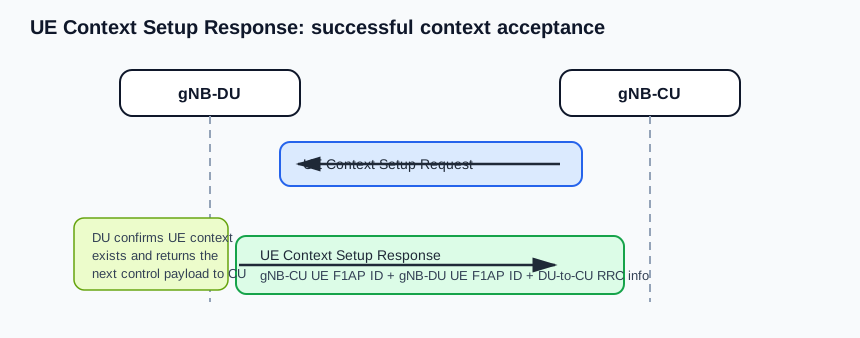
UE context accepted at the DU
Acceptance branch: the DU establishes the UE context and returns the successful outcome with both UE identifiers and DU-to-CU RRC information.
Call flow position: The gNB-DU accepted the requested SpCell and established the UE context, so it returns the successful outcome instead of UE Context Setup Failure.
Typical state: The UE-associated logical F1 connection exists, or was created as part of the procedure, and the CU can continue with normal UE-associated signaling.
Preconditions:
The gNB-DU was able to establish the UE context.
The DU accepted the requested SpCell for the procedure.
At least procedure-level setup succeeded, even if some requested items may still have failed individually.
Next likely message: DL RRC Message Transfer or later UE Context Modification
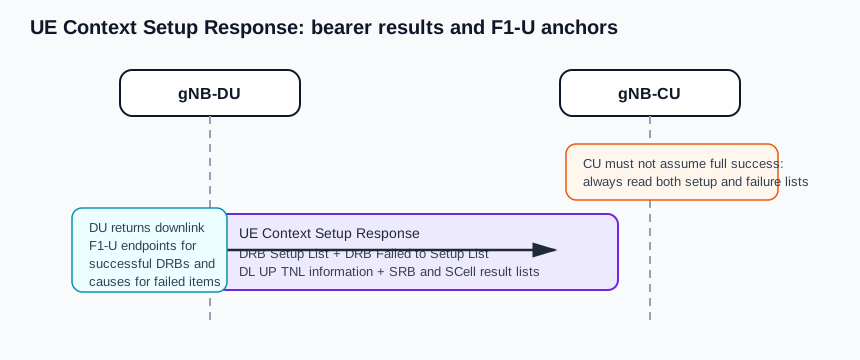
Bearer-by-bearer result reporting
Bearer branch: the response reports which resources succeeded, which failed, and which downlink F1-U endpoints the CU must use.
Call flow position: The gNB-DU returns a successful procedure outcome but reports which requested bearers or channels were established and which ones failed.
Typical state: The procedure is successful overall, but the CU must inspect setup and failed-to-setup lists item-by-item before assuming full bearer availability.
Preconditions:
The gNB-CU asked for one or more SRBs, DRBs, BH RLC channels, relay channels, sidelink bearers, or multicast resources.
The DU completed enough work to keep the overall procedure successful.
Next likely message: CU-side continuation using only the bearers and resources confirmed by the response
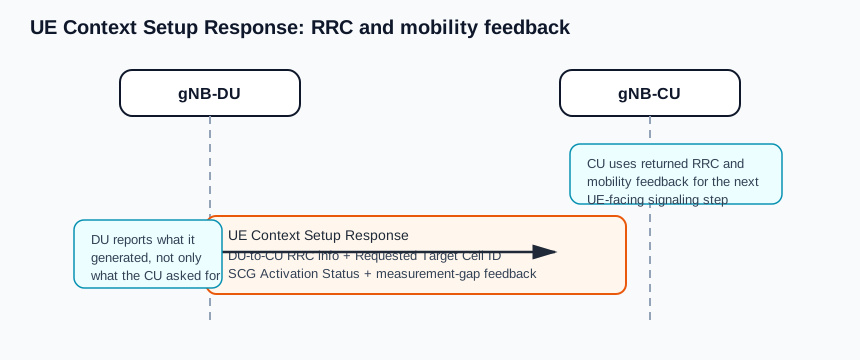
RRC and mobility feedback returned to the CU
Control branch: the response returns DU-generated RRC, measurement-gap, and mobility-significant feedback the CU must incorporate into next steps.
Call flow position: The gNB-DU returns DU-to-CU RRC information, requested target-cell echoing, measurement-gap data, or SCG activation status that the CU must incorporate into its next UE-facing decisions.
Typical state: The response is not only an acknowledgement; it is an input to the CU’s next RRC and mobility actions.
Preconditions:
The original request included CU-to-DU RRC content, mobility flags, SCG activation, or candidate-cell semantics that require feedback.
The DU generated the corresponding lower-layer or mobility outcome.
Next likely message: RRC delivery to the UE or a mobility-related follow-up procedure
Transport / encapsulation: F1AP over SCTP/IP between gNB-CU and gNB-DU
Security context: UE Context Setup Response does not create NAS security on its own. It confirms the DU-side UE radio and bearer state that was successfully built from the CU request and returns the information the gNB-CU needs to continue UE signaling and user-plane activation.
Message Structure Overview
UE Context Setup Response is the successfulOutcome of UE Context Setup and confirms the UE context at the DU has been created at procedure level.
The message starts with both UE F1AP IDs and mandatory DU to CU RRC Information, because the CU needs both correlation and DU-generated lower-layer feedback before continuing.
The response is heavily list-based: successful and failed setup results are returned separately for DRBs, SRBs, SCells, BH RLC channels, relay channels, sidelink bearers, and multicast resources.
Successful DRB items are operationally critical because they return the gNB-DU side F1-U tunnel endpoints for downlink transport.
A successful response does not imply that every requested item succeeded. The CU must inspect both setup lists and failed-to-setup lists before proceeding.
If the DU cannot establish the UE context or cannot establish even one bearer required for the procedure, the DU sends UE Context Setup Failure instead of this successful outcome.
The successful outcome is structurally simpler than the request in one sense: it does not propose state, it reports results. But it is still large because it must cover all successful and failed setup permutations across bearers, mobility variants, relay channels, IAB resources, and optional RRC feedback.
5G F1AP - UE Context Setup Response - Example Dump
Read the outcome at two levels: first decide whether the procedure itself succeeded, then inspect each setup and failed-to-setup list before assuming every requested resource exists.
For each successful DRB, the most important returned payload is the DL UP TNL information because that is the gNB-DU anchor for downlink F1-U traffic.
DU to CU RRC Information often carries the next control clues the CU needs, such as CellGroupConfig, MeasGapConfig, ServCellInfoList, or MUSIM gap feedback.
Important Information Elements
IE
Presence
Description
gNB-CU UE F1AP ID
Mandatory
Mandatory CU-side UE identifier used to correlate the successful outcome with the original UE Context Setup Request.
gNB-DU UE F1AP ID
Mandatory
Mandatory DU-side UE identifier returned once the DU-side UE context is established.
DU to CU RRC Information
Mandatory
Mandatory DU-originated RRC container returned to the CU. It always includes CellGroupConfig and can also carry MeasGapConfig, DRX offsets, ServCellInfoList, MUSIM gap information, inter-frequency no-gap feedback, and related lower-layer results.
C-RNTI
Optional
Optional C-RNTI allocated at the gNB-DU for the UE context. If present, the CU shall consider that the DU allocated it for this UE.
Full Configuration
Optional
Optional indicator that the DU generated CellGroupConfig using full configuration rather than delta configuration.
DRB Setup List
Optional
Optional list of DRBs successfully established by the DU. Each successful DRB item returns the DRB ID and the downlink F1-U tunnel information the CU must use.
DL UP TNL Information to Be Setup List
Mandatory
Mandatory inside each successful DRB item. It identifies the gNB-DU endpoint for downlink F1-U transport by transport address and GTP TEID.
Current QoS Parameters Set Index
Optional
Optional index to the currently fulfilled alternative QoS parameter set for a successful DRB.
TSC Traffic Characteristics Feedback
Optional
Optional TSC downlink and uplink feedback returned for a TSC QoS flow when the request asked the DU to determine feedback.
ECN Marking or Congestion Information Reporting Status
Optional
Optional status indicating whether ECN marking or congestion information reporting is active for a successful DRB.
SRB Setup List
Optional
Optional list of successfully established SRBs, including LCID for the primary path when relevant.
SRB Failed to Setup List
Optional
Optional list of requested SRBs that failed, each with an SRB ID and optional cause.
DRB Failed to Setup List
Optional
Optional list of requested DRBs that failed, each with a DRB ID and optional cause precise enough for the CU to understand the failure reason.
SCell Failed To Setup List
Optional
Optional list of requested SCells that failed to set up, each with SCell ID and cause.
Inactivity Monitoring Response
Optional
Optional indication that inactivity monitoring is not supported for the UE when the request asked for it.
Requested Target Cell ID
Optional
Optional echo of the SpCell from the request when the setup involved conditional inter-DU mobility, LTM, or related target-cell preparation semantics.
SCG Activation Status
Optional
Optional status indicating whether SCG resources are activated or deactivated when SCG activation was requested.
Detailed field explanation
gNB-CU UE F1AP ID
Mandatory CU-side UE identifier used to correlate the successful outcome with the original UE Context Setup Request.
Presence: Mandatory
In practice: In practice, compare this field with the original request and with any later release-dependent optional fields so you can see whether the network accepted the same service model the UE asked for.
gNB-DU UE F1AP ID
Mandatory DU-side UE identifier returned once the DU-side UE context is established.
Presence: Mandatory
In practice: In practice, compare this field with the original request and with any later release-dependent optional fields so you can see whether the network accepted the same service model the UE asked for.
DU to CU RRC Information
Mandatory DU-originated RRC container returned to the CU. It always includes CellGroupConfig and can also carry MeasGapConfig, DRX offsets, ServCellInfoList, MUSIM gap information, inter-frequency no-gap feedback, and related lower-layer results.
Presence: Mandatory
In practice: In practice, compare this field with the original request and with any later release-dependent optional fields so you can see whether the network accepted the same service model the UE asked for.
C-RNTI
Optional C-RNTI allocated at the gNB-DU for the UE context. If present, the CU shall consider that the DU allocated it for this UE.
Presence: Optional
In practice: In practice, compare this field with the original request and with any later release-dependent optional fields so you can see whether the network accepted the same service model the UE asked for.
Full Configuration
Optional indicator that the DU generated CellGroupConfig using full configuration rather than delta configuration.
Presence: Optional
In practice: In practice, compare this field with the original request and with any later release-dependent optional fields so you can see whether the network accepted the same service model the UE asked for.
DRB Setup List
Optional list of DRBs successfully established by the DU. Each successful DRB item returns the DRB ID and the downlink F1-U tunnel information the CU must use.
Presence: Optional
In practice: In practice, compare this field with the original request and with any later release-dependent optional fields so you can see whether the network accepted the same service model the UE asked for.
DL UP TNL Information to Be Setup List
Mandatory inside each successful DRB item. It identifies the gNB-DU endpoint for downlink F1-U transport by transport address and GTP TEID.
Presence: Mandatory
In practice: In practice, compare this field with the original request and with any later release-dependent optional fields so you can see whether the network accepted the same service model the UE asked for.
Current QoS Parameters Set Index
Optional index to the currently fulfilled alternative QoS parameter set for a successful DRB.
Presence: Optional
In practice: QoS rules are the real service profile of the session. Inspect the QFI mapping, packet filters, and precedence because those values explain how user traffic will actually be classified and forwarded.
TSC Traffic Characteristics Feedback
Optional TSC downlink and uplink feedback returned for a TSC QoS flow when the request asked the DU to determine feedback.
Presence: Optional
In practice: In practice, compare this field with the original request and with any later release-dependent optional fields so you can see whether the network accepted the same service model the UE asked for.
ECN Marking or Congestion Information Reporting Status
Optional status indicating whether ECN marking or congestion information reporting is active for a successful DRB.
Presence: Optional
In practice: In practice, compare this field with the original request and with any later release-dependent optional fields so you can see whether the network accepted the same service model the UE asked for.
SRB Setup List
Optional list of successfully established SRBs, including LCID for the primary path when relevant.
Presence: Optional
In practice: In practice, compare this field with the original request and with any later release-dependent optional fields so you can see whether the network accepted the same service model the UE asked for.
SRB Failed to Setup List
Optional list of requested SRBs that failed, each with an SRB ID and optional cause.
Presence: Optional
In practice: In practice, compare this field with the original request and with any later release-dependent optional fields so you can see whether the network accepted the same service model the UE asked for.
DRB Failed to Setup List
Optional list of requested DRBs that failed, each with a DRB ID and optional cause precise enough for the CU to understand the failure reason.
Presence: Optional
In practice: In practice, compare this field with the original request and with any later release-dependent optional fields so you can see whether the network accepted the same service model the UE asked for.
SCell Failed To Setup List
Optional list of requested SCells that failed to set up, each with SCell ID and cause.
Presence: Optional
In practice: In practice, compare this field with the original request and with any later release-dependent optional fields so you can see whether the network accepted the same service model the UE asked for.
Inactivity Monitoring Response
Optional indication that inactivity monitoring is not supported for the UE when the request asked for it.
Presence: Optional
In practice: In practice, compare this field with the original request and with any later release-dependent optional fields so you can see whether the network accepted the same service model the UE asked for.
Requested Target Cell ID
Optional echo of the SpCell from the request when the setup involved conditional inter-DU mobility, LTM, or related target-cell preparation semantics.
Presence: Optional
In practice: In practice, compare this field with the original request and with any later release-dependent optional fields so you can see whether the network accepted the same service model the UE asked for.
SCG Activation Status
Optional status indicating whether SCG resources are activated or deactivated when SCG activation was requested.
Presence: Optional
In practice: In practice, compare this field with the original request and with any later release-dependent optional fields so you can see whether the network accepted the same service model the UE asked for.
What to check in logs and traces
Match both gNB-CU UE F1AP ID and gNB-DU UE F1AP ID with the original request before reading any bearer details.
Inspect DU to CU RRC Information immediately after the IDs because it carries the DU-generated lower-layer result the CU will use next.
For each successful DRB, capture the DL UP TNL information and confirm the returned transport address and GTP TEID are consistent with the CU-side F1-U model.
Always inspect failed-to-setup lists even when the procedure itself succeeded, because a successful outcome can still contain partial bearer or cell failures.
If Requested Target Cell ID or SCG Activation Status is present, treat the response as mobility-significant rather than as a generic bearer confirmation.
Common Issues and Troubleshooting
The procedure succeeded, but user-plane traffic still does not flow on a requested DRB.
Likely cause: The DRB may not be in DRB Setup List, or its returned DL UP TNL information may not have been consumed correctly by the CU.
What to inspect: Check DRB Setup List first, then read the DL UP TNL information for the affected DRB and compare it with the expected F1-U tunnel model.
Next step: Treat the response as the authoritative DU-side downlink tunnel declaration and debug from that returned transport anchor.
The overall setup looks successful, but one bearer or SCell is missing later.
Likely cause: The response may contain a partial failure in SRB Failed to Setup List, DRB Failed to Setup List, or SCell Failed To Setup List even though the overall procedure succeeded.
What to inspect: Review all failed-to-setup lists and their causes instead of assuming the response means complete success.
Next step: Continue only with confirmed items, and correct the request-side payload for the failed items before retry or modification.
The CU behaves as if inactivity monitoring, SCG activation, or target-cell preparation succeeded, but later traces disagree.
Likely cause: The optional response indicators may show not-supported inactivity monitoring, SCG deactivated status, or a Requested Target Cell ID that must be honored explicitly by the CU.
What to inspect: Read Inactivity Monitoring Response, SCG Activation Status, and Requested Target Cell ID directly from the response.
Next step: Drive CU behavior from the actual response outcome rather than from the original request intent.
LTE / 5G / Variant Comparison
Compared with UE Context Setup Request
The request asks the DU to build UE state. The response reports what was actually built, returns DU-generated RRC output, and provides downlink F1-U transport endpoints for successful DRBs.
Compared with UE Context Setup Failure
The response means the DU established the UE context at procedure level. Failure means the DU could not establish the UE context, could not accept the SpCell, or could not establish even one bearer required for the procedure.
Complete success versus partial success
A response may still include failed-to-setup lists. Engineers must separate procedure success from per-resource success before deciding what the CU may do next.
FAQ
What is UE Context Setup Response in 5G F1AP?
It is the successful outcome the gNB-DU sends after it establishes the UE context requested by the gNB-CU. It confirms the created UE state and reports the results of requested resource setup.
Who sends UE Context Setup Response?
The gNB-DU sends it to the gNB-CU over F1-C.
What is mandatory in UE Context Setup Response?
gNB-CU UE F1AP ID, gNB-DU UE F1AP ID, and DU to CU RRC Information are mandatory.
What does the response return for successful DRBs?
It returns successful DRBs in DRB Setup List and provides the downlink F1-U tunnel information from the gNB-DU side for each successful DRB.
Can UE Context Setup Response still contain failures?
Yes. The overall procedure can succeed while the response still reports individual SRB, DRB, SCell, BH RLC, relay, or multicast setup failures in dedicated failed-to-setup lists.
Decode this message with the 3GPP Decoder, inspect the related message database, or open the matching call flow to see where this signaling step fits in the full procedure.