UE Context Release Complete is the successful outcome the gNB-DU sends after handling a UE Context Release Command, confirming that the requested UE-associated F1 context release or conditional-resource cancellation has been executed and optionally returning Criticality Diagnostics or Recommended SSBs for Paging List that the gNB-CU may store for later paging assistance.
Message Fact Sheet
Protocol
f1ap
Network
5g
Spec
3GPP TS 38.473
Spec Section
Section 8.3.3 and sections 9.2.2.5 to 9.2.2.6 (Release 18 baseline)
The gNB-DU has processed UE Context Release Command, released the relevant signaling and user-plane resources or cancelled the requested prepared branches, and now needs to acknowledge completion back to the gNB-CU.
Main purpose
Confirms that the gNB-DU finished the release or selective cleanup requested by UE Context Release Command and optionally returns paging-assistance or diagnostics that shape the gNB-CU's next actions after teardown.
Main specification
3GPP TS 38.473, Section 8.3.3 and sections 9.2.2.5 to 9.2.2.6 (Release 18 baseline)
Release added
Release 15
Procedures where used
Normal UE release confirmation over F1, Conditional handover cleanup confirmation, Conditional PSCell addition or change cleanup confirmation, Subsequent CPAC cleanup confirmation, Post-release paging-beam assistance
What is UE Context Release Complete in simple terms?
UE Context Release Complete is the successful outcome the gNB-DU sends after handling a UE Context Release Command, confirming that the requested UE-associated F1 context release or conditional-resource cancellation has been executed and optionally returning Criticality Diagnostics or Recommended SSBs for Paging List that the gNB-CU may store for later paging assistance.
Confirms that the gNB-DU finished the release or selective cleanup requested by UE Context Release Command and optionally returns paging-assistance or diagnostics that shape the gNB-CU's next actions after teardown.
Why this message matters
UE Context Release Complete is the DU's acknowledgement that the requested UE release or cleanup work has finished, with optional paging-beam advice the CU can keep for later use.
Where this message appears in the call flow
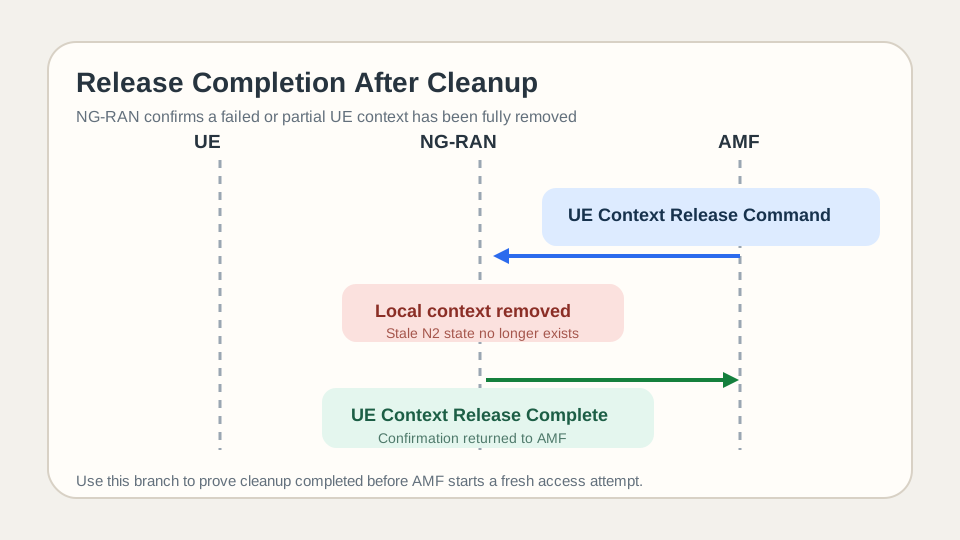
Full release completion
Cleanup branch: the DU completes the requested release handling and closes the procedure with the successful outcome.
Call flow position: The DU has released the UE-associated logical F1 connection and related resources requested by the CU and now returns the successful outcome.
Typical state: The targeted DU-side UE context is no longer active after the release handling completes.
Preconditions:
UE Context Release Command was received from the gNB-CU.
The DU completed the requested signaling and user-plane cleanup for the targeted UE association.
Next likely message: No direct UE-associated continuation on this DU until a later setup or re-establishment branch occurs
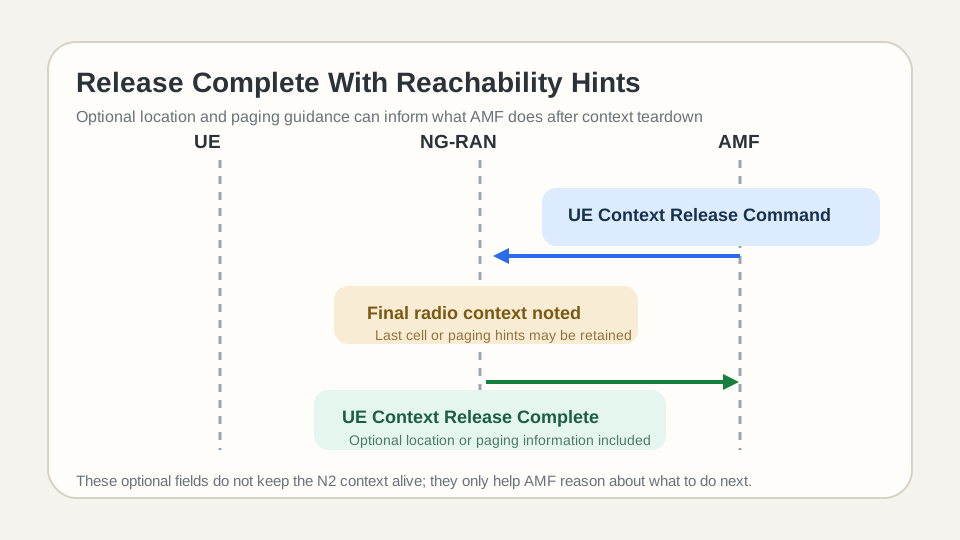
Paging-assistance branch: release completion can still leave the CU with useful SSB guidance for later paging toward the same DU cells.
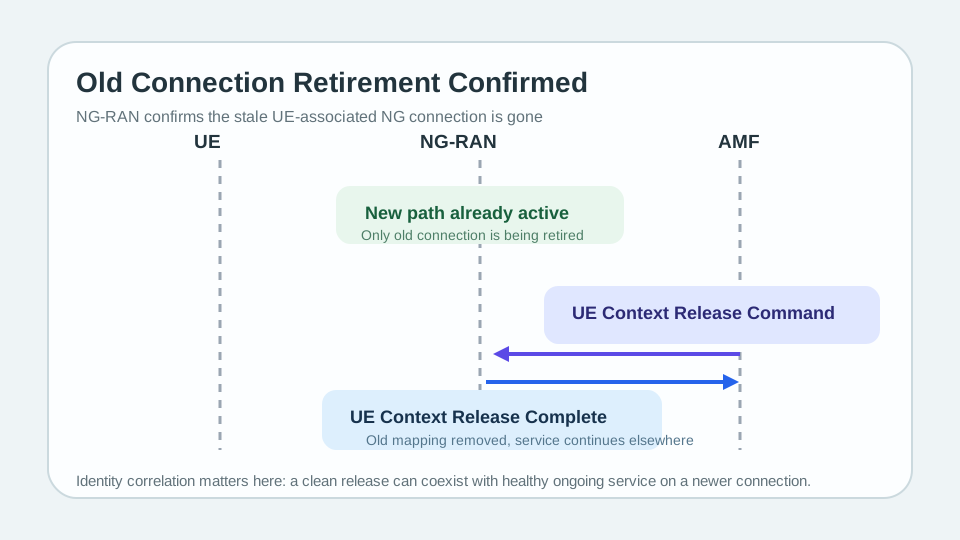
Call flow position: The DU used the command to cancel prepared candidate cells or related prepared branches rather than only confirming a plain hard teardown.
Typical state: The DU confirms that the requested cleanup branch finished for the targeted UE-associated signaling connection.
Preconditions:
The release command included Candidate Cells To Be Cancelled List or similar selective cleanup semantics.
The DU applied the requested cancellation for the associated prepared branch set.
Next likely message: Later mobility or paging decisions at the CU using the cleaned-up state
Post-release paging assistance
Lifecycle branch: release complete marks the clean end of one DU-side context before a later setup, re-establishment, or replacement path begins.
Call flow position: The DU returns Recommended SSBs for Paging List as useful DU-side assistance after the release completes.
Typical state: The live UE context is gone, but the CU may still store beam-oriented paging assistance for later reachability.
Preconditions:
The DU has paging-relevant SSB advice to return.
The CU supports storing and later using that assistance.
Next likely message: Later paging or later setup toward the same DU or cell area
Transport / encapsulation: F1AP over SCTP/IP between gNB-CU and gNB-DU
Security context: UE Context Release Complete does not establish NAS or AS security. It confirms that the DU has completed the requested context teardown or conditional-resource cleanup and may return paging assistance for later UE reachability.
Message Structure Overview
UE Context Release Complete is the successfulOutcome of UE Context Release and is sent by the gNB-DU back to the gNB-CU after release handling finishes.
The message is intentionally small: both UE IDs are mandatory, while Criticality Diagnostics and Recommended SSBs for Paging List are the two meaningful optional additions.
This is a completion acknowledgement, not a bearer-result report. Once the release finishes, there are no setup or modification lists left to describe.
Recommended SSBs for Paging List is the operationally interesting optional field because it lets the DU leave the CU with beam-oriented assistance for later paging, even though the UE context itself has been released.
Criticality Diagnostics, when present, should be read as a clue that the triggering release signaling had IE-level comprehension or logical issues that were still worth surfacing.
The complete message is deliberately small because the DU is confirming work already requested by the command rather than returning a rich result matrix. The main operational choice is whether paging assistance or diagnostics are attached to the acknowledgement.
5G F1AP - UE Context Release Complete - Example Dump
Start by matching both UE IDs with the release command. This message has no Cause field because the reason for release was already carried by UE Context Release Command.
If Recommended SSBs for Paging List is present, treat it as post-release assistance the CU may retain for later paging rather than as confirmation of still-live UE state.
If Criticality Diagnostics is present, compare it with the original release command to see which IE was missing or not comprehended during the procedure.
Important Information Elements
IE
Presence
Description
gNB-CU UE F1AP ID
Mandatory
Mandatory CU-side UE identifier that correlates the successful outcome with the original UE Context Release Command.
gNB-DU UE F1AP ID
Mandatory
Mandatory DU-side UE identifier for the context or prepared branch whose release handling has completed.
Criticality Diagnostics
Optional
Optional diagnostics returned when the DU needs to report missing, not understood, or logically problematic information elements tied to the release procedure.
Recommended SSBs for Paging List
Optional
Optional list of NR cells and recommended SSB indices that the CU may store and use as assistance information for subsequent paging after the release has completed.
NR CGI
Mandatory
Mandatory inside each Recommended SSBs for Paging List item to identify the DU cell for which paging-beam assistance is being provided.
SSB Index
Mandatory
Mandatory inside each SSBs for Paging List item and identifies a recommended beam index the CU may later use as paging assistance.
Detailed field explanation
gNB-CU UE F1AP ID
Mandatory CU-side UE identifier that correlates the successful outcome with the original UE Context Release Command.
Presence: Mandatory
In practice: In practice, compare this field with the original request and with any later release-dependent optional fields so you can see whether the network accepted the same service model the UE asked for.
gNB-DU UE F1AP ID
Mandatory DU-side UE identifier for the context or prepared branch whose release handling has completed.
Presence: Mandatory
In practice: In practice, compare this field with the original request and with any later release-dependent optional fields so you can see whether the network accepted the same service model the UE asked for.
Criticality Diagnostics
Optional diagnostics returned when the DU needs to report missing, not understood, or logically problematic information elements tied to the release procedure.
Presence: Optional
In practice: In practice, compare this field with the original request and with any later release-dependent optional fields so you can see whether the network accepted the same service model the UE asked for.
Recommended SSBs for Paging List
Optional list of NR cells and recommended SSB indices that the CU may store and use as assistance information for subsequent paging after the release has completed.
Presence: Optional
In practice: In practice, compare this field with the original request and with any later release-dependent optional fields so you can see whether the network accepted the same service model the UE asked for.
NR CGI
Mandatory inside each Recommended SSBs for Paging List item to identify the DU cell for which paging-beam assistance is being provided.
Presence: Mandatory
In practice: In practice, compare this field with the original request and with any later release-dependent optional fields so you can see whether the network accepted the same service model the UE asked for.
SSB Index
Mandatory inside each SSBs for Paging List item and identifies a recommended beam index the CU may later use as paging assistance.
Presence: Mandatory
In practice: In practice, compare this field with the original request and with any later release-dependent optional fields so you can see whether the network accepted the same service model the UE asked for.
What to check in logs and traces
Correlate gNB-CU UE F1AP ID and gNB-DU UE F1AP ID with the triggering UE Context Release Command before interpreting the completion.
Remember that the release reason is in the command, not in the complete message. Read the two messages together.
Check whether Recommended SSBs for Paging List is present and store the indicated cells and SSB indices if the CU supports paging assistance handling.
If Criticality Diagnostics is present, inspect the IE-level issue rather than assuming the release procedure was semantically perfect.
When the original command was selective cleanup, verify that the complete is being read as confirmation of that cleanup branch rather than as proof that every UE-related artifact was deleted globally.
Common Issues and Troubleshooting
Release complete arrives, but later paging still performs poorly.
Likely cause: Recommended SSBs for Paging List may be absent, ignored by the CU, or not interpreted as later beam-specific paging assistance.
What to inspect: Check whether the complete message included Recommended SSBs for Paging List and whether the CU stored the returned NR CGI and SSB indices.
Next step: Treat the field as actionable post-release paging assistance instead of passive trace decoration.
The release looks acknowledged, but cleanup appears incomplete in later traces.
Likely cause: The original command may have requested only selective candidate-cell or prepared-branch cancellation rather than a global DU wipe, or some non-associated entries were ignored under abnormal-condition rules.
What to inspect: Read UE Context Release Command together with the complete message and verify the intended cleanup scope.
Next step: Diagnose release scope first before concluding the DU failed to honor the completion.
Likely cause: The DU may have detected missing, not understood, or logically problematic IEs during the release procedure but still returned the successful outcome.
What to inspect: Read Criticality Diagnostics against the command payload and identify the exact offending IE or semantic mismatch.
Next step: Correct the command composition for future releases even if the current teardown still completed.
LTE / 5G / Variant Comparison
Compared with UE Context Release Command
The command tells the DU what to release or cancel and why. The complete message tells the CU that the requested release branch has finished and may attach paging assistance or diagnostics.
Compared with UE Context Setup Response
Setup response reports created live UE state, bearer setup, and DU-generated RRC output. Release complete confirms the opposite lifecycle moment: that the DU-side context or prepared branch cleanup is done.
Compared with UE Context Modification Response
Modification response is rich with result lists because the UE context stays alive. Release complete is intentionally compact because the context or prepared branch has just been torn down or cancelled.
FAQ
What is UE Context Release Complete in 5G F1AP?
It is the successful outcome the gNB-DU sends after it finishes the release or cleanup requested by UE Context Release Command.
Who sends UE Context Release Complete?
The gNB-DU sends it to the gNB-CU over F1-C.
What is mandatory in UE Context Release Complete?
The mandatory core is Message Type, gNB-CU UE F1AP ID, and gNB-DU UE F1AP ID.
What is the most important optional field in UE Context Release Complete?
Recommended SSBs for Paging List is usually the most operationally useful optional field because the CU may store it and use it as assistance for later paging after the UE context has been released.
Does UE Context Release Complete include the release cause?
No. The release reason is carried in UE Context Release Command. Release Complete is the acknowledgement that the DU finished the requested release handling.
Decode this message with the 3GPP Decoder, inspect the related message database, or open the matching call flow to see where this signaling step fits in the full procedure.