UE Context Modification Response is the NGAP message the NG-RAN sends to AMF to confirm that requested updates to an already established UE context were processed.
NG-RAN has processed UE Context Modification Request and needs to report that the requested context changes were applied, together with any useful resulting state information.
Main purpose
Confirms whether NG-RAN applied the requested UE context delta and can optionally return resulting RRC state, user location, or diagnostics useful for subsequent AMF decisions.
What is UE Context Modification Response in simple terms?
UE Context Modification Response is the NGAP message the NG-RAN sends to AMF to confirm that requested updates to an already established UE context were processed.
Confirms whether NG-RAN applied the requested UE context delta and can optionally return resulting RRC state, user location, or diagnostics useful for subsequent AMF decisions.
Why this message matters
UE Context Modification Response is the gNB telling the AMF that it processed the requested update to the existing UE context.
Where this message appears in the call flow
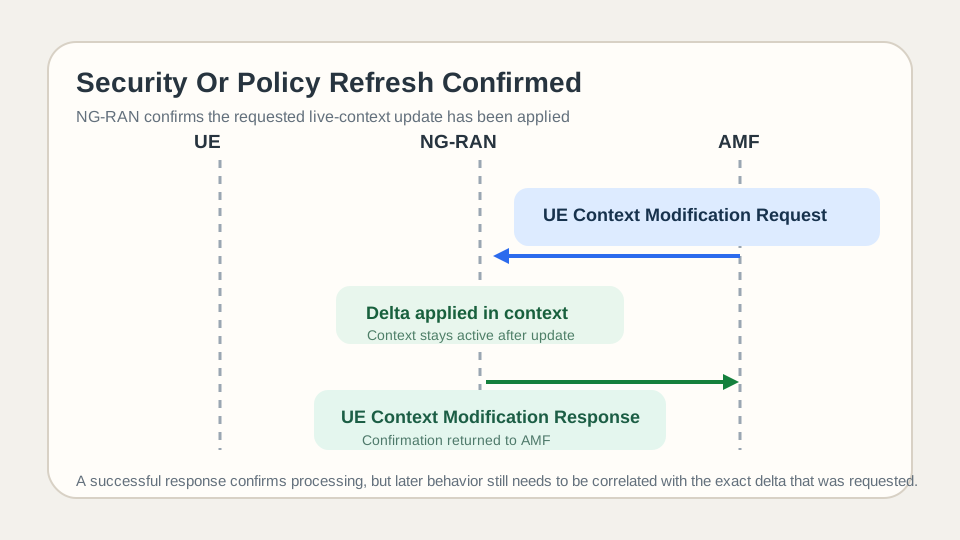
Security or policy refresh confirmation
Security or policy branch: NG-RAN confirms the requested live-context update was processed.
Call flow position: NG-RAN result message after AMF requested in-place context tuning for security or policy-related parameters.
Typical state: The existing UE context remains active, and NG-RAN reports whether the requested delta has been absorbed into the live context.
Preconditions:
UE Context Modification Request was received and processed.
AMF UE NGAP ID and RAN UE NGAP ID mapping is still valid.
Next likely message: Service continuation on updated context
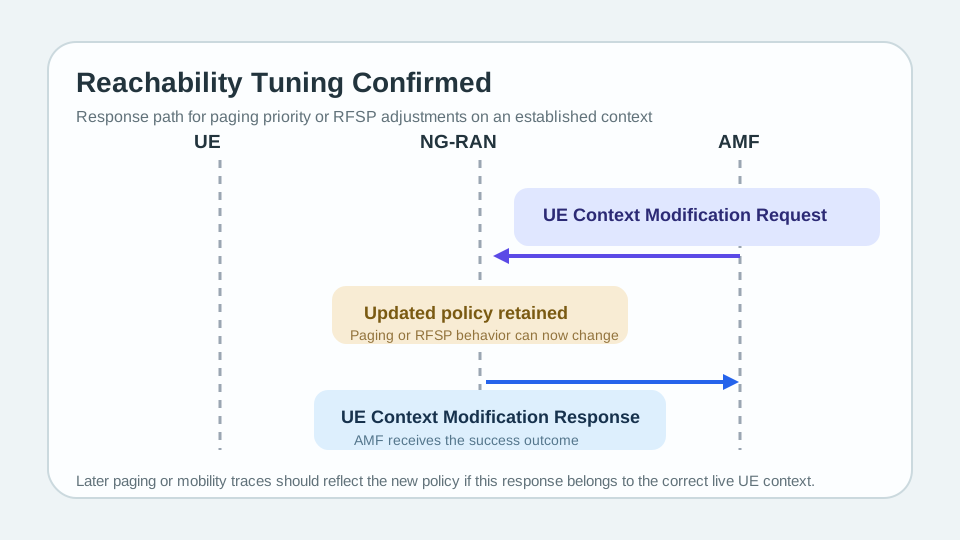
Paging priority or RFSP retuning result
Reachability tuning branch: the response confirms that updated handling policy is now in place.
Call flow position: NG-RAN confirms that reachability or radio-selection-related tuning for the established UE context has been handled.
Typical state: The UE context remains established, but AMF now has confirmation that NG-RAN accepted the new handling policy.
Preconditions:
AMF requested an RFSP or paging-related change.
NG-RAN evaluated the requested delta against the live context.
Next likely message: Later paging or mobility branch using updated behavior
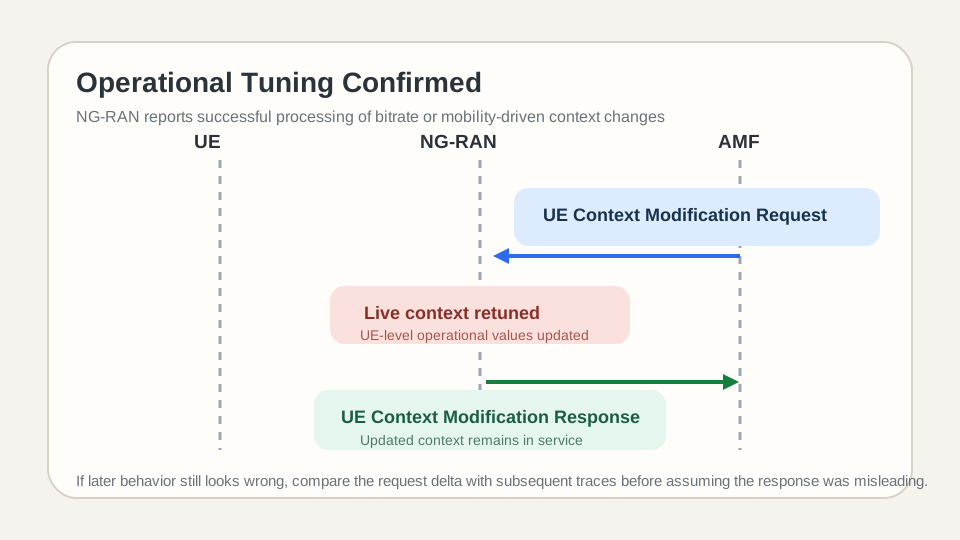
Bitrate or mobility-driven adjustment result
Operational tuning branch: NG-RAN reports successful completion of the requested delta update.
Call flow position: NG-RAN returns the outcome of UE-level operational tuning after mobility, session, or policy-driven context changes.
Typical state: AMF can continue using the context if the modification succeeded or decide on fallback handling if the live context still looks unstable.
Preconditions:
Requested update targeted an already established UE-associated NG connection.
NG-RAN finished modification processing.
Next likely message: Normal continuation or fallback cleanup
Transport / encapsulation: NGAP over SCTP/IP between AMF and NG-RAN
Security context: The message reports outcome of previously requested context updates; it does not define a fresh security baseline but can confirm successful application of security-related changes.
Message Structure Overview
UE Context Modification Response is the NG-RAN-to-AMF successfulOutcome message for the UE Context Modification procedure.
AMF UE NGAP ID and RAN UE NGAP ID are the mandatory response anchors.
Optional RRC state, location, and diagnostics make the message operationally useful beyond simple acknowledgment.
ASN.1 for 5G NGAP - UE Context Modification Response
UEContextModificationResponse ::= SEQUENCE {
  protocolIEs ProtocolIE-Container { {UEContextModificationResponse-IEs} },
  ...
}

UEContextModificationResponse-IEs NGAP-PROTOCOL-IES ::= {
  { ID id-AMF-UE-NGAP-ID          CRITICALITY reject TYPE AMF-UE-NGAP-ID          PRESENCE mandatory } |
  { ID id-RAN-UE-NGAP-ID          CRITICALITY reject TYPE RAN-UE-NGAP-ID          PRESENCE mandatory } |
  { ID id-RRCState                CRITICALITY ignore TYPE RRCState                PRESENCE optional  } |
  { ID id-UserLocationInformation CRITICALITY ignore TYPE UserLocationInformation PRESENCE optional  } |
  { ID id-CriticalityDiagnostics  CRITICALITY ignore TYPE CriticalityDiagnostics  PRESENCE optional  },
  ...
}
How to read this ASN.1
Decode the mandatory UE identifiers first to confirm the response belongs to the expected live context. Then inspect optional RRC state or location only if they are actually present and relevant to the next AMF decision.
5G NGAP - UE Context Modification Response - Example Dump
This response may be very short; absence of optional fields does not imply failure.
RRC State can be useful when the next question is whether the UE is still actively reachable after the modification.
Location information is especially useful when the modification was tied to mobility or subsequent paging expectations.
Important Information Elements
IE
Presence
Description
AMF UE NGAP ID
Mandatory
Mandatory AMF-side UE identifier used to correlate the modification result with the original request and the established UE context.
RAN UE NGAP ID
Mandatory
Mandatory NG-RAN-side UE identifier used to confirm which radio-side context was actually modified.
RRC State
Optional
Optional resulting RRC state information that can help AMF understand UE reachability or activity after the modification was applied.
User Location Information
Optional
Optional location context that can help AMF correlate the modified UE context with the latest known serving area or cell.
Criticality Diagnostics
Optional
Optional diagnostics that may explain unusual processing conditions or partial decode issues associated with the response path.
Detailed field explanation
AMF UE NGAP ID
Mandatory AMF-side UE identifier used to correlate the modification result with the original request and the established UE context.
Presence: Mandatory
In practice: In practice, compare this field with the original request and with any later release-dependent optional fields so you can see whether the network accepted the same service model the UE asked for.
RAN UE NGAP ID
Mandatory NG-RAN-side UE identifier used to confirm which radio-side context was actually modified.
Presence: Mandatory
In practice: In practice, compare this field with the original request and with any later release-dependent optional fields so you can see whether the network accepted the same service model the UE asked for.
RRC State
Optional resulting RRC state information that can help AMF understand UE reachability or activity after the modification was applied.
Presence: Optional
In practice: In practice, compare this field with the original request and with any later release-dependent optional fields so you can see whether the network accepted the same service model the UE asked for.
User Location Information
Optional location context that can help AMF correlate the modified UE context with the latest known serving area or cell.
Presence: Optional
In practice: In practice, compare this field with the original request and with any later release-dependent optional fields so you can see whether the network accepted the same service model the UE asked for.
Criticality Diagnostics
Optional diagnostics that may explain unusual processing conditions or partial decode issues associated with the response path.
Presence: Optional
In practice: In practice, compare this field with the original request and with any later release-dependent optional fields so you can see whether the network accepted the same service model the UE asked for.
What to check in logs and traces
Match AMF UE NGAP ID and RAN UE NGAP ID with the original UE Context Modification Request.
Check whether the modified context is still the same live UE mapping after mobility or re-establishment events.
Inspect RRC State if AMF behavior after the response depends on UE reachability or connected/idle assumptions.
Inspect User Location Information if the modification was tied to mobility, paging, or serving-area decisions.
If expected behavior still does not change, compare this response with the exact optional IEs that were present in the request.
Common Issues and Troubleshooting
UE Context Modification Response arrives, but the network behaves as if nothing changed.
Likely cause: The response only confirms processing; the requested delta may have been small, irrelevant to the observed symptom, or misread in the original request.
What to inspect: Compare the request's actual optional IEs with the behavior you expected to change, then inspect any returned RRC state or location hints.
Next step: Validate the requested delta first before concluding NG-RAN ignored the modification.
The response is present, but later release or failure still happens quickly.
Likely cause: The modification may have succeeded technically while the underlying UE context remained unstable for unrelated reasons.
What to inspect: Correlate the response with subsequent failure, release, or mobility events rather than blaming the response itself.
Next step: Treat the modification as one step in a larger context lifecycle, not the sole explanation for later cleanup.
AMF appears to receive a valid response for the wrong UE.
Likely cause: The trace may be mixing old and new UE context mappings after re-establishment or mobility, causing identity confusion.
What to inspect: Rebuild the AMF UE NGAP ID and RAN UE NGAP ID timeline around the request, response, and any release or new setup branches.
Next step: Resolve identity correlation before drawing conclusions about modification success or failure.
LTE / 5G / Variant Comparison
Compared with UE Context Modification Request
Request carries the AMF-side delta to apply. Response confirms that NG-RAN processed the modification for the targeted context.
Compared with UE Context Release Complete
Modification Response confirms a live context was updated and remains in use. UE Context Release Complete confirms a context was torn down and removed.
Compared with Initial Context Setup Response
Initial Context Setup Response reports creation of the original context baseline. UE Context Modification Response reports later in-place updates to that existing baseline.
FAQ
What is UE Context Modification Response in 5G NGAP?
It is the NG-RAN-to-AMF message confirming that requested modifications to an established UE context were processed.
What are the mandatory IEs in UE Context Modification Response?
AMF UE NGAP ID and RAN UE NGAP ID are mandatory so AMF can correlate the response with the correct UE context.
Can UE Context Modification Response include useful state information?
Yes. It can optionally include RRC State, User Location Information, and Criticality Diagnostics.
Does this response mean the whole UE context was rebuilt?
No. It confirms in-place modification of an existing context, not full context setup from scratch.
Decode this message with the 3GPP Decoder, inspect the related message database, or open the matching call flow to see where this signaling step fits in the full procedure.