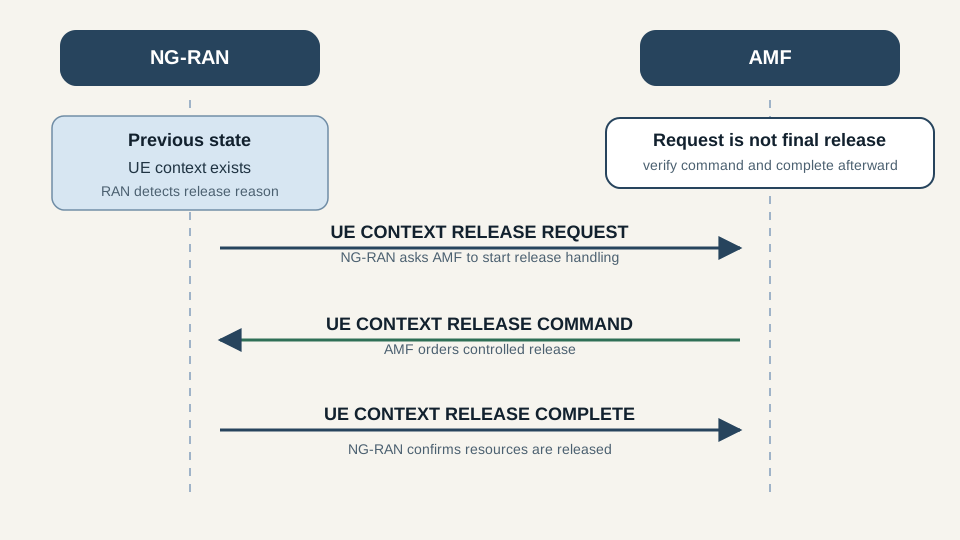
NG-RAN detects a reason to release the UE-associated NGAP context, such as radio connection loss, inactivity, local RAN decision, protocol issue, or transport/resource problem.
Main purpose
Informs AMF that NG-RAN wants release of a UE-associated NGAP context, provides the mandatory release cause, can report affected PDU session resources, can include location or RAN context information, and triggers AMF-controlled release cleanup.
What is UE Context Release Request in simple terms?
UE Context Release Request is the NGAP message sent by the NG-RAN node to the AMF when the RAN side requests release of a UE-associated NGAP context.
Informs AMF that NG-RAN wants release of a UE-associated NGAP context, provides the mandatory release cause, can report affected PDU session resources, can include location or RAN context information, and triggers AMF-controlled release cleanup.
Why this message matters
UE Context Release Request is the gNB asking the AMF to release a UE context, with Cause explaining why. The AMF still has to command the release afterward.
Call flow position: NG-RAN sends this initiatingMessage when it wants AMF to start release handling for an existing UE-associated NGAP context.
Typical state: The UE context still exists; NG-RAN is asking AMF to decide and command the controlled release sequence.
Preconditions:
AMF UE NGAP ID and RAN UE NGAP ID identify a live UE-associated NGAP context.
NG-RAN has a release reason available in the Cause IE.
Optional PDU session, location, PSCell, or RAN node context may be available.
Next likely message: UE Context Release Command
Cause-driven release escalation
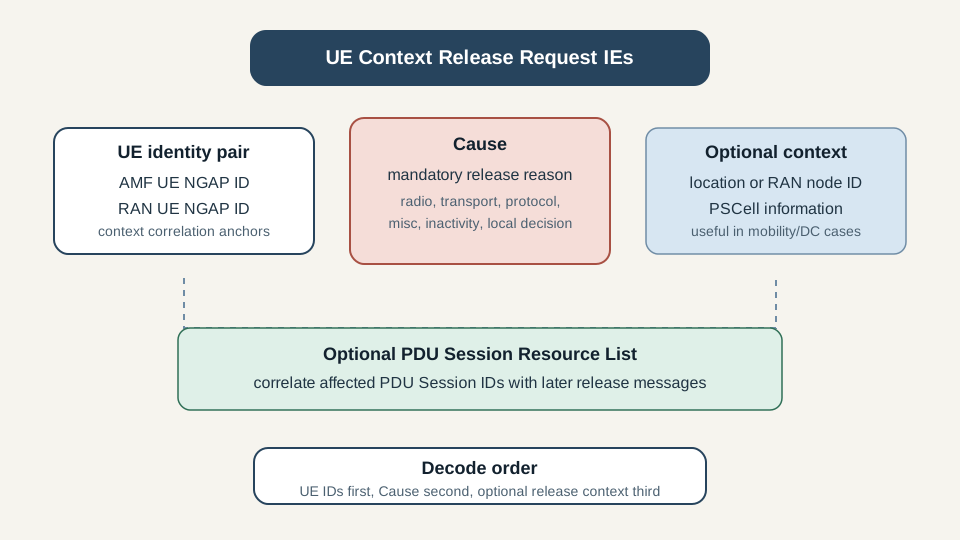
Decode branch: Cause is mandatory and drives troubleshooting, while optional fields add PDU session, location, secondary-cell, or RAN node context.
Call flow position: The request carries the reason NG-RAN wants release, allowing AMF to interpret whether the trigger is radio, transport, protocol, local RAN, inactivity, or another cause category.
Typical state: The cause determines how engineers should interpret the release request and what AMF should clean up next.
Preconditions:
Cause IE is present and decoded.
The cause is correlated with the immediately preceding radio, mobility, or transport events.
Next likely message: UE Context Release Command followed by UE Context Release Complete
Release request with PDU session impact
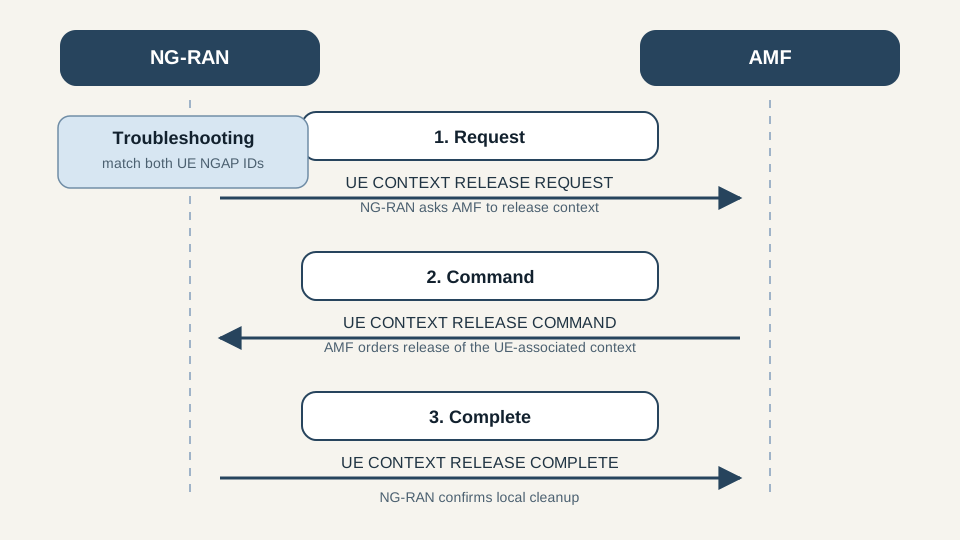
Sequence branch: request asks for release, command orders release, and complete confirms local cleanup.
Call flow position: The request may include PDU session resource information so AMF and SMF can understand which session resources are affected by the requested context release.
Typical state: UE context release may affect one or more PDU session resources, but session cleanup is completed through AMF-controlled follow-up.
Preconditions:
One or more PDU session resources may exist for the UE context.
PDU Session Resource List is present when NG-RAN reports affected session resources.
Next likely message: AMF-controlled release and related PDU session cleanup handling
Call flow position
Previous message(s): Existing UE-associated NGAP context, NG-RAN detects a reason to release the UE context
Transport / encapsulation: NGAP over SCTP/IP between NG-RAN and AMF
Security context: The message assumes an existing UE-associated NGAP context. It requests AMF-side release handling and does not by itself complete teardown of the UE context.
Message Structure Overview
UE Context Release Request is an NG-RAN-to-AMF initiatingMessage in UE Context Management.
It requests release handling but does not complete the UE context release by itself.
AMF UE NGAP ID and RAN UE NGAP ID identify the UE-associated NGAP context.
Cause is mandatory and explains why NG-RAN is asking AMF to release the context.
Optional PDU Session Resource List, User Location Information, PSCell Information, and Global RAN Node ID add context for AMF-side cleanup.
The normal follow-up is UE Context Release Command and then UE Context Release Complete.
ASN.1 for 5G NGAP - UE Context Release Request
UEContextReleaseRequest ::= SEQUENCE {
  protocolIEs ProtocolIE-Container { {UEContextReleaseRequest-IEs} },
  ...
}

UEContextReleaseRequest-IEs NGAP-PROTOCOL-IES ::= {
  { ID id-AMF-UE-NGAP-ID              CRITICALITY reject TYPE AMF-UE-NGAP-ID              PRESENCE mandatory } |
  { ID id-RAN-UE-NGAP-ID              CRITICALITY reject TYPE RAN-UE-NGAP-ID              PRESENCE mandatory } |
  { ID id-PDUSessionResourceList      CRITICALITY ignore TYPE PDUSessionResourceList      PRESENCE optional  } |
  { ID id-Cause                       CRITICALITY ignore TYPE Cause                       PRESENCE mandatory } |
  { ID id-UserLocationInformation     CRITICALITY ignore TYPE UserLocationInformation     PRESENCE optional  } |
  { ID id-PSCellInformation           CRITICALITY ignore TYPE PSCellInformation           PRESENCE optional  } |
  { ID id-GlobalRANNodeID             CRITICALITY ignore TYPE GlobalRANNodeID             PRESENCE optional  },
  ...
}
How to read this ASN.1
Decode AMF UE NGAP ID and RAN UE NGAP ID first, then read Cause before optional context. The request is best understood as a RAN-triggered release reason plus identity correlation, not as proof that the context has already been released.
5G NGAP - UE Context Release Request - Example Dump
Treat this as a teaching example based on the spec structure, not as a captured network trace.
The Cause IE explains why NG-RAN requests release; it should be decoded before optional context is interpreted.
The request does not release the context immediately. Look for UE Context Release Command and UE Context Release Complete.
If PDU Session Resource List is present, correlate those sessions with later release or cleanup messages.
Important Information Elements
IE
Presence
Description
Message Type
Mandatory
Identifies the NGAP PDU as UE CONTEXT RELEASE REQUEST.
AMF UE NGAP ID
Mandatory
Mandatory AMF-side UE identifier used to bind the release request to the correct UE-associated NGAP context.
RAN UE NGAP ID
Mandatory
Mandatory NG-RAN-side UE identifier used to identify the radio-side UE context requesting release.
PDU Session Resource List
Optional
Optional PDU session resources associated with the release request, useful for AMF and SMF handling of affected sessions.
Cause
Mandatory
Mandatory reason why NG-RAN requests release. This is the most important troubleshooting field.
User Location Information
Optional
Optional latest UE location context at the time NG-RAN requests release.
PSCell Information
Optional
Optional secondary-cell context relevant when dual connectivity or secondary-cell behavior contributes to the release trigger.
Global RAN Node ID
Optional
Optional RAN node identity context for the release request.
Detailed field explanation
Message Type
Identifies the NGAP PDU as UE CONTEXT RELEASE REQUEST.
Presence: Mandatory
In practice: In practice, compare this field with the original request and with any later release-dependent optional fields so you can see whether the network accepted the same service model the UE asked for.
AMF UE NGAP ID
Mandatory AMF-side UE identifier used to bind the release request to the correct UE-associated NGAP context.
Presence: Mandatory
In practice: In practice, compare this field with the original request and with any later release-dependent optional fields so you can see whether the network accepted the same service model the UE asked for.
RAN UE NGAP ID
Mandatory NG-RAN-side UE identifier used to identify the radio-side UE context requesting release.
Presence: Mandatory
In practice: In practice, compare this field with the original request and with any later release-dependent optional fields so you can see whether the network accepted the same service model the UE asked for.
PDU Session Resource List
Optional PDU session resources associated with the release request, useful for AMF and SMF handling of affected sessions.
Presence: Optional
In practice: In practice, compare this field with the original request and with any later release-dependent optional fields so you can see whether the network accepted the same service model the UE asked for.
Cause
Mandatory reason why NG-RAN requests release. This is the most important troubleshooting field.
Presence: Mandatory
In practice: In practice, compare this field with the original request and with any later release-dependent optional fields so you can see whether the network accepted the same service model the UE asked for.
User Location Information
Optional latest UE location context at the time NG-RAN requests release.
Presence: Optional
In practice: In practice, compare this field with the original request and with any later release-dependent optional fields so you can see whether the network accepted the same service model the UE asked for.
PSCell Information
Optional secondary-cell context relevant when dual connectivity or secondary-cell behavior contributes to the release trigger.
Presence: Optional
In practice: In practice, compare this field with the original request and with any later release-dependent optional fields so you can see whether the network accepted the same service model the UE asked for.
Global RAN Node ID
Optional RAN node identity context for the release request.
Presence: Optional
In practice: In practice, compare this field with the original request and with any later release-dependent optional fields so you can see whether the network accepted the same service model the UE asked for.
What to check in logs and traces
Confirm the message direction is NG-RAN node to AMF.
Match AMF UE NGAP ID and RAN UE NGAP ID to the active UE context.
Decode Cause before drawing conclusions about the release trigger.
Check PDU Session Resource List when present.
Inspect User Location Information, PSCell Information, and Global RAN Node ID when present.
Verify AMF follows with UE Context Release Command.
Verify NG-RAN eventually sends UE Context Release Complete.
Common Issues and Troubleshooting
The UE context appears to be treated as released immediately after the request.
Likely cause: The request is being confused with the AMF-controlled release command and completion steps.
What to inspect: Check whether UE Context Release Command and UE Context Release Complete occur after the request for the same UE IDs.
Next step: Use the request as the trigger, then validate the command/complete sequence before declaring release complete.
The reason for release is unclear.
Likely cause: The Cause IE may have been ignored or decoded too late.
What to inspect: Decode Cause first and correlate it with preceding radio, transport, handover, inactivity, or protocol events.
Next step: Use the cause category to focus the root-cause path before analyzing optional fields.
Wrong UE is associated with the release request during a mass event.
Likely cause: AMF UE NGAP ID and RAN UE NGAP ID correlation may be stale or mixed across simultaneous releases.
What to inspect: Rebuild the UE identity timeline and compare both identifiers across prior context setup, modification, and release signaling.
Next step: Fix UE ID correlation before interpreting the cause or PDU session impact.
PDU sessions look unexpectedly affected after UE context release.
Likely cause: The request may include PDU Session Resource List, or the later AMF-controlled release flow may clean up sessions associated with the context.
What to inspect: Check PDU Session Resource List in the request and correlate those PDU Session IDs with later release command and complete messages.
Next step: Troubleshoot affected sessions by PDU Session ID rather than only by UE context ID.
Dual-connectivity context seems related to release but is missed.
Likely cause: PSCell Information may be present and overlooked.
What to inspect: Decode PSCell Information and compare it with secondary-cell or dual-connectivity events immediately before the request.
Next step: Include PSCell context in the release trigger analysis.
LTE / 5G / Variant Comparison
Compared with UE Context Release Command
Release Request is NG-RAN asking AMF to release. Release Command is AMF ordering NG-RAN to perform the release.
Compared with UE Context Release Complete
Release Complete confirms the context has been released. Release Request only starts the AMF-controlled release path.
Compared with Error Indication
Error Indication reports protocol or processing problems. UE Context Release Request asks for controlled release of the UE-associated context with a specific cause.
FAQ
What is UE Context Release Request in NGAP?
It is the NG-RAN-to-AMF message used when NG-RAN requests AMF-side release handling for a UE-associated NGAP context.
Who sends UE Context Release Request?
The NG-RAN node sends UE Context Release Request to the AMF.
Does this message release the UE context immediately?
No. It requests release handling. AMF normally follows with UE Context Release Command, and NG-RAN confirms with UE Context Release Complete.
What is the response to UE Context Release Request?
The normal follow-up is UE Context Release Command from AMF to NG-RAN, followed by UE Context Release Complete from NG-RAN to AMF.
What does the Cause IE mean?
Cause explains why NG-RAN is requesting release, such as radio, transport, protocol, inactivity, or local RAN reasons.
Can this message include PDU session information?
Yes. PDU Session Resource List is optional and identifies PDU session resources associated with the release request.
What is the difference between Release Request and Release Command?
Release Request is NG-RAN asking AMF to release the context. Release Command is AMF ordering NG-RAN to release it.
How do you troubleshoot UE Context Release Request?
Match both UE NGAP IDs, decode Cause first, inspect optional PDU session and location context, then verify the later Release Command and Release Complete.
Decode this message with the 3GPP Decoder, inspect the related message database, or open the matching call flow to see where this signaling step fits in the full procedure.