UE Radio Capability Check Request is the NGAP message sent by the AMF to the NG-RAN node to ask whether UE radio capability information is compatible with NG-RAN handling.
Message Fact Sheet
Protocol
ngap
Network
5g
Spec
3GPP TS 38.413
Spec Section
Clause 9.2.13.2 and UE Radio Capability Management messages (Release 18 baseline)
AMF has UE radio capability information or a related capability context and needs NG-RAN to check whether it is compatible with radio-side handling.
Main purpose
Requests NG-RAN-side UE radio capability checking, helps determine whether the UE capability can be supported, coordinates AMF and NG-RAN capability handling, and enables a clear compatibility result in UE Radio Capability Check Response.
Main specification
3GPP TS 38.413, Clause 9.2.13.2 and UE Radio Capability Management messages (Release 18 baseline)
Release added
Release 15
Procedures where used
UE Radio Capability Check, UE Radio Capability Management, Capability compatibility validation, AMF and NG-RAN capability coordination
What is UE Radio Capability Check Request in simple terms?
UE Radio Capability Check Request is the NGAP message sent by the AMF to the NG-RAN node to ask whether UE radio capability information is compatible with NG-RAN handling.
Requests NG-RAN-side UE radio capability checking, helps determine whether the UE capability can be supported, coordinates AMF and NG-RAN capability handling, and enables a clear compatibility result in UE Radio Capability Check Response.
Why this message matters
UE Radio Capability Check Request is the AMF asking the gNB to check whether a UE radio capability can be supported. The answer comes in UE Radio Capability Check Response.
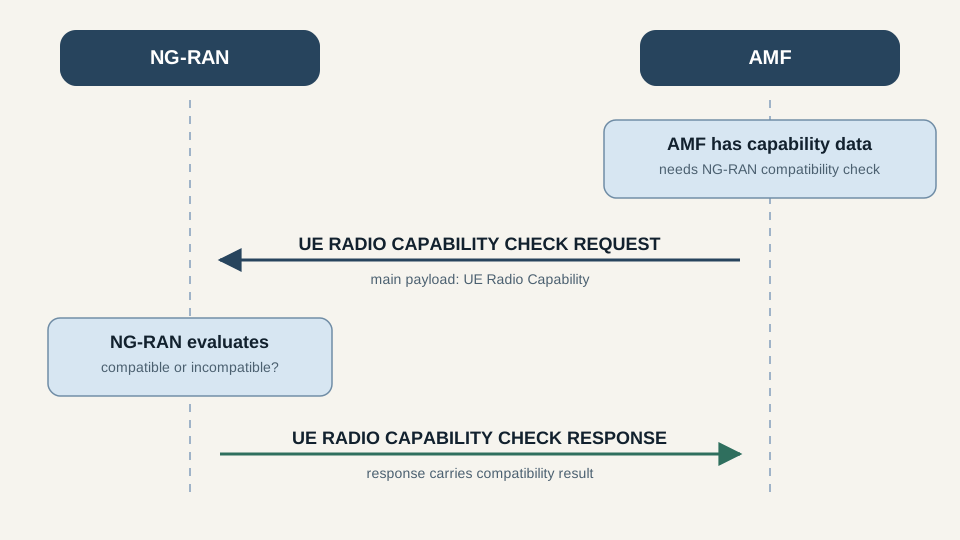
Where this message appears in the call flow
UE Radio Capability Check
Check branch: AMF sends the capability payload and NG-RAN returns the compatibility result.
Call flow position: AMF sends this initiatingMessage to ask NG-RAN to evaluate UE radio capability compatibility.
Typical state: NG-RAN evaluates the provided UE Radio Capability IE and returns the result in UE Radio Capability Check Response.
Preconditions:
AMF UE NGAP ID and RAN UE NGAP ID identify the UE-associated NGAP context.
AMF has UE Radio Capability information to check.
NG-RAN is expected to evaluate radio-side compatibility.
Next likely message: UE Radio Capability Check Response
Capability compatibility decision
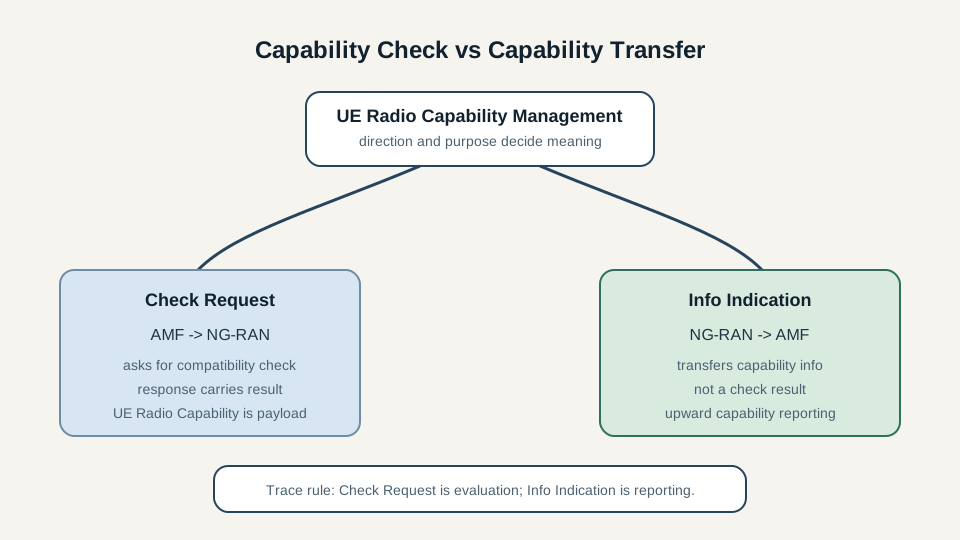
Direction distinction: Info Indication transfers capability upward, while Check Request asks NG-RAN to evaluate compatibility.
Call flow position: The request gives NG-RAN the capability payload that must be judged against supported radio configuration.
Typical state: The response determines whether capability handling can continue as compatible or requires fallback.
Preconditions:
UE Radio Capability IE is present and decodable.
NG-RAN has enough local support information to decide compatibility.
Next likely message: Compatible or incompatible result in response
Transport / encapsulation: NGAP over SCTP/IP between AMF and NG-RAN
Security context: The message carries UE radio capability information for NG-RAN compatibility evaluation. It does not itself transfer newly collected capability information from NG-RAN to AMF.
Message Structure Overview
UE Radio Capability Check Request is an AMF-to-NG-RAN initiatingMessage in UE Radio Capability Management.
AMF UE NGAP ID and RAN UE NGAP ID identify the UE-associated context.
UE Radio Capability is mandatory and is the main payload.
NG-RAN evaluates compatibility and responds with UE Radio Capability Check Response.
The message requests capability checking; it is not UE Radio Capability Info Indication and not ID Mapping.
ASN.1 for 5G NGAP - UE Radio Capability Check Request
UERadioCapabilityCheckRequest ::= SEQUENCE {
  protocolIEs ProtocolIE-Container { {UERadioCapabilityCheckRequest-IEs} },
  ...
}

UERadioCapabilityCheckRequest-IEs NGAP-PROTOCOL-IES ::= {
  { ID id-AMF-UE-NGAP-ID        CRITICALITY reject TYPE AMF-UE-NGAP-ID        PRESENCE mandatory } |
  { ID id-RAN-UE-NGAP-ID        CRITICALITY reject TYPE RAN-UE-NGAP-ID        PRESENCE mandatory } |
  { ID id-UERadioCapability     CRITICALITY reject TYPE UERadioCapability     PRESENCE mandatory },
  ...
}
How to read this ASN.1
Decode both UE identifiers first, then inspect UE Radio Capability as the main payload. The response, not the request, carries the final compatibility result.
5G NGAP - UE Radio Capability Check Request - Example Dump
Treat this as a teaching example based on the expected message structure, not as a captured network trace.
The UE Radio Capability IE is the key payload.
The request asks NG-RAN to check compatibility; look for UE Radio Capability Check Response for the result.
Do not confuse this with UE Radio Capability Info Indication, which transfers capability information upward.
Important Information Elements
IE
Presence
Description
Message Type
Mandatory
Identifies the NGAP PDU as UE RADIO CAPABILITY CHECK REQUEST.
AMF UE NGAP ID
Mandatory
Mandatory AMF-side UE identifier used to bind the request to the correct UE-associated NGAP context.
RAN UE NGAP ID
Mandatory
Mandatory NG-RAN-side UE identifier used to identify the radio-side UE context that should evaluate capability compatibility.
UE Radio Capability
Mandatory
Mandatory UE radio capability information that NG-RAN checks and reports on in UE Radio Capability Check Response.
Detailed field explanation
Message Type
Identifies the NGAP PDU as UE RADIO CAPABILITY CHECK REQUEST.
Presence: Mandatory
In practice: In practice, compare this field with the original request and with any later release-dependent optional fields so you can see whether the network accepted the same service model the UE asked for.
AMF UE NGAP ID
Mandatory AMF-side UE identifier used to bind the request to the correct UE-associated NGAP context.
Presence: Mandatory
In practice: In practice, compare this field with the original request and with any later release-dependent optional fields so you can see whether the network accepted the same service model the UE asked for.
RAN UE NGAP ID
Mandatory NG-RAN-side UE identifier used to identify the radio-side UE context that should evaluate capability compatibility.
Presence: Mandatory
In practice: In practice, compare this field with the original request and with any later release-dependent optional fields so you can see whether the network accepted the same service model the UE asked for.
UE Radio Capability
Mandatory UE radio capability information that NG-RAN checks and reports on in UE Radio Capability Check Response.
Presence: Mandatory
In practice: In practice, compare this field with the original request and with any later release-dependent optional fields so you can see whether the network accepted the same service model the UE asked for.
What to check in logs and traces
Confirm direction is AMF to NG-RAN node.
Match AMF UE NGAP ID and RAN UE NGAP ID to the active UE context.
Verify UE Radio Capability IE is present.
Confirm NG-RAN returns UE Radio Capability Check Response.
Decode compatibility result from the response.
Do not confuse the procedure with Info Indication or ID Mapping.
Common Issues and Troubleshooting
NG-RAN cannot evaluate the request.
Likely cause: UE Radio Capability IE may be missing, malformed, unsupported, or inconsistent with the active UE context.
What to inspect: Check the presence and decode of UE Radio Capability and confirm UE ID correlation.
Next step: Fix the capability payload or context mapping before retrying the check.
Trace is interpreted as capability transfer rather than compatibility checking.
Likely cause: UE Radio Capability Check Request is being confused with UE Radio Capability Info Indication.
What to inspect: Check direction and procedure: AMF-to-NG-RAN Check Request versus NG-RAN-to-AMF Info Indication.
Next step: Use the Check Response for compatibility result; use Info Indication for capability transfer analysis.
Compatibility result is missing.
Likely cause: UE Radio Capability Check Response may be absent, dropped, or correlated with a different UE context.
What to inspect: Search for UE Radio Capability Check Response with matching AMF UE NGAP ID and RAN UE NGAP ID.
Next step: Do not infer compatibility from the request alone.
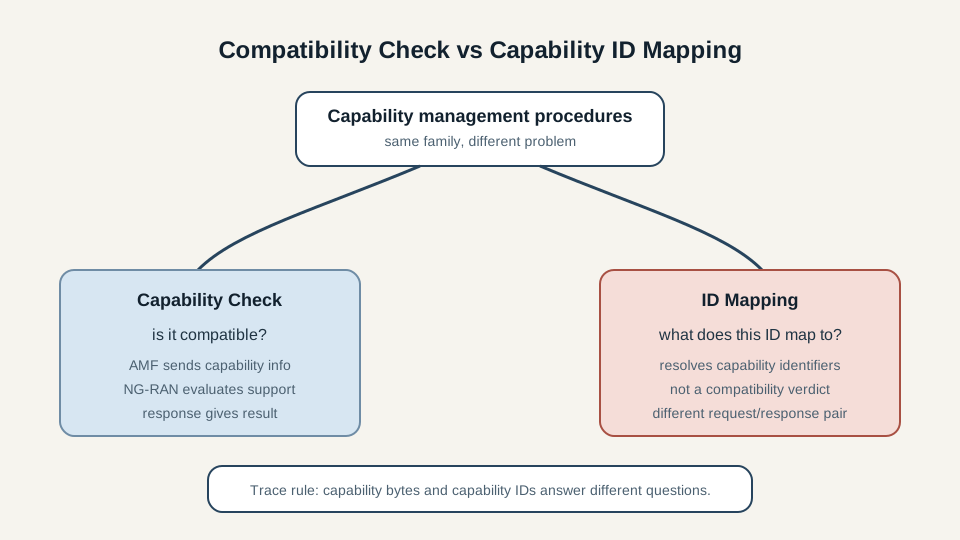
Capability check is confused with capability ID mapping.
Likely cause: Both procedures belong to UE Radio Capability Management but solve different problems.
What to inspect: Check whether the message carries UE Radio Capability information or radio capability ID mapping information.
Next step: Analyze Check Request/Response for compatibility and ID Mapping Request/Response for identifier resolution.
Wrong UE capability appears to be checked.
Likely cause: AMF UE NGAP ID and RAN UE NGAP ID correlation may be stale after setup, modification, or mobility.
What to inspect: Rebuild UE identity continuity before and after the capability check.
Next step: Fix UE context correlation before judging the compatibility outcome.
LTE / 5G / Variant Comparison
Compared with UE Radio Capability Check Response
Check Request asks NG-RAN to evaluate capability compatibility. Check Response reports the result.
Compared with UE Radio Capability Info Indication
Info Indication transfers UE radio capability information from NG-RAN to AMF. Check Request asks NG-RAN to evaluate capability compatibility.
Compared with UE Radio Capability ID Mapping
Check Request verifies compatibility. ID Mapping resolves or maps UE Radio Capability IDs.
FAQ
What is UE Radio Capability Check Request in NGAP?
It is the AMF-to-NG-RAN message used to ask NG-RAN to check whether UE radio capability information is compatible with radio-side handling.
Who sends UE Radio Capability Check Request?
The AMF sends UE Radio Capability Check Request to the NG-RAN node.
What does this message check?
It asks NG-RAN to evaluate the UE Radio Capability IE and determine whether the capability is compatible.
What is the response to UE Radio Capability Check Request?
NG-RAN responds with UE Radio Capability Check Response.
Is this the same as UE Radio Capability Info Indication?
No. Info Indication transfers UE radio capability information from NG-RAN to AMF, while Check Request asks NG-RAN to perform a compatibility check.
What is the UE Radio Capability IE?
It is the encoded UE radio capability information that NG-RAN evaluates in the check procedure.
How is capability check different from capability ID mapping?
Capability check verifies support or compatibility. Capability ID mapping resolves or maps UE Radio Capability IDs.
How do you troubleshoot UE Radio Capability Check Request?
Match both UE NGAP IDs, confirm UE Radio Capability is present and decodable, find the Check Response, and avoid mixing the procedure with Info Indication or ID Mapping.
Decode this message with the 3GPP Decoder, inspect the related message database, or open the matching call flow to see where this signaling step fits in the full procedure.