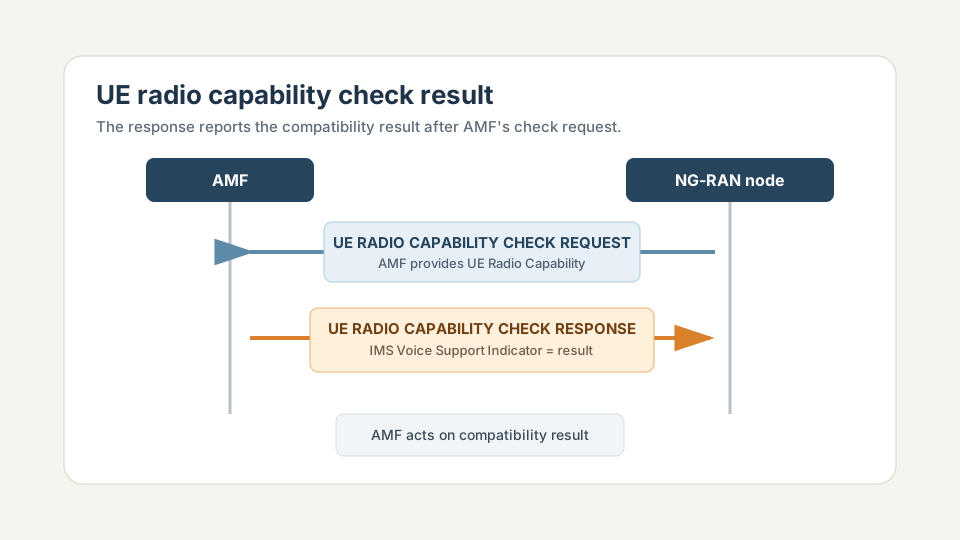
UE Radio Capability Check Response is the NGAP message sent by the NG-RAN node to the AMF to report the compatibility result after a UE Radio Capability Check Request.
Message Fact Sheet
Protocol
ngap
Network
5g
Spec
3GPP TS 38.413
Spec Section
UE Radio Capability Management messages and UE Radio Capability Check Response (Release 18 baseline)
NG-RAN has processed a UE Radio Capability Check Request from the AMF and reports the resulting IMS voice support compatibility indication.
Main purpose
Reports whether the UE radio capability context checked by NG-RAN is compatible, completes the UE Radio Capability Check procedure, helps AMF decide further UE handling, and separates compatibility result reporting from capability transfer.
Main specification
3GPP TS 38.413, UE Radio Capability Management messages and UE Radio Capability Check Response (Release 18 baseline)
Release added
Release 15
Procedures where used
UE Radio Capability Check, UE Radio Capability Management, IMS voice support compatibility reporting, AMF and NG-RAN capability coordination
What is UE Radio Capability Check Response in simple terms?
UE Radio Capability Check Response is the NGAP message sent by the NG-RAN node to the AMF to report the compatibility result after a UE Radio Capability Check Request.
Reports whether the UE radio capability context checked by NG-RAN is compatible, completes the UE Radio Capability Check procedure, helps AMF decide further UE handling, and separates compatibility result reporting from capability transfer.
Why this message matters
UE Radio Capability Check Response is the gNB's answer to AMF's capability check. The main thing to read is the IMS Voice Support Indicator.
Where this message appears in the call flow
UE Radio Capability Check
Response branch: NG-RAN evaluates the request and returns the IMS voice support compatibility result.
Call flow position: NG-RAN sends this successfulOutcome after evaluating the UE Radio Capability supplied by the AMF.
Typical state: AMF receives the compatibility result and can update UE capability handling.
Preconditions:
A matching UE Radio Capability Check Request was sent by the AMF.
AMF UE NGAP ID and RAN UE NGAP ID identify the same UE-associated NGAP context.
NG-RAN evaluated the UE radio capability context.
Next likely message: AMF-side capability handling or later UE context procedures
IMS voice support compatibility
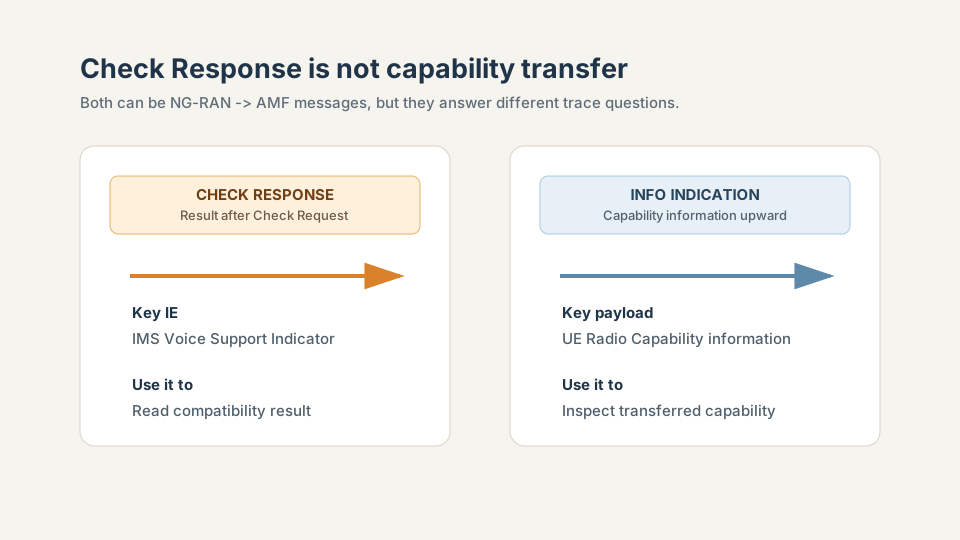
Do not treat Check Response as full capability transfer. It reports the result of a prior check.
Call flow position: The response carries the mandatory IMS Voice Support Indicator as the practical result field.
Typical state: AMF uses the indicator to understand IMS voice over PS support for the checked UE/capability context.
Preconditions:
The response is decoded as UE Radio Capability Check Response, not Info Indication.
The IMS Voice Support Indicator is present and interpreted correctly.
Next likely message: Capability-dependent AMF decision
Capability management distinction
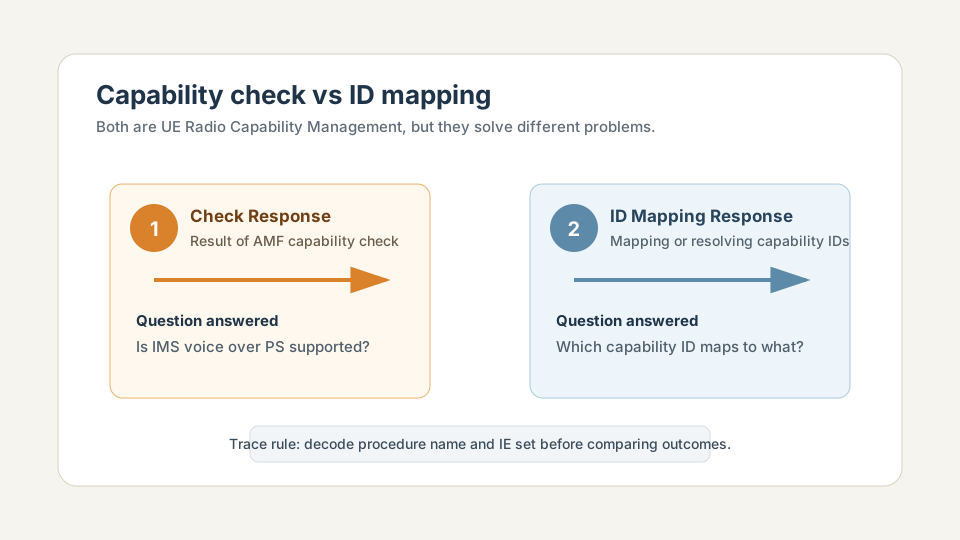
Capability check reports compatibility. ID mapping resolves or maps UE Radio Capability IDs.
Call flow position: The response reports a compatibility result and should not be treated as full capability transfer or capability ID mapping.
Typical state: Trace analysis separates Check Response from UE Radio Capability Info Indication and UE Radio Capability ID Mapping Response.
Preconditions:
Procedure name, direction, and IE set are checked before drawing conclusions.
Next likely message: Correct procedure-specific analysis
Transport / encapsulation: NGAP over SCTP/IP between NG-RAN and AMF
Security context: The message reports the compatibility result for a UE radio capability check. It does not carry the full UE radio capability payload.
Message Structure Overview
UE Radio Capability Check Response is an NG-RAN-to-AMF successfulOutcome in UE Radio Capability Management.
AMF UE NGAP ID and RAN UE NGAP ID correlate the response with the request and UE context.
IMS Voice Support Indicator is mandatory and is the key compatibility result field.
Criticality Diagnostics may appear when protocol-level diagnostics are needed.
The response reports a result; it does not transfer the full UE radio capability payload.
ASN.1 for 5G NGAP - UE Radio Capability Check Response
UERadioCapabilityCheckResponse ::= SEQUENCE {
  protocolIEs ProtocolIE-Container { {UERadioCapabilityCheckResponse-IEs} },
  ...
}

UERadioCapabilityCheckResponse-IEs NGAP-PROTOCOL-IES ::= {
  { ID id-AMF-UE-NGAP-ID              CRITICALITY reject TYPE AMF-UE-NGAP-ID              PRESENCE mandatory } |
  { ID id-RAN-UE-NGAP-ID              CRITICALITY reject TYPE RAN-UE-NGAP-ID              PRESENCE mandatory } |
  { ID id-IMSVoiceSupportIndicator    CRITICALITY reject TYPE IMSVoiceSupportIndicator    PRESENCE mandatory } |
  { ID id-CriticalityDiagnostics      CRITICALITY ignore TYPE CriticalityDiagnostics      PRESENCE optional },
  ...
}
How to read this ASN.1
Decode both UE identifiers first, then inspect IMS Voice Support Indicator as the main check result. Do not expect the response to repeat the full UE Radio Capability payload from the request.
5G NGAP - UE Radio Capability Check Response - Example Dump
Treat this as a teaching example based on the expected message structure, not as a captured network trace.
IMS Voice Support Indicator is the key result field.
The response completes a matching UE Radio Capability Check Request.
Do not look for the full UE radio capability payload in this response.
Important Information Elements
IE
Presence
Description
Message Type
Mandatory
Identifies the NGAP PDU as UE RADIO CAPABILITY CHECK RESPONSE.
AMF UE NGAP ID
Mandatory
Mandatory AMF-side UE identifier used to correlate the response with the earlier check request.
RAN UE NGAP ID
Mandatory
Mandatory NG-RAN-side UE identifier used to bind the response to the radio-side UE context.
IMS Voice Support Indicator
Mandatory
Mandatory result field indicating NG-RAN support for IMS voice over PS for the checked UE radio capability context.
Criticality Diagnostics
Optional
Optional diagnostics for protocol-level IE handling or criticality behavior.
Detailed field explanation
Message Type
Identifies the NGAP PDU as UE RADIO CAPABILITY CHECK RESPONSE.
Presence: Mandatory
In practice: In practice, compare this field with the original request and with any later release-dependent optional fields so you can see whether the network accepted the same service model the UE asked for.
AMF UE NGAP ID
Mandatory AMF-side UE identifier used to correlate the response with the earlier check request.
Presence: Mandatory
In practice: In practice, compare this field with the original request and with any later release-dependent optional fields so you can see whether the network accepted the same service model the UE asked for.
RAN UE NGAP ID
Mandatory NG-RAN-side UE identifier used to bind the response to the radio-side UE context.
Presence: Mandatory
In practice: In practice, compare this field with the original request and with any later release-dependent optional fields so you can see whether the network accepted the same service model the UE asked for.
IMS Voice Support Indicator
Mandatory result field indicating NG-RAN support for IMS voice over PS for the checked UE radio capability context.
Presence: Mandatory
In practice: In practice, compare this field with the original request and with any later release-dependent optional fields so you can see whether the network accepted the same service model the UE asked for.
Criticality Diagnostics
Optional diagnostics for protocol-level IE handling or criticality behavior.
Presence: Optional
In practice: In practice, compare this field with the original request and with any later release-dependent optional fields so you can see whether the network accepted the same service model the UE asked for.
What to check in logs and traces
Confirm the response follows a matching UE Radio Capability Check Request.
Confirm direction is NG-RAN node to AMF.
Match AMF UE NGAP ID and RAN UE NGAP ID to the request.
Decode IMS Voice Support Indicator correctly.
Check Criticality Diagnostics if present.
Do not confuse this response with UE Radio Capability Info Indication or ID Mapping Response.
Common Issues and Troubleshooting
The trace appears to lack the UE radio capability payload.
Likely cause: UE Radio Capability Check Response reports a result and does not carry the full UE radio capability information.
What to inspect: Find the preceding UE Radio Capability Check Request for the capability payload.
Next step: Use the response for IMS voice support compatibility and the request for the checked capability content.
Compatibility result is unclear.
Likely cause: IMS Voice Support Indicator may be missing from the decode view or interpreted as a generic optional field.
What to inspect: Decode id-IMSVoiceSupportIndicator and confirm its supported or not-supported value.
Next step: Treat this IE as the main result of the check procedure.
Response cannot be correlated with a request.
Likely cause: AMF UE NGAP ID or RAN UE NGAP ID mapping may be wrong, stale, or mixed with another UE.
What to inspect: Match both UE identifiers to the earlier UE Radio Capability Check Request.
Next step: Rebuild UE context continuity before judging the check result.
Message is mistaken for capability transfer.
Likely cause: UE Radio Capability Check Response is being confused with UE Radio Capability Info Indication.
What to inspect: Check direction and IE set: Check Response is NG-RAN-to-AMF with IMS Voice Support Indicator.
Next step: Use Info Indication for capability transfer analysis and Check Response for compatibility result analysis.
Message is mistaken for capability ID mapping.
Likely cause: UE Radio Capability Management procedures are being grouped together without checking the procedure name.
What to inspect: Compare procedure code and expected IEs against UE Radio Capability ID Mapping Response.
Next step: Analyze ID Mapping Response for identifier resolution and Check Response for compatibility reporting.
LTE / 5G / Variant Comparison
Compared with UE Radio Capability Check Request
Check Request asks NG-RAN to evaluate UE radio capability. Check Response returns the compatibility result.
Compared with UE Radio Capability Info Indication
Info Indication transfers UE radio capability information from NG-RAN to AMF. Check Response reports the result of an AMF-requested compatibility check.
Compared with UE Radio Capability ID Mapping Response
Check Response reports compatibility, especially IMS voice support. ID Mapping Response resolves or maps UE Radio Capability IDs.
FAQ
What is UE Radio Capability Check Response in NGAP?
It is the NG-RAN-to-AMF response message used to report the result of a UE Radio Capability Check Request.
Who sends UE Radio Capability Check Response?
The NG-RAN node sends UE Radio Capability Check Response to the AMF.
What message triggers this response?
It is triggered by a preceding UE Radio Capability Check Request from the AMF.
What does IMS Voice Support Indicator mean?
It indicates whether IMS voice over PS is supported for the UE radio capability context evaluated by NG-RAN.
Does this message carry full UE radio capability?
No. The full UE radio capability is carried in the check request or related capability-transfer procedures. The response carries the result.
How is it different from UE Radio Capability Info Indication?
Info Indication transfers UE radio capability information from NG-RAN to AMF. Check Response reports the result of an AMF-requested compatibility check.
How is it different from UE Radio Capability ID Mapping Response?
ID Mapping Response resolves or maps UE Radio Capability IDs. Check Response reports compatibility, especially the IMS voice support result.
How do you troubleshoot UE Radio Capability Check Response?
Match it to the preceding Check Request using both UE NGAP IDs, decode IMS Voice Support Indicator, inspect Criticality Diagnostics if present, and avoid confusing it with Info Indication or ID Mapping Response.
Decode this message with the 3GPP Decoder, inspect the related message database, or open the matching call flow to see where this signaling step fits in the full procedure.