UE Radio Capability ID Mapping Request is the NGAP message sent by the AMF to the NG-RAN node to request mapping or resolution of a UE Radio Capability ID.
Message Fact Sheet
Protocol
ngap
Network
5g
Spec
3GPP TS 38.413
Spec Section
UE Radio Capability Management messages and UE Radio Capability ID Mapping Request (Release 18 baseline)
AMF has or receives a UE Radio Capability ID and needs NG-RAN-side mapping or resolution before using the capability context.
Main purpose
Asks NG-RAN to map or resolve a UE Radio Capability ID, avoids unnecessary full capability transfer, supports capability caching and optimization, aligns AMF and NG-RAN on capability identity, and supports later UE context and mobility decisions.
Main specification
3GPP TS 38.413, UE Radio Capability Management messages and UE Radio Capability ID Mapping Request (Release 18 baseline)
Release added
Release 15
Procedures where used
UE Radio Capability ID Mapping, UE Radio Capability Management, Capability caching and optimization, AMF and NG-RAN capability identity alignment
What is UE Radio Capability ID Mapping Request in simple terms?
UE Radio Capability ID Mapping Request is the NGAP message sent by the AMF to the NG-RAN node to request mapping or resolution of a UE Radio Capability ID.
Asks NG-RAN to map or resolve a UE Radio Capability ID, avoids unnecessary full capability transfer, supports capability caching and optimization, aligns AMF and NG-RAN on capability identity, and supports later UE context and mobility decisions.
Why this message matters
UE Radio Capability ID Mapping Request is the AMF asking the gNB to resolve a capability identifier instead of sending or checking the full capability payload.
Where this message appears in the call flow
UE Radio Capability ID Mapping
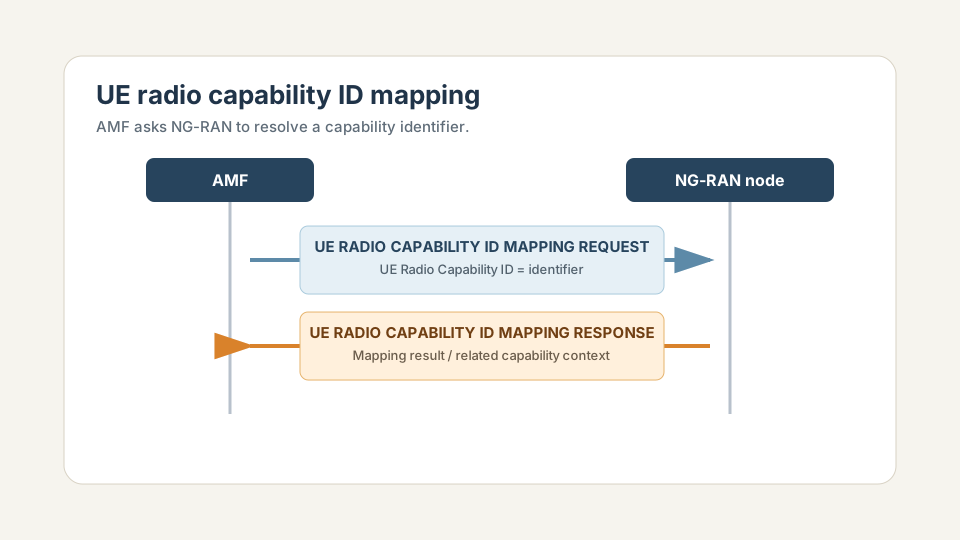
Mapping branch: AMF sends the capability ID and NG-RAN returns the mapping result.
Call flow position: AMF sends this initiatingMessage to ask NG-RAN to map or resolve a UE Radio Capability ID.
Typical state: NG-RAN processes the capability identifier and returns UE Radio Capability ID Mapping Response.
Preconditions:
AMF UE NGAP ID and RAN UE NGAP ID identify the UE-associated NGAP context.
UE Radio Capability ID is present.
AMF needs NG-RAN-side mapping or resolution.
Next likely message: UE Radio Capability ID Mapping Response
Capability ID optimization
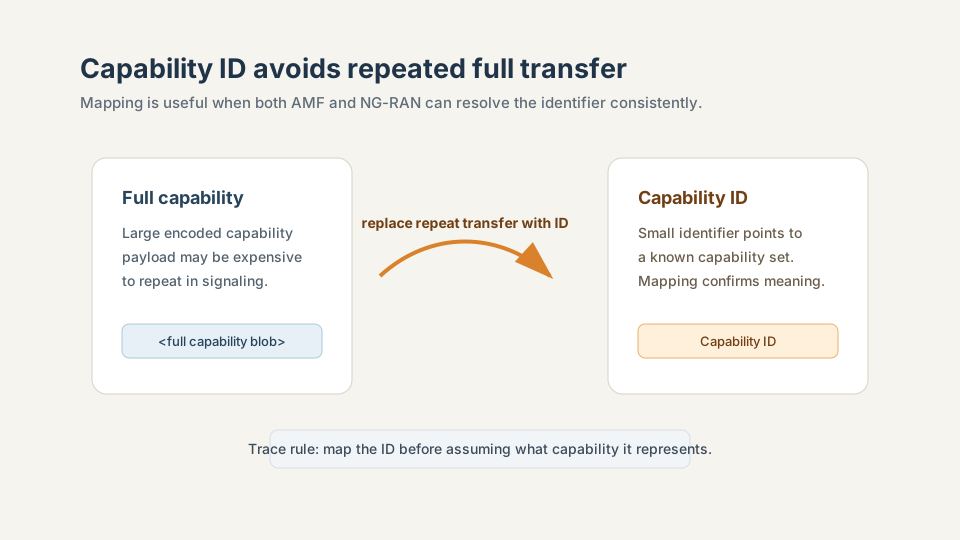
Capability IDs reduce repeated full capability transfer when both sides can resolve the identifier.
Call flow position: The request supports capability caching by using an identifier rather than repeatedly transferring the full capability container.
Typical state: The response allows AMF and NG-RAN to align on what the capability ID represents.
Preconditions:
The capability ID is valid enough to attempt mapping.
Both sides support the capability ID procedure.
Next likely message: Mapping result or related capability information
Capability management distinction
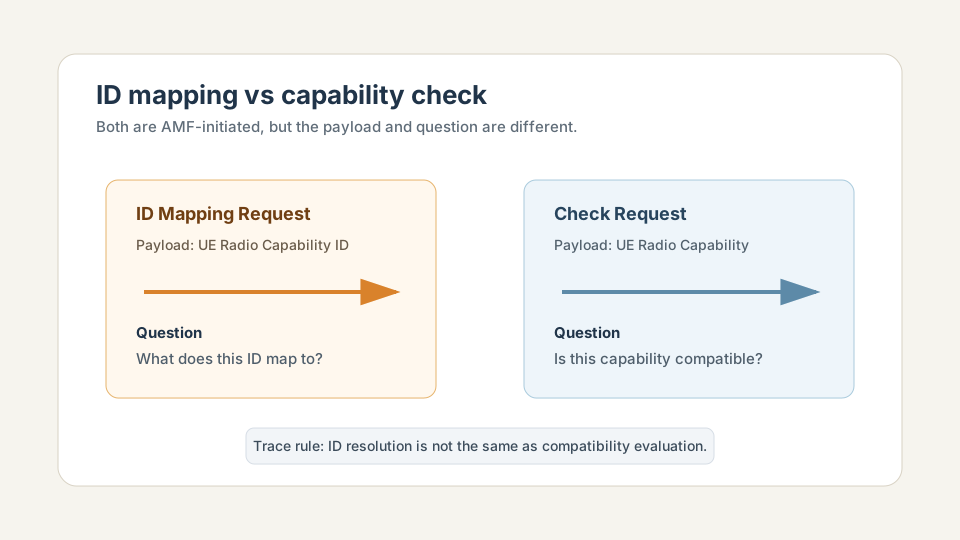
ID mapping resolves identity. Capability check evaluates compatibility.
Call flow position: The request is different from UE Radio Capability Info Indication and UE Radio Capability Check Request.
Typical state: Trace analysis treats this as ID resolution, not full capability transfer or compatibility checking.
Preconditions:
Procedure name, direction, and UE Radio Capability ID payload are verified.
Next likely message: Correct procedure-specific analysis
Call flow position
Previous message(s): AMF has or receives a UE Radio Capability ID, Capability ID resolution is needed
Transport / encapsulation: NGAP over SCTP/IP between AMF and NG-RAN
Security context: The message carries a UE Radio Capability ID to be mapped or resolved. It does not carry the full UE radio capability payload.
Message Structure Overview
UE Radio Capability ID Mapping Request is an AMF-to-NG-RAN initiatingMessage in UE Radio Capability Management.
AMF UE NGAP ID and RAN UE NGAP ID identify the UE context.
UE Radio Capability ID is mandatory and is the main payload.
NG-RAN returns the mapping result in UE Radio Capability ID Mapping Response.
The request resolves capability identity; it does not transfer full UE radio capability and does not ask for compatibility checking.
ASN.1 for 5G NGAP - UE Radio Capability ID Mapping Request
UERadioCapabilityIDMappingRequest ::= SEQUENCE {
  protocolIEs ProtocolIE-Container { {UERadioCapabilityIDMappingRequest-IEs} },
  ...
}

UERadioCapabilityIDMappingRequest-IEs NGAP-PROTOCOL-IES ::= {
  { ID id-AMF-UE-NGAP-ID          CRITICALITY reject TYPE AMF-UE-NGAP-ID          PRESENCE mandatory } |
  { ID id-RAN-UE-NGAP-ID          CRITICALITY reject TYPE RAN-UE-NGAP-ID          PRESENCE mandatory } |
  { ID id-UERadioCapabilityID     CRITICALITY reject TYPE UERadioCapabilityID     PRESENCE mandatory },
  ...
}
How to read this ASN.1
Decode both UE identifiers first, then inspect UE Radio Capability ID as the identifier that must be mapped or resolved. The full UE Radio Capability payload is not expected in this request.
5G NGAP - UE Radio Capability ID Mapping Request - Example Dump
Treat this as a teaching example based on the expected message structure, not as a captured network trace.
UE Radio Capability ID is the key payload.
Look for UE Radio Capability ID Mapping Response for the mapping result.
Do not expect full UE radio capability information in this request.
Important Information Elements
IE
Presence
Description
Message Type
Mandatory
Identifies the NGAP PDU as UE RADIO CAPABILITY ID MAPPING REQUEST.
AMF UE NGAP ID
Mandatory
Mandatory AMF-side UE identifier used to bind the mapping request to the correct UE-associated NGAP context.
RAN UE NGAP ID
Mandatory
Mandatory NG-RAN-side UE identifier used to bind the request to the radio-side UE context.
UE Radio Capability ID
Mandatory
Mandatory capability identifier that the AMF wants NG-RAN to map or resolve.
Detailed field explanation
Message Type
Identifies the NGAP PDU as UE RADIO CAPABILITY ID MAPPING REQUEST.
Presence: Mandatory
In practice: In practice, compare this field with the original request and with any later release-dependent optional fields so you can see whether the network accepted the same service model the UE asked for.
AMF UE NGAP ID
Mandatory AMF-side UE identifier used to bind the mapping request to the correct UE-associated NGAP context.
Presence: Mandatory
In practice: In practice, compare this field with the original request and with any later release-dependent optional fields so you can see whether the network accepted the same service model the UE asked for.
RAN UE NGAP ID
Mandatory NG-RAN-side UE identifier used to bind the request to the radio-side UE context.
Presence: Mandatory
In practice: In practice, compare this field with the original request and with any later release-dependent optional fields so you can see whether the network accepted the same service model the UE asked for.
UE Radio Capability ID
Mandatory capability identifier that the AMF wants NG-RAN to map or resolve.
Presence: Mandatory
In practice: In practice, compare this field with the original request and with any later release-dependent optional fields so you can see whether the network accepted the same service model the UE asked for.
What to check in logs and traces
Confirm direction is AMF to NG-RAN node.
Match AMF UE NGAP ID and RAN UE NGAP ID to the active UE context.
Verify UE Radio Capability ID is present.
Confirm UE Radio Capability ID Mapping Response follows.
Correlate response by UE IDs and capability ID.
Do not confuse this request with UE Radio Capability Check Request.
Common Issues and Troubleshooting
NG-RAN cannot process the mapping request.
Likely cause: UE Radio Capability ID may be missing, malformed, unknown, or inconsistent with the UE context.
What to inspect: Check the UE Radio Capability ID field and both UE NGAP identifiers.
Next step: Retry with a valid capability ID or use full capability reporting if ID mapping is not usable.
No matching Mapping Response appears.
Likely cause: The response may be dropped, delayed, or correlated with a different UE context.
What to inspect: Search for UE Radio Capability ID Mapping Response with matching AMF UE NGAP ID, RAN UE NGAP ID, and capability ID.
Next step: Do not assume mapping succeeded without the response.
Trace is interpreted as full capability transfer.
Likely cause: Mapping Request is being confused with UE Radio Capability Info Indication.
What to inspect: Check direction and payload: Mapping Request is AMF-to-NG-RAN and carries a capability ID.
Next step: Use Info Indication for full capability or capability context reporting.
Mapping is confused with compatibility checking.
Likely cause: UE Radio Capability ID Mapping Request is being confused with UE Radio Capability Check Request.
What to inspect: Check whether the payload is UE Radio Capability ID or full UE Radio Capability.
Next step: Use Mapping Request/Response for ID resolution and Check Request/Response for compatibility results.
Wrong capability appears to be mapped.
Likely cause: UE ID or capability ID correlation may be stale after context setup, modification, or mobility.
What to inspect: Rebuild UE context continuity and capability ID history.
Next step: Correlate by both UE identifiers and the capability ID before judging the result.
LTE / 5G / Variant Comparison
Compared with UE Radio Capability ID Mapping Response
Mapping Request asks NG-RAN to map or resolve a capability ID. Mapping Response returns the result.
Compared with UE Radio Capability Info Indication
Info Indication reports full capability or capability ID context from NG-RAN to AMF. Mapping Request asks NG-RAN to resolve a capability ID.
Compared with UE Radio Capability Check Request
Check Request asks whether a capability is compatible. ID Mapping Request asks what a capability ID maps to.
FAQ
What is UE Radio Capability ID Mapping Request in NGAP?
It is the AMF-to-NG-RAN message used to request mapping or resolution of a UE Radio Capability ID.
Who sends UE Radio Capability ID Mapping Request?
The AMF sends UE Radio Capability ID Mapping Request to the NG-RAN node.
What is UE Radio Capability ID?
It is an identifier for a UE radio capability set, used to avoid repeated full capability transfer when the ID can be resolved.
What is the response to this message?
NG-RAN responds with UE Radio Capability ID Mapping Response.
Is this the same as UE Radio Capability Check Request?
No. Check Request asks NG-RAN to evaluate capability compatibility. ID Mapping Request asks NG-RAN to resolve a capability ID.
Does this message carry full UE radio capability?
No. The key payload is UE Radio Capability ID, not the full UE Radio Capability container.
Why use a capability ID instead of full capability information?
A capability ID can reduce signaling and repeated transfer of large UE radio capability information when the ID is valid and resolvable.
How do you troubleshoot mapping request failures?
Check both UE NGAP IDs, verify UE Radio Capability ID is present and valid, find the matching Mapping Response, and avoid confusing the procedure with capability checking.
Decode this message with the 3GPP Decoder, inspect the related message database, or open the matching call flow to see where this signaling step fits in the full procedure.