Handover Request is the XnAP message the source NG-RAN node sends to the target NG-RAN node to request preparation of resources for an incoming handover on the Xn interface.
The source NG-RAN node decides to hand the UE to a target NG-RAN node over Xn and must prepare the target before issuing the handover command toward the UE.
Main purpose
Requests the target NG-RAN node to allocate UE, radio, and PDU session related resources so inter-gNB handover can proceed once target preparation succeeds.
Handover Request is the XnAP message the source NG-RAN node sends to the target NG-RAN node to request preparation of resources for an incoming handover on the Xn interface.
Requests the target NG-RAN node to allocate UE, radio, and PDU session related resources so inter-gNB handover can proceed once target preparation succeeds.
Why this message matters
Handover Request is the source gNB asking the target gNB over Xn to get ready for the incoming UE before the UE is told to move.
Where this message appears in the call flow
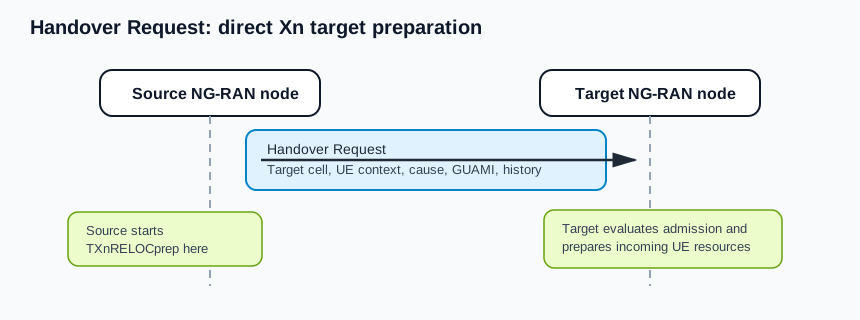
Direct Xn target preparation
Preparation branch: the source node asks the target node over Xn to prepare the incoming UE and starts TXnRELOCprep.
Call flow position: The source NG-RAN node sends Handover Request directly to the target NG-RAN node to prepare resources for the incoming UE.
Typical state: The UE is still on the source side while the target decides whether it can admit and prepare the handover.
Preconditions:
An operational Xn relationship already exists between source and target nodes.
The source node has selected a target cell and collected the UE context needed for preparation.
The source node is ready to start TXnRELOCprep when sending the request.
Next likely message: Handover Request Acknowledge if the target admits the UE
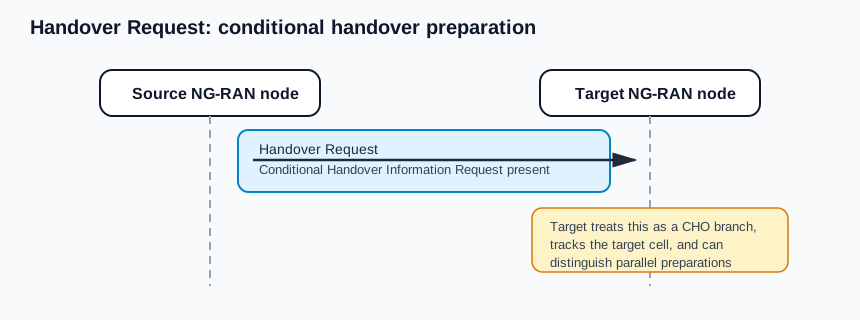
Conditional handover preparation
CHO branch: if conditional-handover information is present, the target prepares the request as a conditional handover transaction tied to the target cell.
Call flow position: The source includes conditional-handover information in the request so the target can prepare a CHO branch instead of a single immediate handover branch.
Typical state: Parallel transactions are allowed for conditional handover, with target cell identity used to distinguish requests when the source UE identifiers are the same.
Preconditions:
Conditional Handover Information Request is present in the message.
The target supports the requested CHO handling for the identified target cell.
Next likely message: Handover Request Acknowledge with conditional-handover information acknowledge, or Handover Preparation Failure
IAB or no-PDU-session mobility branch
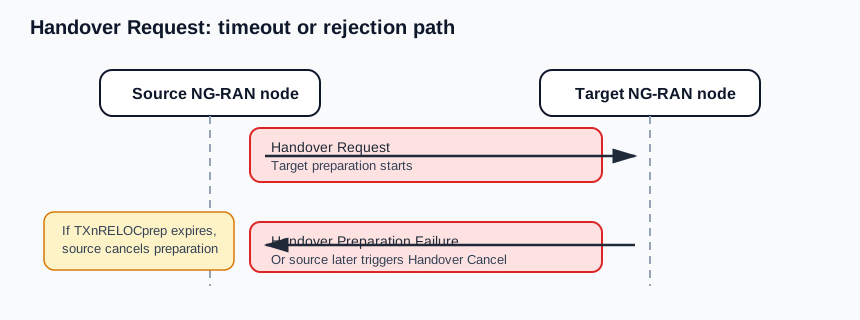
Failure branch: target rejection or missing response drives the source into Handover Preparation Failure handling or timeout-triggered cancellation.
Call flow position: The request may identify a special branch such as IAB-node mobility or a no-active-PDU-session case.
Typical state: The target still prepares UE context, but some PDU session setup handling may be modified or ignored according to the received indicators.
Preconditions:
The source includes IAB-node or no-PDU-session related indicators when that branch applies.
The target can interpret the specialized mobility context carried in the request.
Next likely message: Handover Request Acknowledge or Handover Preparation Failure depending on target readiness
Transport / encapsulation: XnAP over SCTP/IP between source and target NG-RAN nodes
Security context: The message transfers UE context for target preparation, but it does not itself execute the handover. It prepares the target-side state that later completion and release logic depend on.
Message Structure Overview
Handover Request is the source-to-target XnAP initiatingMessage used for target preparation in Xn handover.
The source starts TXnRELOCprep when sending the message.
The message is UE-associated and centers on target admission, target-cell identity, and the UE context payload needed for preparation.
Conditional handover is explicitly modeled: if the conditional-handover request block is present, the target treats the branch as CHO preparation.
If the target cannot admit at least one required resource or another failure occurs during preparation, the failure path moves to Handover Preparation Failure.
The stable center of gravity is the mandatory target-preparation set: source UE XnAP ID, Cause, Target Cell Global ID, GUAMI, UE Context Info HO Request, and UE History Information. Many optional IEs specialize the branch for CHO, sidelink, IAB, timing, or measurement-related handling.
Read the mandatory target-preparation set first before decoding any optional branch-specific context.
If Conditional Handover Information Request is present, treat the trace as a CHO branch and correlate target cell identity carefully.
The source starts TXnRELOCprep when the message is sent, so later timing analysis should anchor on this send event.
Important Information Elements
IE
Presence
Description
Source NG-RAN node UE XnAP ID
Mandatory
Mandatory source-side UE identifier used to correlate the UE-associated Xn signaling branch.
Cause
Mandatory
Mandatory reason for the handover so the target can interpret why the source is requesting preparation.
Target Cell Global ID
Mandatory
Mandatory target-cell identity that anchors which cell or candidate cell the target should prepare.
GUAMI
Mandatory
Mandatory core-identity context carried toward the target as part of the prepared UE context.
UE Context Info HO Request
Mandatory
Mandatory UE-context container that carries the handover preparation payload the target needs to build its incoming UE state.
UE History Information
Mandatory
Mandatory recent-radio-history context used by the target during mobility preparation.
Trace Activation
Optional
Optional tracing context if the source wants tracing behavior to continue through the handover branch.
Masked IMEISV
Optional
Optional masked equipment identity context.
UE Context Ref at SN-HO Request
Optional
Optional context reference for specific handover branches.
Conditional Handover Information Request
Optional
Optional conditional-handover request block. If present, the target treats the message as a conditional handover preparation branch.
Mobility Information
Optional
Optional mobility-specific context associated with the handover branch.
UE History Information From The UE
Optional
Optional history information provided from the UE side.
IAB Node Indication
Optional
Optional indication that the handover concerns an IAB node.
No PDU Session Indication
Optional
Optional indication used when the handover branch concerns an IAB-related or other no-active-PDU-session case.
Time Synchronisation Assistance Information
Optional
Optional timing-assistance context the target stores if supported.
QMC Config Info
Optional
Optional QoE measurement related configuration context.
Detailed field explanation
Source NG-RAN node UE XnAP ID
Mandatory source-side UE identifier used to correlate the UE-associated Xn signaling branch.
Presence: Mandatory
In practice: In practice, compare this field with the original request and with any later release-dependent optional fields so you can see whether the network accepted the same service model the UE asked for.
Cause
Mandatory reason for the handover so the target can interpret why the source is requesting preparation.
Presence: Mandatory
In practice: In practice, compare this field with the original request and with any later release-dependent optional fields so you can see whether the network accepted the same service model the UE asked for.
Target Cell Global ID
Mandatory target-cell identity that anchors which cell or candidate cell the target should prepare.
Presence: Mandatory
In practice: In practice, compare this field with the original request and with any later release-dependent optional fields so you can see whether the network accepted the same service model the UE asked for.
GUAMI
Mandatory core-identity context carried toward the target as part of the prepared UE context.
Presence: Mandatory
In practice: In practice, compare this field with the original request and with any later release-dependent optional fields so you can see whether the network accepted the same service model the UE asked for.
UE Context Info HO Request
Mandatory UE-context container that carries the handover preparation payload the target needs to build its incoming UE state.
Presence: Mandatory
In practice: In practice, compare this field with the original request and with any later release-dependent optional fields so you can see whether the network accepted the same service model the UE asked for.
UE History Information
Mandatory recent-radio-history context used by the target during mobility preparation.
Presence: Mandatory
In practice: In practice, compare this field with the original request and with any later release-dependent optional fields so you can see whether the network accepted the same service model the UE asked for.
Trace Activation
Optional tracing context if the source wants tracing behavior to continue through the handover branch.
Presence: Optional
In practice: In practice, compare this field with the original request and with any later release-dependent optional fields so you can see whether the network accepted the same service model the UE asked for.
Masked IMEISV
Optional masked equipment identity context.
Presence: Optional
In practice: In practice, compare this field with the original request and with any later release-dependent optional fields so you can see whether the network accepted the same service model the UE asked for.
UE Context Ref at SN-HO Request
Optional context reference for specific handover branches.
Presence: Optional
In practice: In practice, compare this field with the original request and with any later release-dependent optional fields so you can see whether the network accepted the same service model the UE asked for.
Conditional Handover Information Request
Optional conditional-handover request block. If present, the target treats the message as a conditional handover preparation branch.
Presence: Optional
In practice: In practice, compare this field with the original request and with any later release-dependent optional fields so you can see whether the network accepted the same service model the UE asked for.
Mobility Information
Optional mobility-specific context associated with the handover branch.
Presence: Optional
In practice: In practice, compare this field with the original request and with any later release-dependent optional fields so you can see whether the network accepted the same service model the UE asked for.
UE History Information From The UE
Optional history information provided from the UE side.
Presence: Optional
In practice: In practice, compare this field with the original request and with any later release-dependent optional fields so you can see whether the network accepted the same service model the UE asked for.
IAB Node Indication
Optional indication that the handover concerns an IAB node.
Presence: Optional
In practice: In practice, compare this field with the original request and with any later release-dependent optional fields so you can see whether the network accepted the same service model the UE asked for.
No PDU Session Indication
Optional indication used when the handover branch concerns an IAB-related or other no-active-PDU-session case.
Presence: Optional
In practice: In practice, compare this field with the original request and with any later release-dependent optional fields so you can see whether the network accepted the same service model the UE asked for.
Time Synchronisation Assistance Information
Optional timing-assistance context the target stores if supported.
Presence: Optional
In practice: In practice, compare this field with the original request and with any later release-dependent optional fields so you can see whether the network accepted the same service model the UE asked for.
QMC Config Info
Optional QoE measurement related configuration context.
Presence: Optional
In practice: In practice, compare this field with the original request and with any later release-dependent optional fields so you can see whether the network accepted the same service model the UE asked for.
What to check in logs and traces
Confirm the Xn relationship was already operational before the source sent Handover Request.
Record the Source NG-RAN node UE XnAP ID and Target Cell Global ID first.
Check that GUAMI, UE Context Info HO Request, and UE History Information are present before analyzing target admission behavior.
If the request contains conditional-handover information, separate that branch from normal immediate handover preparation.
Anchor timing analysis on the Handover Request send time because TXnRELOCprep starts there.
Common Issues and Troubleshooting
The source chooses a target, but target preparation never completes.
Likely cause: The target may reject the handover branch, fail to admit resources, or the source may hit TXnRELOCprep expiry before a response arrives.
What to inspect: Check Handover Request timing, then look for Handover Request Acknowledge, Handover Preparation Failure, or a later Handover Cancel.
Next step: Separate target-admission failure from target-response timeout before debugging UE-side execution.
Conditional handover traces look duplicated or confusing.
Likely cause: Parallel CHO transactions are allowed when the request concerns conditional handover, and target-cell identity becomes part of how the branch is distinguished.
What to inspect: Read Conditional Handover Information Request and correlate requests by Source NG-RAN node UE XnAP ID plus target cell identity.
Next step: Model each candidate-target preparation as a separate CHO branch instead of one generic handover attempt.
The target prepares UE context, but PDU session handling looks inconsistent.
Likely cause: The branch may include partial admission, no-PDU-session treatment, or branch-specific user-plane handling inside the UE context preparation payload.
What to inspect: Compare the Handover Request context payload with the later acknowledge or failure outcome at session granularity.
Next step: Debug target preparation as a context-build problem, not only as a radio admission problem.
LTE / 5G / Variant Comparison
Compared with NGAP Handover Request
NGAP Handover Request is AMF to target NG-RAN over N2. XnAP Handover Request is source NG-RAN to target NG-RAN directly over Xn.
Compared with Handover Request Acknowledge
Handover Request asks the target to prepare resources. Handover Request Acknowledge reports the target-side admission result and readiness.
Compared with Handover Cancel
Handover Request starts target preparation. Handover Cancel is used when the source aborts that preparation, including timeout-driven cancellation after TXnRELOCprep expiry.
FAQ
What is Handover Request in 5G XnAP?
It is the source NG-RAN node to target NG-RAN node message used to request target preparation for an incoming handover over Xn.
What are the key mandatory fields in XnAP Handover Request?
The core mandatory set is Source NG-RAN node UE XnAP ID, Cause, Target Cell Global ID, GUAMI, UE Context Info HO Request, and UE History Information.
When does TXnRELOCprep start?
The source NG-RAN node starts TXnRELOCprep when it sends Handover Request.
How does conditional handover affect this message?
If Conditional Handover Information Request is present, the target treats the branch as conditional handover preparation and returns the corresponding acknowledge information if it accepts.
Decode this message with the 3GPP Decoder, inspect the related message database, or open the matching call flow to see where this signaling step fits in the full procedure.