
3GPP Release 18 is the first real 5G-Advanced release. On paper, the release is broad: NTN, IoT/MTC, positioning, industry support, multicast/broadcast, slicing, UAV, energy efficiency, AI/ML, and XR are all part of the story. But the important question is not how many features are in Rel-18. The real question is: which Release 18 features will change radio design, optimization and mobility behavior?
In this post, let us check the Rel-18 items that matter most from a practical engineering point of view. My shortlist is this: NTN enhancements, L1/L2 mobility, MIMO evolution, network energy savings, and AI/ML for the NR air interface. There are other important Rel-18 topics too, but these five are the ones most likely to affect how networks are built, tuned, and operated.
1) NTN moves from “interesting” to “practical”

NTN was already introduced earlier, but Release 18 makes it much more relevant for real deployments. 3GPP’s Rel-18 work goes beyond simply saying “5G can use satellites.” It adds concrete enhancements such as a new NTN band n254, uplink coverage improvements, PUCCH repetition for Msg4 HARQ-ACK, PUSCH DMRS bundling for NTN timing-drift conditions, network-verified UE location, and improved NTN-TN / NTN-NTN mobility and service continuity procedures.
The most important practical signal is that RAN1 explicitly targeted commercial smartphones for NR NTN uplink coverage work, using assumptions like -5.5 dBi antenna gain and 3 dB polarization loss. That is a big shift. It means NTN work is no longer only about specialized terminals or ideal lab conditions. It is about making satellite access work with the RF limitations of real handheld devices. RAN1 also added improved GNSS operations during long connection times and reduced-power behavior, which is exactly the sort of detail that determines whether NTN becomes usable or remains a demo feature.
For wireless engineers, this matters because NTN adds a different type of radio problem: synchronization depends on GNSS and ephemeris data, the UE must pre-compensate timing advance and Doppler, and mobility now has to account for satellite switch and terrestrial fallback. In other words, NTN in Rel-18 starts to look like a real engineering domain rather than a future roadmap bullet.
2) L1/L2 mobility is one of the most practical Rel-18 features

Mobility is not always the most glamorous topic, but it is one of the most important. Release 18 introduces L1/L2-based inter-cell mobility to reduce the latency, overhead, and interruption time of the legacy L3-heavy approach. 3GPP says the measurement latency is significantly reduced, and the handover procedure is simplified so that it does not require a random access procedure to the target cell.
That sounds simple, but the impact is big. Handover performance has always been one of the hardest areas to optimize, especially in dense deployments, beam-based operation, FR2, and multi-layer networks. Rel-18 also adds non-serving cell beam management and non-serving cell timing advance acquisition to support this L1/L2 mobility framework. This means mobility decisions can move closer to the fast radio layer instead of depending so heavily on slower, more signaling-heavy procedures.
For RAN and optimization teams, this is a feature worth serious attention. Better mobility is not just about reducing ping-pong handovers. It directly affects interruption time, packet continuity, user experience at cell edge, and the ability to support high-frequency and beam-centric deployments without excessive mobility penalties. In practical terms, this is one of the Rel-18 features most likely to show up in KPI discussions.
3) MIMO evolution continues to be a real performance lever

Release 18 also continues the quiet but important work on MIMO evolution. RAN1 focused on four major areas: CSI, multi-TRP, uplink, and reference signals. Specific improvements include CSI enhancements for medium and high UE velocity, expansion of the unified TCI framework from Rel-17 into multi-TRP scenarios, support for two timing advances, uplink improvements for multi-panel transmission, and DMRS support up to 24 orthogonal ports for MU-MIMO.
This part of Rel-18 matters because MIMO is still where a lot of real spectral-efficiency gain comes from. Engineers often focus on new use cases, but many network performance gains still come from better beam management, cleaner CSI behavior, smarter multi-TRP coordination, and improved uplink capability. If you operate or design high-capacity NR networks, Rel-18 MIMO work is not a side topic. It is still a core throughput and coverage topic.
Also, notice the direction here: 3GPP is not abandoning classical radio engineering. Even in a release that talks about AI/ML and new architectures, Rel-18 still invests heavily in improving how the radio itself measures, schedules, beams, and combines transmissions. That is a good reminder that 5G-Advanced is still very much an air-interface story.
4) Network energy savings becomes a standard engineering topic, not just an OPEX discussion

Energy efficiency is one of the new headline areas in Release 18, and this is not just a management slide topic anymore. In RAN1, network energy savings for NR started with a study item and then moved into a work item. During that study, 3GPP defined a base station energy consumption model, the related evaluation methodology, and KPIs. It then studied techniques in the time, frequency, spatial, and power domains, and the work item phase specified enhancements in the spatial/power domain plus cell DTX/DRX enhancements.
This is important because energy saving is now being standardized as part of radio behavior, not treated only as an implementation secret inside vendor features. For engineers, that means energy saving starts interacting with coverage, latency, scheduler behavior, wake-up timing, and UE experience in a more explicit way. Once you standardize models, KPIs, and radio procedures around energy, the topic becomes measurable and optimizable across vendors instead of being just a marketing claim.
SA5 reinforces this by adding management support around energy and automation. Release 18 introduces new energy-related measurements, AI/ML lifecycle management, intent-driven management, and prediction capabilities so operators can express throughput or energy targets and let the system balance performance and energy saving. That makes energy efficiency one of the most cross-functional topics in Rel-18: it touches RAN, OAM, analytics, and automation together.
5) AI/ML enters the air interface in a controlled and useful way
AI/ML is one of the most talked-about parts of 5G-Advanced, but Release 18 is actually quite disciplined here. RAN1 did not try to standardize “AI for everything.” Instead, the Rel-18 study focused on three representative use cases: CSI feedback, beam management, and positioning. It also studied the framework around AI/ML, including algorithm stages, collaboration between UE and gNB, lifecycle handling, and dataset needs.
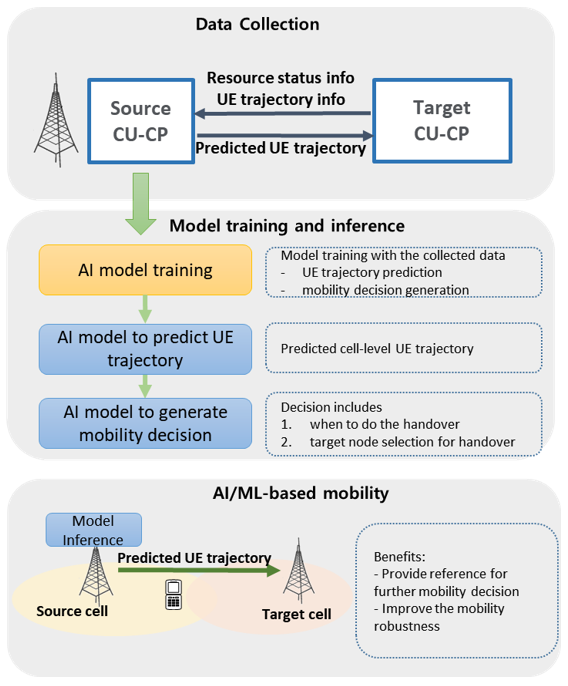
That is the right approach. For radio engineers, AI/ML only becomes useful when it solves very concrete problems such as reducing CSI overhead, improving beam prediction, or making positioning more accurate or less expensive in signaling and measurement terms. 3GPP’s AI/ML for NR Air Interface page also explains that the related Rel-18 normative project in NG-RAN focuses on data collection and signaling enhancements to support AI/ML-based network energy savings, load balancing, and mobility optimization.
So the practical takeaway is this: Release 18 is not the point where gNBs suddenly become fully autonomous AI systems. It is the point where 3GPP starts standardizing the plumbing needed for AI/ML to become useful in radio networks. That includes the use cases, the framework, the data collection, and the management hooks. For engineers, that is much more valuable than hype because it shows where future implementation work is likely to land.
The hidden Rel-18 feature: better observability and management
If I had to add one “bonus” feature to this list, it would be the SA5 work on measurements, KPIs, QoE, and automation. This is not as flashy as NTN or AI/ML, but it may end up being just as important. SA5 added new measurements covering areas such as NTN delay, packet loss, paging, mobility management, beam/cell related handover behavior, wake-up signal functionality, time advance, UE-level delays, throughput, QoE data collection, and NWDAF-related statistics.
Why does this matter? Because once the network becomes more complex, the hardest problem is often no longer adding a feature. The hardest problem is seeing what the feature is doing in a multi-vendor live network. Rel-18 management work is valuable because it gives operators and engineers more standardized ways to observe, compare, troubleshoot, and automate behavior across the stack.
What I would watch, but not rank in the top five
Release 18 also includes important work around XR/immersive communications, multicast/broadcast services, UAV, industrial support, and network slicing. These are all important, but they are not equally urgent for every wireless engineer in 2026. Their relevance depends much more on your deployment profile, vertical focus, and product roadmap. That is why I would track them, but I would not put them ahead of NTN, mobility, MIMO, energy savings, and AI/ML for most engineering teams.
Final thoughts
If I had to summarize Release 18 in one sentence, it would be this: Rel-18 matters because it brings 5G-Advanced closer to real engineering problems. Satellite access becomes more deployable, mobility becomes faster, MIMO keeps pushing spectral efficiency, energy saving becomes standardized, and AI/ML finally gets a serious framework inside the radio and management architecture.
That is why Release 18 is worth attention. Not because it has the biggest feature list, but because it puts engineering effort into the areas where real networks still struggle: coverage, mobility, efficiency, observability, and intelligent optimization.