5G Deregistration Procedure Explained
Introduction
The Deregistration procedure in 5G networks allows the User Equipment (UE) or the network to release the UE’s registration context in the 5G Core (5GC).
Once deregistration is completed:
- the UE is no longer reachable for paging
- mobility management context is removed
- data sessions are released
- security context may be deleted
The procedure is defined by the 3rd Generation Partnership Project in:
- 3GPP TS 23.502 - 5G System Procedures
- 3GPP TS 24.501 - NAS Protocol
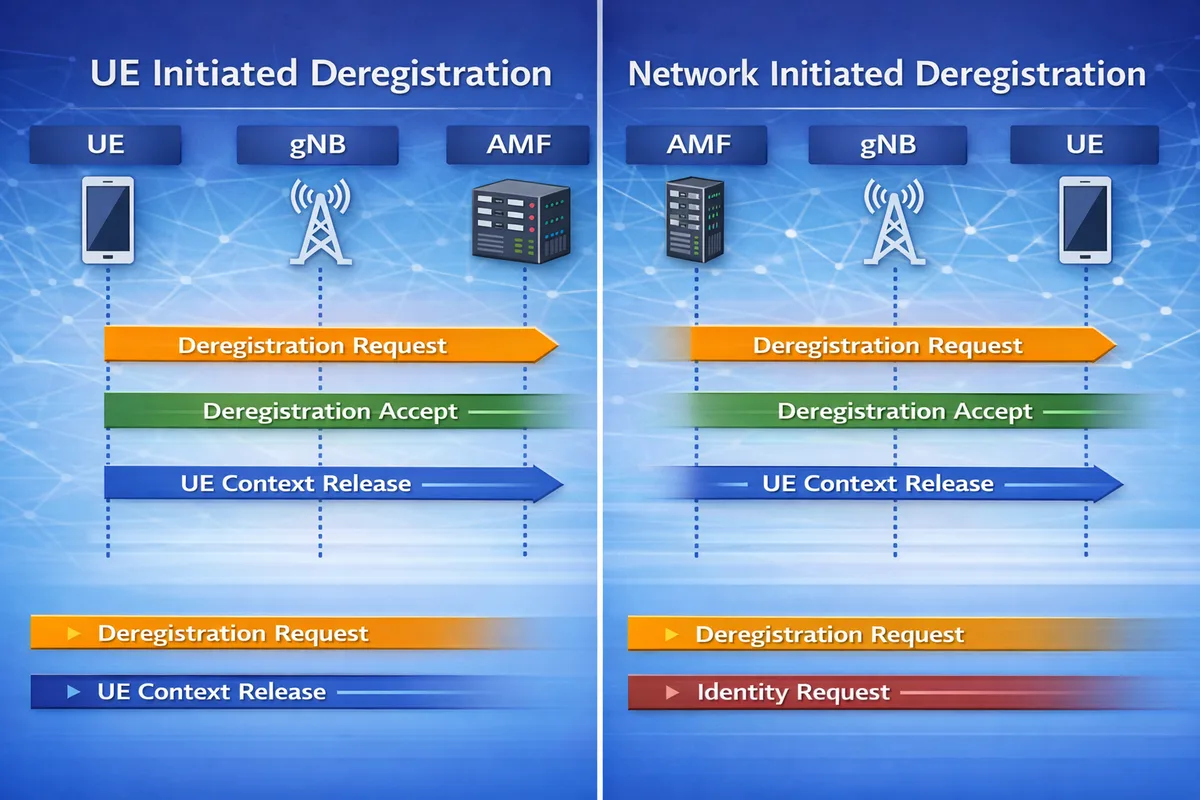
Types of Deregistration
There are two major types of deregistration in 5G networks.
| Type | Trigger |
|---|---|
| UE Initiated Deregistration | UE powers off or leaves network |
| Network Initiated Deregistration | Network releases UE context |
Network Elements Involved
UE (User Equipment)
The UE may trigger deregistration when:
- the device powers off
- the SIM is removed
- the user disables network connectivity
gNB (5G Base Station)
The gNB forwards NAS signaling between the UE and the core network.
AMF (Access and Mobility Management Function)
The AMF manages UE registration state and removes UE context during deregistration.
Interfaces Used
| Interface | Description |
|---|---|
| NR-Uu | Radio interface between UE and gNB |
| N1 | NAS signaling between UE and AMF |
| N2 | Control plane between gNB and AMF |
UE Initiated Deregistration Call Flow
When the UE decides to leave the network, it sends a Deregistration Request.
UE                gNB                AMF
 |                 |                  |
 |---Deregistration Request--------->|
 |                 |----N2---------->|
 |                 |                  |
 |<--Deregistration Accept-----------|
 |                                   |
 |-----UE Context Release------------|
Step-by-Step Explanation
Step 1: Deregistration Request
The UE sends a Deregistration Request NAS message.
Typical triggers include:
- UE power off
- SIM deactivation
- manual network disconnect
Important parameters to check
Engineers should verify:
- deregistration type
- UE identity (5G-GUTI)
- switch-off indicator
Step 2: Network Processing
The AMF processes the request and performs several actions:
- release UE context
- release mobility information
- terminate active sessions
The network may also release associated PDU sessions.
Important parameters to check
Check:
- UE context release cause
- PDU session release events
- AMF context removal
Step 3: Deregistration Accept
The AMF sends a Deregistration Accept message.
After this step:
- the UE is no longer registered
- paging is disabled
- NAS context is removed
Network Initiated Deregistration
Sometimes the network forces deregistration.
Typical scenarios include:
- subscription cancellation
- network maintenance
- policy enforcement
- roaming restrictions
Network Initiated Deregistration Call Flow
AMF                gNB                UE
 |                  |                 |
 |--Deregistration Request---------->|
 |                  |----N2---------->|
 |                  |                 |
 |<--Deregistration Accept-----------|
 |                                   |
 |------UE Context Release---------->|
Key NAS Messages
| Message | Purpose |
|---|---|
| Deregistration Request | Trigger deregistration |
| Deregistration Accept | Confirm deregistration |
| UE Context Release | Release UE context |
Deregistration Causes
Common deregistration reasons include:
- UE power off
- subscription expiration
- mobility restrictions
- security issues
- operator policy
Deregistration vs Registration
| Feature | Registration | Deregistration |
|---|---|---|
| Purpose | Connect UE to network | Remove UE from network |
| Trigger | UE attach or update | UE or network request |
| Result | UE reachable | UE unreachable |
Troubleshooting Deregistration Issues
Unexpected Deregistration
Possible causes:
- AMF overload
- subscription policy enforcement
- roaming restrictions
UE Cannot Deregister
Possible causes:
- NAS signaling failure
- RRC connection problems
- network configuration issues
Data Sessions Not Released
Possible causes:
- SMF session cleanup failure
- UPF context retention
- session timeout misconfiguration
Relevant 3GPP Specifications
The deregistration procedure is defined in:
- 3GPP TS 23.502 - 5G System Procedures
- 3GPP TS 24.501 - NAS Protocol
- 3GPP TS 38.300 - NR Architecture
Published by the 3rd Generation Partnership Project.
Summary
The 5G Deregistration procedure removes the UE’s registration context from the 5G Core network. It can be triggered either by the UE or the network and ensures that resources are released and subscriber context is properly cleared.
This procedure is important for:
- network resource management
- subscriber policy enforcement
- maintaining accurate UE location tracking