5G Mobility Registration Update Procedure Explained
Introduction
The Mobility Registration Update procedure occurs when a User Equipment (UE) moves to a new Registration Area (RA) in a 5G network.
When the UE detects that it has entered a different Tracking Area (TA) that is not part of its current Registration Area list, it must update its location in the 5G Core Network.
This allows the network to:
- track the UE location
- update paging areas
- maintain UE mobility context
- support seamless service continuity
The procedure is defined by the 3rd Generation Partnership Project in TS 23.502 and TS 24.501.
When Mobility Registration Update Occurs
The UE triggers this procedure when:
- the UE moves to a new tracking area
- the current TA is not part of the allowed Registration Area list
This typically happens when:
- the UE travels between cities
- the UE crosses operator-defined tracking area boundaries
- the UE performs long-distance mobility
Network Elements Involved
UE (User Equipment)
Detects a change in Tracking Area Identity (TAI) and initiates the procedure.
gNB (5G Base Station)
Provides radio access and forwards signaling to the core network.
AMF (Access and Mobility Management Function)
Handles mobility management and updates UE location context.
Interfaces Used
| Interface | Description |
|---|---|
| NR-Uu | Radio interface between UE and gNB |
| N1 | NAS signaling between UE and AMF |
| N2 | Control plane between gNB and AMF |
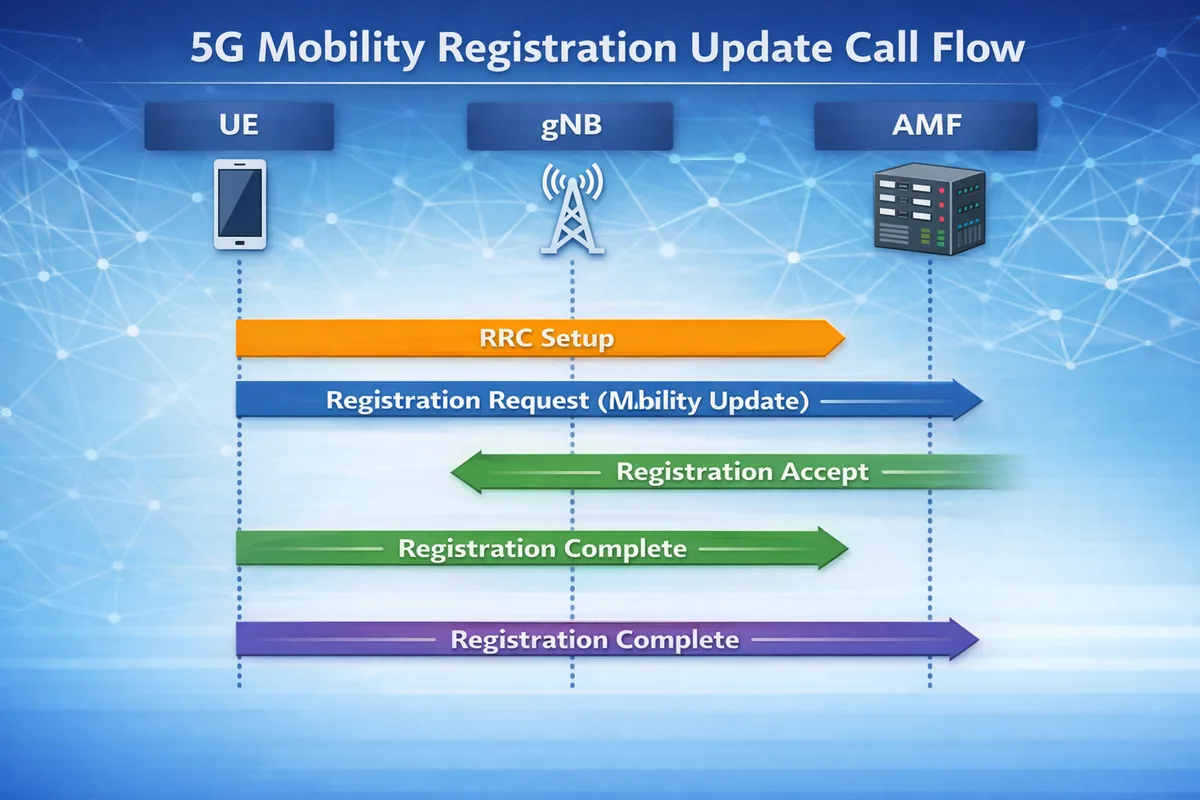
Mobility Registration Update Call Flow
Below is the simplified message sequence.
UE                gNB                AMF
 |                 |                  |
 |----RRC Setup--->|                  |
 |                 |                  |
 |---Registration Request (Mobility Update)-->|
 |                 |----N2----------->|
 |                 |                  |
 |<--Registration Accept--------------|
 |---Registration Complete----------->|
The procedure is simpler than Initial Registration because:
- UE is already authenticated
- security context already exists
Step-by-Step Explanation
Step 1: Tracking Area Change Detection
The UE monitors system information broadcast by the gNB.
It reads the Tracking Area Identity (TAI) from the cell.
If the new TAI:
- is not in the stored Registration Area list
then the UE must perform a Mobility Registration Update.
Important parameters to check
Engineers should verify:
- current TAI
- stored Registration Area list
- PLMN ID
- UE mobility state
Step 2: RRC Connection Setup
If the UE is in Idle Mode, it must establish an RRC connection.
Typical messages:
- RRC Setup Request
- RRC Setup
- RRC Setup Complete
This allows NAS signaling to be transmitted to the network.
Important parameters to check
Check:
- RRC establishment cause
- serving cell ID
- radio signal strength (RSRP / RSRQ)
Step 3: Registration Update Request
The UE sends a Registration Request with the Registration Type set to Mobility Update.
Information included:
- UE identity (5G-GUTI)
- mobility registration type
- current tracking area
- UE capabilities
The message travels:
UE → gNB → AMFImportant parameters to check
Verify:
- registration type = mobility updating
- UE identity
- requested NSSAI
- security context validity
Step 4: AMF Location Update
The AMF performs several checks:
- verifies UE context
- updates the UE location
- updates the tracking area list
If the UE moved into another AMF region, AMF relocation may occur.
Important parameters to check
Engineers should check:
- serving AMF ID
- new tracking area list
- slice authorization
Step 5: Registration Accept
The AMF sends Registration Accept to the UE.
This message may contain:
- updated Registration Area list
- updated T3512 timer
- updated slice information
Important parameters to check
Look for:
- updated TAI list
- allowed NSSAI
- registration result
Step 6: Registration Complete
The UE sends Registration Complete to confirm the procedure.
At this point:
- UE location is updated in AMF
- network can page the UE in the new area
Differences Between Registration Procedures
| Procedure | Trigger |
|---|---|
| Initial Registration | UE first connects to network |
| Periodic Update | Timer expiry |
| Mobility Update | UE moves to new tracking area |
Common Troubleshooting Scenarios
Registration Update Not Triggered
Possible causes:
- UE misreads TAI
- incorrect system information
- UE firmware issue
Registration Reject
Possible reasons:
- slice not allowed in new area
- roaming restrictions
- subscription mismatch
UE Performs Full Registration Instead
Possible reasons:
- AMF context lost
- UE identity not recognized
- security context expired
Key Messages in Mobility Registration Update
| Message | Purpose |
|---|---|
| RRC Setup | Establish signaling channel |
| Registration Request | UE initiates mobility update |
| Registration Accept | Network updates location |
| Registration Complete | UE confirms procedure |
Relevant 3GPP Specifications
This procedure is defined in:
- TS 23.502 - 5G System Procedures
- TS 24.501 - NAS Protocol
- TS 38.300 - NR Architecture
Published by the 3rd Generation Partnership Project.
Summary
The Mobility Registration Update procedure ensures that the network always knows the current location of the UE when it moves between tracking areas.
This allows the network to:
- update the UE context
- maintain paging functionality
- ensure uninterrupted services
The procedure is lightweight compared to Initial Registration, making it efficient for frequent mobility events in modern 5G networks.