5G Periodic Registration Update Call Flow and Procedure
Introduction
The 5G Periodic Registration Update procedure is used when a UE is already registered in a 5G Standalone (SA) network and needs to refresh its registration context before the periodic timer expires. This helps the network keep the UE reachable and confirms that the registration state is still valid in the Access and Mobility Management Function (AMF).
Unlike initial registration, this procedure usually relies on existing security context and previously established subscription information. It is mainly a timer-driven maintenance procedure rather than a first-time network entry process.
Once the periodic update is completed successfully, the UE remains registered and can continue using services such as:
- mobile data
- voice services (VoNR)
- messaging services
- network slice-based services
This procedure is defined in 3GPP specifications including TS 23.502 (5G procedures) and TS 24.501 (NAS signaling).
Network Elements Involved
Before examining the call flow, let's understand the key network components involved.
UE (User Equipment)
The UE triggers the periodic update when its registration update timer expires or is about to expire. It can be a smartphone, modem, router, or IoT device already attached to the 5G system.
gNB (5G Base Station)
The gNB provides radio access and transports NAS signaling between the UE and the 5G Core when the update procedure is sent.
AMF (Access and Mobility Management Function)
The AMF is the control-plane node that processes the periodic registration update, maintains mobility and registration context, and returns updated timer or area information when needed.
UDM (Unified Data Management)
The UDM may be involved when the AMF needs to confirm or refresh subscriber-related data associated with the UE registration context.
Interfaces Used
| Interface | Description |
|---|---|
| NR-Uu | Radio interface between UE and gNB |
| N1 | NAS signaling between UE and AMF |
| N2 | Control plane interface between gNB and AMF |
| N8 | Interface between AMF and UDM when subscriber context is checked |
5G Periodic Registration Update Call Flow Diagram
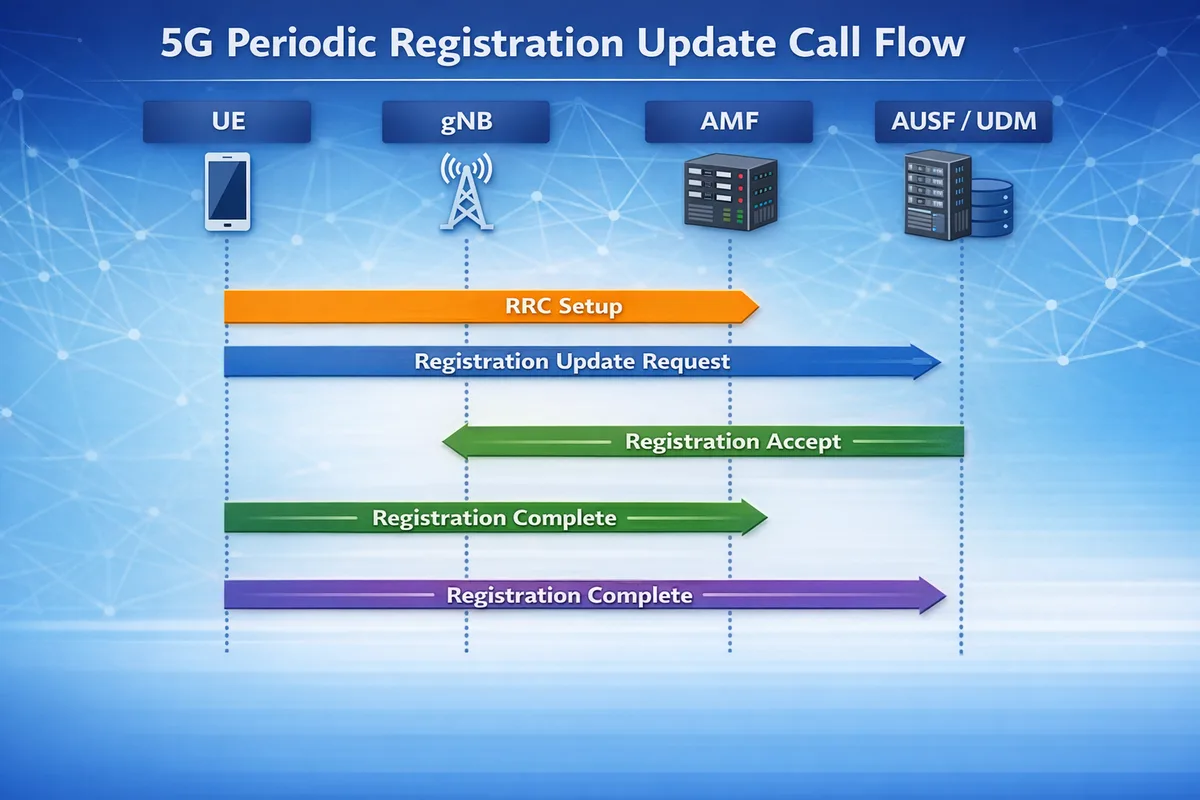
Below is the simplified message flow for the Periodic Registration Update procedure.
UE               gNB               AMF               UDM
 |                |                 |                 |
 |----RRC Resume->|                 |                 |
 |                |                 |                 |
 |---Registration Request---------->|                 |
 |                |----N2---------->|                 |
 |                |                 |---Context Check>|
 |                |                 |<--Subscriber Data|
 |                |                 |                 |
 |<--Registration Accept-----------|                 |
 |---Registration Complete-------->|                 |
Step-by-Step Explanation
1. Periodic Timer Expiry
The procedure starts when the UE detects that the periodic registration update timer is expiring. This timer is typically provided by the network in earlier registration signaling.
Important parameters to check
Engineers should verify:
- T3512 timer value
- UE timer handling behavior
- registration state before expiry
2. RRC Connection or Resume
If the UE is in idle or inactive state, it may need to re-establish or resume radio signaling with the gNB before sending NAS messages toward the core network.
Typical messages can include:
- RRC Resume Request
- RRC Resume
- RRC Resume Complete
Important parameters to check
Look at:
- serving cell identity
- RAN paging or resume cause
- radio link quality measurements
3. Registration Request
The UE sends a Registration Request with registration type set to Periodic Registration Updating. The message is carried over N1 through the gNB to the AMF.
The request typically includes:
- 5G-GUTI or other UE identity
- registration update type
- current security context usage
- UE capability or slice information if required
Important parameters to check
Engineers should check:
- registration type value
- mobile identity field
- NAS message integrity protection
4. AMF Context Validation
The AMF verifies that the UE context is still valid. Depending on the scenario, the AMF may consult other core functions to confirm subscriber information or refresh stored context.
Important parameters to check
During troubleshooting, verify:
- AMF UE context availability
- subscriber data retrieval outcome
- reject or failure causes if validation fails
5. Registration Accept
If the periodic update succeeds, the AMF sends Registration Accept to the UE. The message may refresh timer values and provide updated area or mobility-related information.
Important parameters to check
Engineers should verify:
- updated periodic timer value
- registration result
- tracking area information
6. Registration Complete
The UE confirms successful completion by sending Registration Complete. At this point, the periodic update is finished and the UE remains registered in the network.
What Happens After Periodic Registration Update?
After the update completes, the UE continues operating in registered state and can still perform additional procedures such as:
- PDU Session Establishment or Resume
- IMS signaling for voice-related services
- Paging response when downlink activity arrives
- Mobility procedures if the UE moves across areas
Key Messages in the Procedure
| Message | Purpose |
|---|---|
| RRC Resume Request | UE requests signaling resume when needed |
| Registration Request | Starts periodic registration update |
| Context Validation | AMF checks UE registration state and subscriber context |
| Registration Accept | Network confirms successful registration update |
| Registration Complete | UE confirms procedure completion |
Differences Between Initial Registration and Periodic Registration Update
| Feature | Initial Registration | Periodic Registration Update |
|---|---|---|
| Trigger | First network entry | Timer expiry while already registered |
| Security Context | Usually established during procedure | Usually already available |
| Main Goal | Create registration context | Refresh registration context |
| Subscriber Authentication | Common during full registration | Not always repeated |
References
The procedure is described in specifications from the 3rd Generation Partnership Project.
Key documents include:
- 3GPP TS 23.502 - 5G System Procedures
- 3GPP TS 24.501 - NAS Protocol for 5G
- 3GPP TS 33.501 - 5G Security Architecture
Summary
The 5G Periodic Registration Update procedure is the timer-based process that keeps a UE registered in the 5G Core network after the initial registration has already been completed.
During this procedure, the UE refreshes its registration state with the AMF, preserves network reachability, and remains ready for ongoing data, voice, and mobility-related services.