5G RRC Reestablishment Procedure Explained
Introduction
In 5G networks, the RRC Reestablishment procedure is the radio recovery procedure used when the UE loses its working RRC connection but still has enough context to try to restore the session without starting over from a full access attempt.
It is typically triggered after radio link failure, handover failure, or another lower-layer problem that breaks the active connection while the UE still remembers its security and radio context.
This makes reestablishment a failure recovery path, not a normal access path like RRC Setup and not a light reconnect path like RRC Resume.
- 3GPP TS 38.331 - NR RRC Protocol
- 3GPP TS 38.300 - NR Overall Description
Why RRC Reestablishment Is Needed
When the active radio connection fails, the network and UE do not always want to fall back immediately to a complete connection restart. Reestablishment offers a controlled way to recover faster if the stored context is still valid and the target cell accepts the request.
| Scenario | Why Reestablishment Helps |
|---|---|
| Radio link failure | Lets the UE attempt recovery without starting from full initial access signaling. |
| Handover failure | Provides a fallback path when the commanded move does not complete correctly. |
| Transient radio disruption | Can restore the session if enough prior context is still usable. |
| Ongoing user-plane activity | Reduces service interruption compared with a full re-setup path. |
Network Elements Involved
UE (User Equipment)
Detects that the active connection has failed and sends RRC Reestablishment Request using the stored failure context.
gNB
Validates the reestablishment attempt, checks context availability, restores the radio configuration if accepted, or rejects the attempt if recovery is not possible.
Interfaces Used
| Interface | Description |
|---|---|
| NR-Uu | Radio interface between UE and gNB used for the reestablishment exchange. |
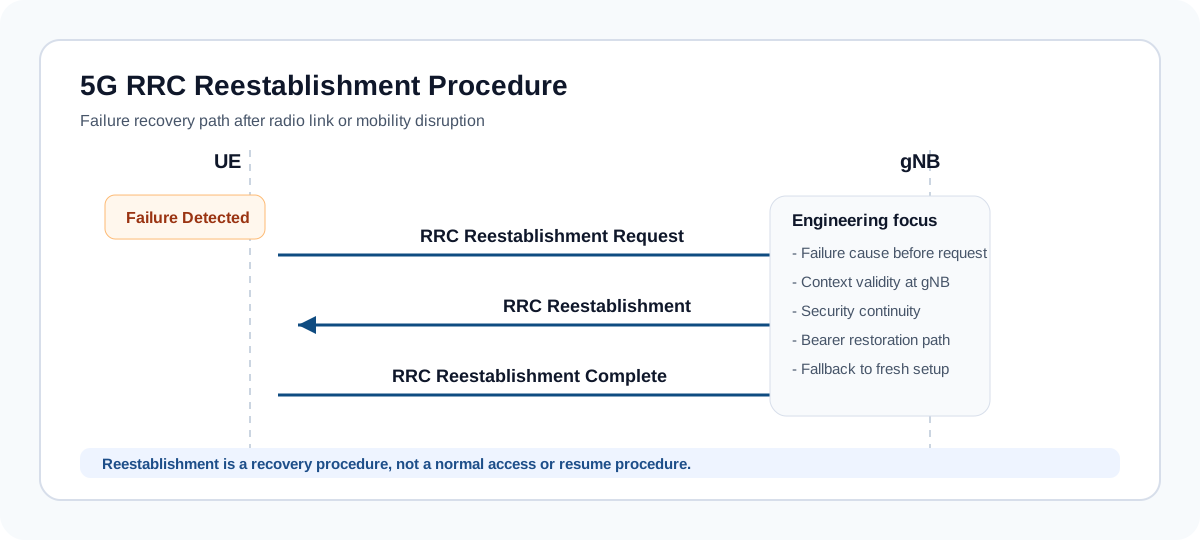
RRC Reestablishment Call Flow
Below is the simplified signaling sequence.
UE                           gNB
 |                            |
 |---RRC Reestablishment Request->|
 |                            |
 |<--RRC Reestablishment------|
 |                            |
 |---RRC Reestablishment Complete->|
If the recovery attempt is not accepted, the UE typically falls back to a fresh access path such as RRC Connection Setup.
Step-by-Step Explanation
Step 1: Failure Detection
The UE detects that the current RRC connection is no longer usable. This usually happens because of radio link failure, failed mobility execution, or lower-layer synchronization loss.
Before the reestablishment request appears, engineers should confirm:
- the preceding failure event in PHY, MAC, or RLC logs
- whether a handover or reconfiguration was in progress
- whether the UE still has valid security and context information
Step 2: RRC Reestablishment Request
The UE sends RRC Reestablishment Request to a suitable cell. This message carries the short identity and reestablishment cause needed for the network to decide whether recovery can proceed.
Important checks:
- reestablishment cause value
- cell identity alignment
- short MAC-I and UE identity consistency
Step 3: RRC Reestablishment
If the network accepts the attempt, it sends RRC Reestablishment with the recovered radio and security configuration required to continue.
Important checks:
- SRB restoration
- security continuity
- radio bearer reactivation details
Step 4: RRC Reestablishment Complete
The UE confirms successful recovery with RRC Reestablishment Complete.
At this point, the UE returns to connected operation and later procedures such as security refresh, reconfiguration, or session continuity handling may continue.
When Reestablishment Fails
If the gNB cannot validate the context, the cell does not permit recovery, or the UE cannot complete the exchange, the recovery path ends and the UE normally falls back to a fresh access attempt.
| Failure Point | Likely Next Action |
|---|---|
| Request rejected or ignored | UE restarts access using RRC Connection Setup. |
| Context not found | Network treats the UE like a fresh access case. |
| Recovery incomplete | Later release or full setup may follow depending on failure stage. |
Troubleshooting RRC Reestablishment
Reestablishment Request Sent but No Response
- Check cell suitability and coverage at the recovery moment.
- Correlate the preceding radio failure and uplink availability.
- Verify whether the UE selected the expected target cell.
Reestablishment Rejected
- Check whether the context still exists in the serving or target gNB.
- Inspect reestablishment cause and identity validation.
- Review handover-failure or security-continuity conditions.
Recovery Completes but Service Still Breaks
- Check later RRC Reconfiguration or bearer-restoration steps.
- Inspect PDCP or user-plane continuity counters.
- Correlate with NGAP and session-management recovery on the core side if traffic remains affected.
Key Messages in RRC Reestablishment
| Message | Purpose |
|---|---|
| RRC Reestablishment Request | UE asks the network to recover a failed connected context. |
| RRC Reestablishment | gNB provides the recovery configuration. |
| RRC Reestablishment Complete | UE confirms that recovery succeeded. |
Relevant 3GPP Specifications
- 3GPP TS 38.331 - NR RRC Protocol
- 3GPP TS 38.300 - NR Overall Architecture
Summary
The RRC Reestablishment procedure is the 5G NR radio recovery path used after an active connection breaks but the UE still has enough context to attempt restoration.
- The UE detects failure and sends RRC Reestablishment Request.
- The gNB validates the context and, if accepted, sends RRC Reestablishment.
- The UE confirms recovery with RRC Reestablishment Complete.
If this path fails, engineers should expect fallback to a fresh setup path and should correlate the issue with radio failure, mobility, and context-continuity behavior.