VoNR Emergency Call Procedure | Voice Over NR Emergency Services Tutorial
Introduction
The VoNR Emergency Call procedure enables a user to place an emergency voice call over a 5G Standalone network.
Emergency calls are given highest priority in the network, ensuring that users can contact emergency services even during network congestion.
In 5G networks, emergency calls are handled through the IP Multimedia Subsystem (IMS) and routed to the Public Safety Answering Point (PSAP).
The procedure is defined by the 3rd Generation Partnership Project in:
- 3GPP TS 23.167 – IP Multimedia Emergency Sessions
- 3GPP TS 23.502 – 5G Procedures
- 3GPP TS 24.229 – SIP signaling for IMS
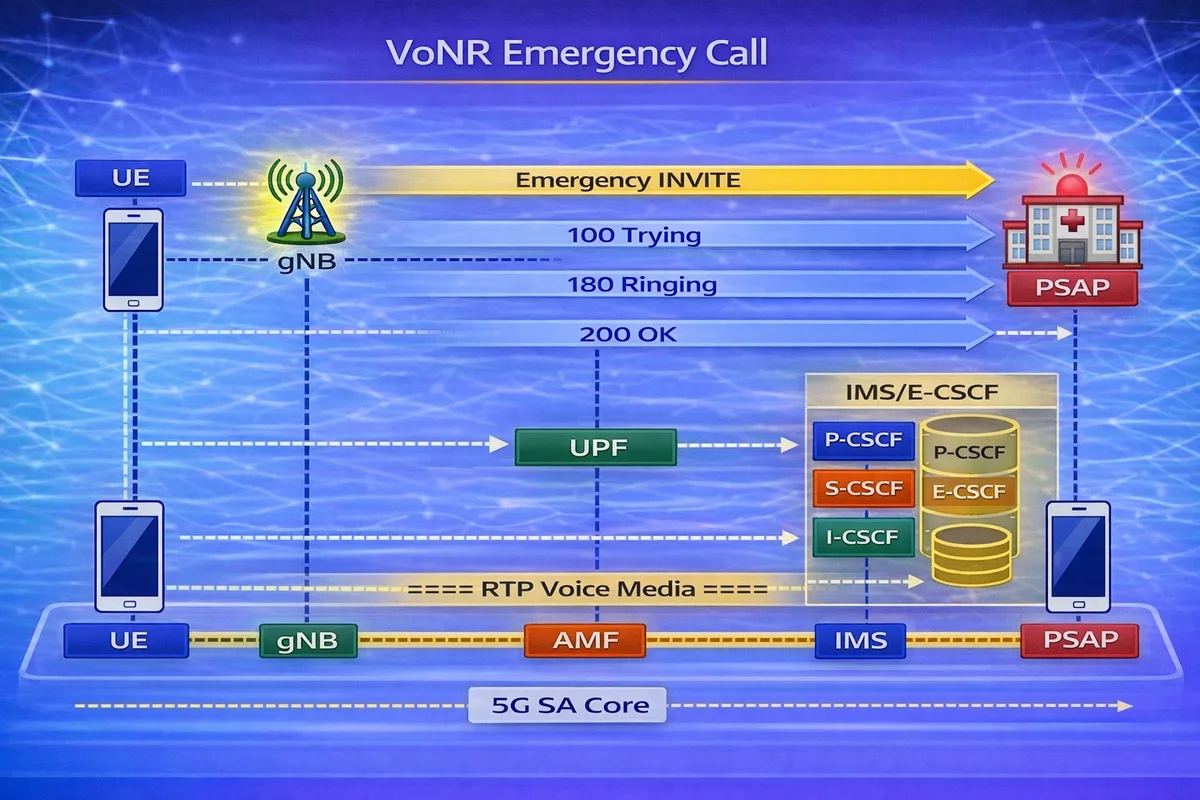
Network Elements Involved
Several network elements participate in the VoNR emergency call flow.
| Network Element | Function |
|---|---|
| UE | User initiating emergency call |
| gNB | NR base station providing radio access |
| AMF | Mobility and session management |
| IMS Core | SIP signaling and call control |
| E-CSCF | Emergency call routing |
| PSAP | Public Safety Answering Point |
VoNR Emergency Call Signaling Flow
UE        gNB        AMF        IMS/E-CSCF        PSAP
 |         |          |            |               |
 |---Emergency INVITE---------------------------->|
 |         |          |            |               |
 |<-------100 Trying------------------------------|
 |<-------180 Ringing-----------------------------|
 |<-------200 OK----------------------------------|
 |---------ACK----------------------------------->|
|========== RTP Voice Media ====================|Step-by-Step VoNR Emergency Call Procedure
Step 1: Emergency Call Trigger
The procedure begins when the user dials an emergency number such as:
| Region | Emergency Number |
|---|---|
| Europe | 112 |
| USA | 911 |
| Global GSM | 112 |
The UE recognizes the dialed number as an emergency service request.
The device generates a SIP INVITE with emergency indicators.
Step 2: SIP Emergency INVITE
The UE sends a SIP INVITE message through the IMS PDU session.
The SIP INVITE contains:
- emergency service indication
- caller identity
- location information
Example header fields:
Request-URI: urn:service:sos
Priority: emergency
Step 3: Emergency Call Routing
The IMS core network routes the emergency call to the Emergency Call Session Control Function (E-CSCF).
The E-CSCF performs:
- emergency service validation
- routing to the nearest PSAP
- priority resource allocation
Step 4: Call Setup
The PSAP system processes the call and returns SIP responses.
Typical responses include:
| SIP Response | Description |
|---|---|
| 100 Trying | Request received |
| 180 Ringing | Emergency center alerted |
| 200 OK | Call accepted |
Step 5: Voice Session Establishment
After the SIP handshake:
- RTP voice media begins
- the user communicates directly with the emergency operator
Voice packets are transmitted through the 5G user plane via the UPF.
Emergency Call Priority Handling
Emergency calls receive highest network priority.
Key mechanisms include:
| Feature | Description |
|---|---|
| Priority Signaling | Emergency SIP INVITE |
| Guaranteed Resources | Dedicated QoS flows |
| Network Congestion Bypass | Emergency traffic prioritized |
QoS Configuration for Emergency Calls
Emergency voice calls use dedicated QoS profiles.
| Service | 5QI |
|---|---|
| SIP signaling | 5QI = 5 |
| Emergency voice media | 5QI = 1 |
This ensures minimal latency and reliable voice communication.
Emergency Call Location Support
The UE may send location information to the network.
This allows emergency services to locate the caller.
Location methods include:
| Method | Description |
|---|---|
| GNSS | GPS-based location |
| Network Location | Cell-based positioning |
| Hybrid Methods | Combined positioning techniques |
Troubleshooting Emergency Call Issues
Emergency Call Not Completed
Possible causes:
- IMS routing failure
- incorrect emergency number recognition
- network configuration issue
Poor Voice Quality
Possible causes:
- radio coverage issues
- packet loss
- congestion
Incorrect PSAP Routing
Possible reasons:
- incorrect location information
- misconfigured emergency routing rules
Summary
The VoNR Emergency Call procedure allows users to contact emergency services directly through the 5G network.
The process includes:
- UE sending Emergency SIP INVITE
- IMS routing the call via E-CSCF
- call delivery to the PSAP
- RTP media session establishment
This mechanism ensures reliable emergency communications in 5G VoNR networks.