UE Context Release Request is the F1AP UE-associated message the gNB-DU sends to the gNB-CU when the DU requests release of an existing UE-associated logical F1 connection or prepared release branch.
Message Fact Sheet
Protocol
f1ap
Network
5g
Spec
3GPP TS 38.473
Spec Section
Section 8.3.2 and UE Context Release Request message
The gNB-DU detects a radio failure, mobility cleanup condition, resource limitation, prepared candidate-cell cleanup, LTM cleanup, protocol inconsistency, or another DU-side condition that requires UE context release handling.
Main purpose
Requests UE context release coordination, informs the CU about DU-side release conditions, supports controlled cleanup of UE-associated resources, prevents stale UE contexts, and lets the CU trigger the formal UE Context Release procedure with UE Context Release Command.
Radio link failure cleanup, Handover or mobility cleanup, UE inactivity and abnormal UE cleanup, DU overload or resource limitation handling, Prepared candidate-cell cleanup, LTM cell cleanup
What is UE Context Release Request in simple terms?
UE Context Release Request is the F1AP UE-associated message the gNB-DU sends to the gNB-CU when the DU requests release of an existing UE-associated logical F1 connection or prepared release branch.
Requests UE context release coordination, informs the CU about DU-side release conditions, supports controlled cleanup of UE-associated resources, prevents stale UE contexts, and lets the CU trigger the formal UE Context Release procedure with UE Context Release Command.
Why this message matters
UE Context Release Request means the DU is asking the CU to coordinate release of an existing UE context. Match both UE IDs, decode Cause first, and then look for UE Context Release Command and Release Complete.
Where this message appears in the call flow
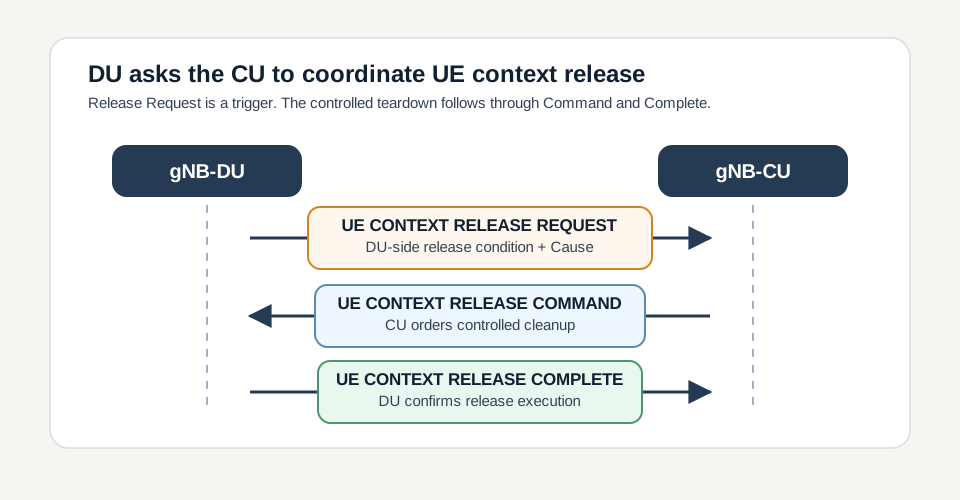
DU-triggered UE context release
Release branch: the DU requests release, the CU orders cleanup, and the DU confirms completion.
Call flow position: The UE context already exists and the gNB-DU sends UE Context Release Request when it wants the gNB-CU to initiate controlled release handling.
Typical state: The UE context is still present until the CU sends UE Context Release Command and the DU completes cleanup.
Preconditions:
The F1 interface is operational.
Both UE F1AP IDs identify an existing UE-associated logical F1 connection.
The DU has detected a release condition.
Next likely message: UE Context Release Command
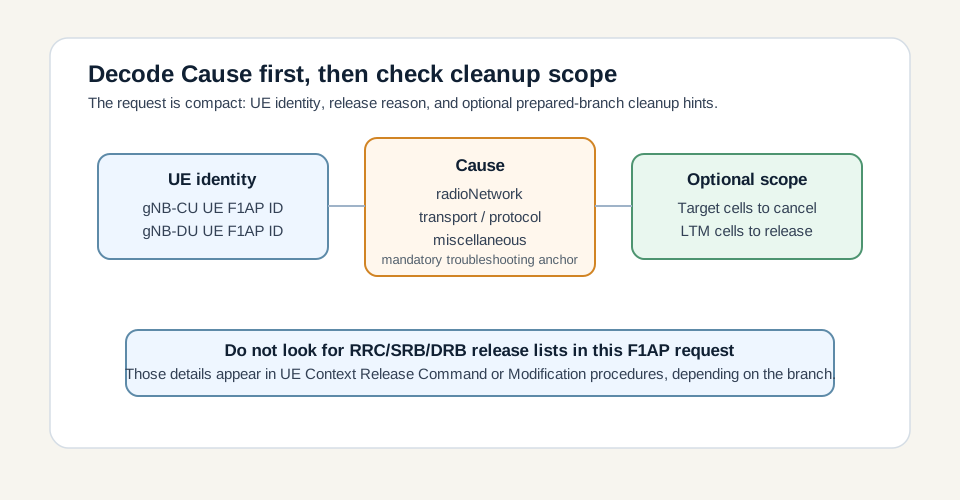
Cause and cleanup-scope analysis
Troubleshooting branch: decode Cause first, then inspect optional prepared-resource cleanup scope.
Call flow position: Cause explains why release is requested; optional target-cell or LTM lists narrow the cleanup scope for prepared resources.
Typical state: The CU can decide whether to send a full release command, a selective cleanup command, or another recovery action.
Preconditions:
Cause is present.
Optional target-cell or LTM details may identify prepared branches about to be released.
Next likely message: UE Context Release Command with matching scope
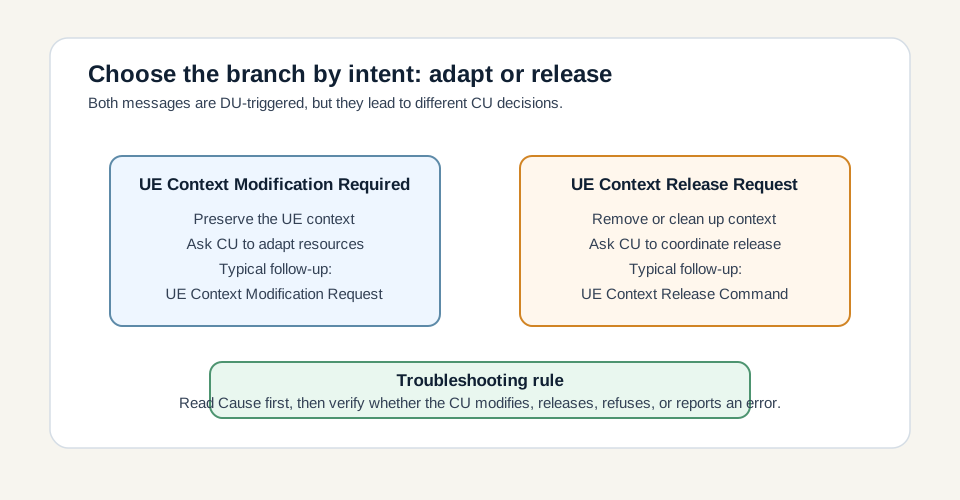
Release versus modification decision
Decision branch: Release Request removes or cleans up; Modification Required tries to preserve and adapt.
Call flow position: Release Request asks to remove or clean up UE context state, while Modification Required asks to preserve and adapt the context.
Typical state: Trace analysis should classify DU intent before expecting a modification or release follow-up.
Preconditions:
The DU is requesting release coordination rather than bearer/resource adaptation.
Next likely message: Release Command, or CU-side recovery handling
Transport / encapsulation: F1AP over SCTP/IP between gNB-CU and gNB-DU
Security context: UE Context Release Request does not establish NAS or AS security. It reports that an existing DU-side UE association or prepared branch should be released under CU control.
Message Structure Overview
UE Context Release Request is sent by the gNB-DU to the gNB-CU for an existing UE-associated F1 context.
It requests release coordination; it does not directly complete the UE context release by itself.
Both UE F1AP IDs and Cause are mandatory.
Cause is the main troubleshooting field because it explains the DU-side release reason.
In the Release 18 F1AP ASN.1, this request does not carry RRC Container, SRBs To Be Released List, or DRBs To Be Released List. Those belong to adjacent release or modification messages.
Optional Target Cells To Cancel and LTM Cells To Be Released List can narrow the cleanup scope for prepared mobility or LTM resources.
Release 18 adds optional prepared-branch cleanup scope to the compact Release Request core. Treat RRC delivery and explicit SRB or DRB release execution as part of the following Release Command or modification procedures, not as fields in this request.
Treat this as a teaching example based on the expected message structure, not as a captured network trace.
Cause is the first troubleshooting field because it explains why the DU wants release handling.
If Target Cells To Cancel or LTM Cells To Be Released List is present, determine whether the request is full context release or selective prepared-resource cleanup.
Look for UE Context Release Command next; this request does not complete the release by itself.
Important Information Elements
IE
Presence
Description
Message Type
Mandatory
Identifies the F1AP PDU as UE CONTEXT RELEASE REQUEST.
gNB-CU UE F1AP ID
Mandatory
Mandatory UE identifier allocated by the gNB-CU and used to correlate this request with the active UE context.
gNB-DU UE F1AP ID
Mandatory
Mandatory UE identifier allocated by the gNB-DU for the existing DU-side UE context.
Cause
Mandatory
Mandatory release reason. Decode this field first to understand why the DU is requesting release.
Target Cells To Cancel
Optional
Optional list of candidate cells whose prepared resources are about to be released by the DU for this UE-associated signaling connection.
LTM Cells To Be Released List
Optional
Optional list of LTM cells whose prepared resources are about to be released by the DU when supported.
Detailed field explanation
Message Type
Identifies the F1AP PDU as UE CONTEXT RELEASE REQUEST.
Presence: Mandatory
In practice: In practice, compare this field with the original request and with any later release-dependent optional fields so you can see whether the network accepted the same service model the UE asked for.
gNB-CU UE F1AP ID
Mandatory UE identifier allocated by the gNB-CU and used to correlate this request with the active UE context.
Presence: Mandatory
In practice: In practice, compare this field with the original request and with any later release-dependent optional fields so you can see whether the network accepted the same service model the UE asked for.
gNB-DU UE F1AP ID
Mandatory UE identifier allocated by the gNB-DU for the existing DU-side UE context.
Presence: Mandatory
In practice: In practice, compare this field with the original request and with any later release-dependent optional fields so you can see whether the network accepted the same service model the UE asked for.
Cause
Mandatory release reason. Decode this field first to understand why the DU is requesting release.
Presence: Mandatory
In practice: In practice, compare this field with the original request and with any later release-dependent optional fields so you can see whether the network accepted the same service model the UE asked for.
Target Cells To Cancel
Optional list of candidate cells whose prepared resources are about to be released by the DU for this UE-associated signaling connection.
Presence: Optional
In practice: In practice, compare this field with the original request and with any later release-dependent optional fields so you can see whether the network accepted the same service model the UE asked for.
LTM Cells To Be Released List
Optional list of LTM cells whose prepared resources are about to be released by the DU when supported.
Presence: Optional
In practice: In practice, compare this field with the original request and with any later release-dependent optional fields so you can see whether the network accepted the same service model the UE asked for.
What to check in logs and traces
Confirm the UE context exists before UE Context Release Request appears.
Verify gNB-CU UE F1AP ID and gNB-DU UE F1AP ID match the active UE context.
Decode Cause first and classify the DU-side release reason.
Inspect Target Cells To Cancel and LTM Cells To Be Released List if present.
Check whether a follow-up UE Context Release Command appears.
Verify UE Context Release Complete appears later and DU resources are cleaned up.
Do not expect RRC Container, SRB release lists, or DRB release lists in the F1AP Release Request itself.
Common Issues and Troubleshooting
UE Context Release Request repeats for the same UE.
Likely cause: The CU may not be sending Release Command, the command scope may not clean the DU-side condition, or the underlying radio/resource issue keeps recurring.
What to inspect: Compare Cause values, UE IDs, optional cleanup lists, follow-up commands, and DU resource state across repeated messages.
Next step: Correct the CU release handling or resolve the DU-side condition before the loop continues.
No UE Context Release Command follows.
Likely cause: The CU may be suppressing the release, waiting for another procedure, handling a collision, or issuing Error Indication instead.
What to inspect: Check CU policy logs, procedure collisions, Cause, SCTP delivery, and any Error Indication.
Next step: Confirm whether CU logic intentionally delayed, rejected, or replaced the release path.
Engineers expect DRB or SRB release lists in the request.
Likely cause: The trace is being interpreted using Release Command or Modification Request fields instead of the Release Request ASN.1.
What to inspect: Check the F1AP PDU type and procedure code, then compare with UE Context Release Command or UE Context Modification Request.
Next step: Use Release Request for release reason and trigger analysis; use the following command and complete for execution details.
LTE / 5G / Variant Comparison
Compared with UE Context Release Command
Release Request asks the CU to initiate release. Release Command is the CU instruction that orders the DU to execute the release or cleanup.
Compared with UE Context Release Complete
Release Request starts coordination from the DU side. Release Complete confirms the DU finished release execution after the command.
Compared with UE Context Modification Required
Modification Required attempts to preserve and adapt the UE context. Release Request asks to remove the context or prepared resources.
FAQ
What is UE Context Release Request in F1AP?
It is the F1AP message the gNB-DU sends to the gNB-CU when an existing UE context or prepared branch should be released under CU control.
Who sends UE Context Release Request?
The gNB-DU sends UE Context Release Request to the gNB-CU over F1-C.
What causes this message?
Common causes include radio link failure, mobility cleanup, resource limitation, transport problems, protocol inconsistency, abnormal UE behavior, or prepared candidate-cell and LTM cleanup.
Does this message directly release the UE context?
No. It requests release handling. The CU normally follows with UE Context Release Command, and the DU later confirms with UE Context Release Complete.
What does the Cause IE mean?
Cause explains why the DU requests release and should be the first field decoded in troubleshooting.
What are Target Cells To Cancel?
They identify prepared candidate cells whose resources are about to be released by the DU for the same UE-associated signaling connection.
How is this different from UE Context Release Complete?
Release Request starts DU-triggered release coordination. Release Complete confirms that the DU finished release execution after a Release Command.
How is this different from UE Context Modification Required?
Modification Required asks the CU to adapt and preserve the context. Release Request asks the CU to remove or clean up the context.
How do you troubleshoot repeated UE Context Release Requests?
Check UE ID matching, decode Cause first, inspect optional cleanup lists, verify the follow-up Release Command and Release Complete, and confirm the DU-side condition is actually cleared.
Decode this message with the 3GPP Decoder, inspect the related message database, or open the matching call flow to see where this signaling step fits in the full procedure.