NG Reset Acknowledge is the bidirectional NGAP successful-outcome message used by either the NG-RAN node or the AMF to confirm completion of a previously received NG Reset request for the full NG interface or for selected UE-associated logical NG-connections.
The receiver of NG Reset completes the requested full-interface or partial UE-associated reset actions and needs to confirm cleanup back to the reset initiator.
Main purpose
Confirms completion of NG Reset processing, including release of the affected NG resources and removal of the relevant UE NGAP identifiers for the full reset scope or the selected UE-associated logical NG-connections carried in the request.
NG Reset Acknowledge is the bidirectional NGAP successful-outcome message used by either the NG-RAN node or the AMF to confirm completion of a previously received NG Reset request for the full NG interface or for selected UE-associated logical NG-connections.
Confirms completion of NG Reset processing, including release of the affected NG resources and removal of the relevant UE NGAP identifiers for the full reset scope or the selected UE-associated logical NG-connections carried in the request.
Why this message matters
NG Reset Acknowledge is the message that confirms the requested NG Reset cleanup has been completed, either by the NG-RAN or by the AMF depending on who received the reset request.
Where this message appears in the call flow
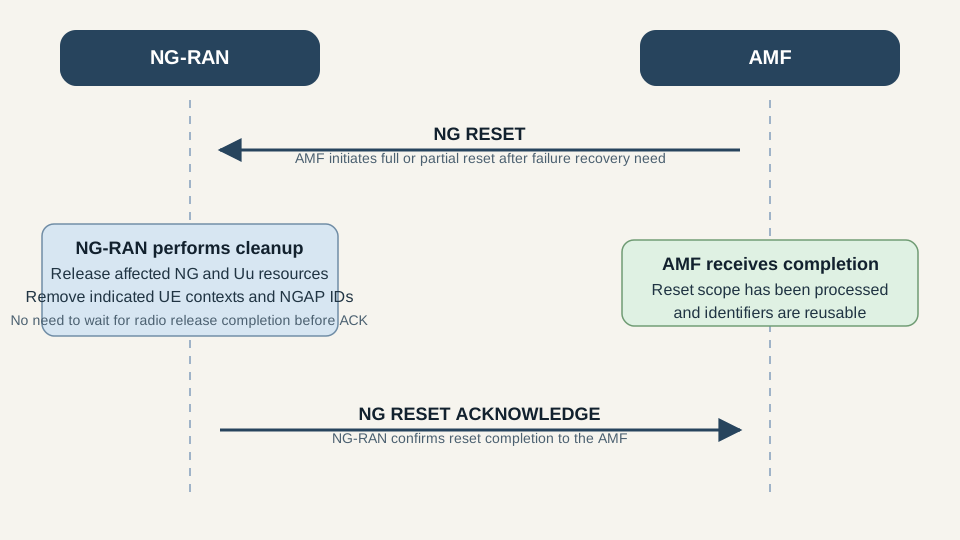
AMF-initiated reset completed at the NG-RAN
AMF-initiated branch: after the AMF sends NG Reset, the NG-RAN completes the requested cleanup and then returns NG Reset Acknowledge.
Call flow position: The AMF sends NG Reset, the NG-RAN performs the requested cleanup, and then the NG-RAN returns NG Reset Acknowledge to confirm completion.
Typical state: The NG-RAN has released the affected NG and Uu resources and removed the indicated UE contexts including NGAP identifiers.
Preconditions:
The AMF initiated NG Reset after failure or transaction-reference-state loss.
The NG-RAN completed the requested full or partial reset actions.
For the affected UE associations, related ongoing procedures on the same NG interface were aborted except another NG Reset.
Next likely message: Fresh post-reset signaling or broader recovery procedures under a clean state
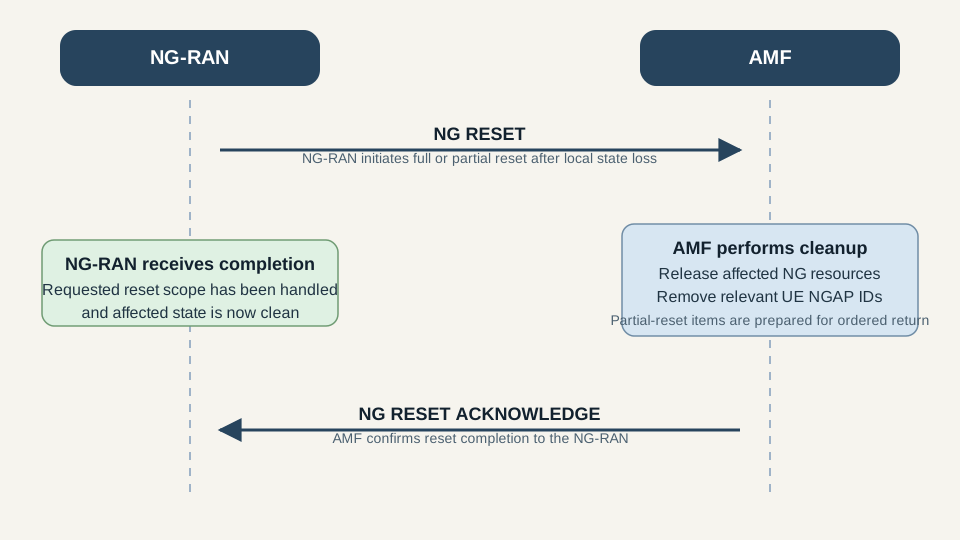
NG-RAN-initiated reset completed at the AMF
NG-RAN-initiated branch: the AMF completes the requested reset actions and then responds with NG Reset Acknowledge.
Call flow position: The NG-RAN sends NG Reset, the AMF releases the affected NG resources and identifiers, and then the AMF returns NG Reset Acknowledge.
Typical state: The AMF has completed the reset scope requested by the NG-RAN and can now confirm the cleanup.
Preconditions:
The NG-RAN initiated NG Reset for full or partial UE-related state cleanup.
The AMF released the affected NG resources and removed the relevant NGAP IDs.
For partial reset, the AMF is ready to return the UE-associated logical NG-connection items in the same order as received.
Next likely message: Normal signaling may resume for unaffected UEs, while reset UEs restart through fresh recovery branches
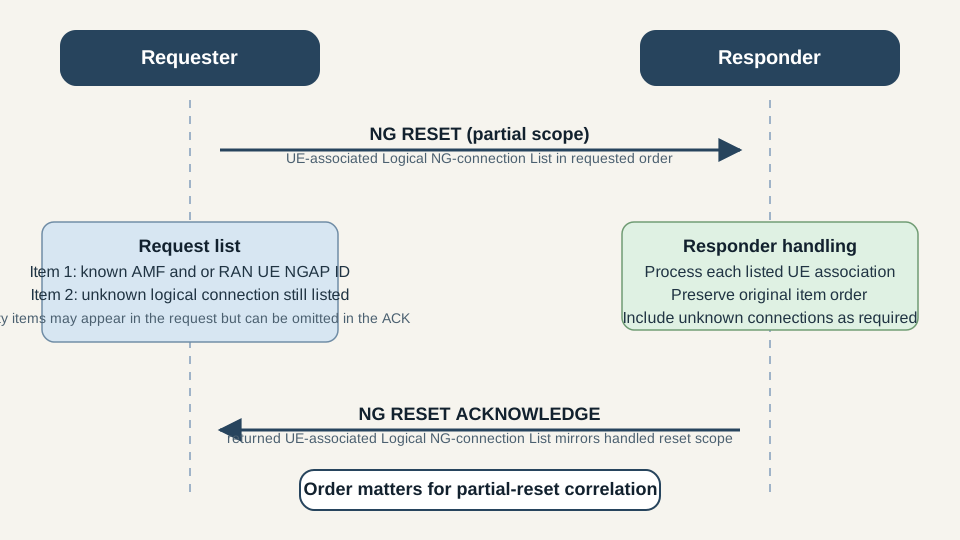
Partial reset acknowledgment details
Partial-reset branch: the acknowledge may return UE-associated Logical NG-connection List in the same order as the request, including unknown logical connections.
Call flow position: The original NG Reset used part-of-NG-interface scope, so the acknowledge may echo the handled UE-associated logical NG-connections.
Typical state: The responder is confirming reset completion per listed UE association rather than only confirming whole-interface cleanup.
Preconditions:
The NG Reset request contained a UE-associated Logical NG-connection List.
The responder preserved request ordering while building the acknowledge list.
Unknown UE-associated logical NG-connections were still represented as required, with empty items omitted where applicable.
Next likely message: The initiator can correlate partial-reset completion item by item
Call flow position
Previous message(s):NG Reset, Failure recovery on N2
Transport / encapsulation: NGAP over SCTP/IP between NG-RAN and AMF
Security context: NG Reset Acknowledge does not establish or modify application-level configuration or UE security context. It confirms completion of UE-related reset cleanup after failure recovery, while application-level configuration data from procedures such as NG Setup remains unaffected.
Message Structure Overview
NG Reset Acknowledge is a non-UE-associated successfulOutcome in the Interface Management family.
The message is bidirectional in normal operation because either the NG-RAN node or the AMF can respond with it depending on who received the NG Reset request.
For full reset, the acknowledge is usually minimal because the whole NG interface scope was reset.
For partial reset, the acknowledge can return UE-associated Logical NG-connection List so the initiator can correlate completion item by item.
The reset procedure affects UE-related NG resources and identifiers but does not affect application-level configuration data such as that exchanged during NG Setup.
NG Reset Acknowledge confirms reset completion, not just message receipt.
ASN.1 for 5G NGAP - NG Reset Acknowledge
NGResetAcknowledge ::= SEQUENCE {
  protocolIEs ProtocolIE-Container { {NGResetAcknowledge-IEs} },
  ...
}

NGResetAcknowledge-IEs NGAP-PROTOCOL-IES ::= {
  { ID id-UE-associatedLogicalNG-connectionList CRITICALITY ignore TYPE UE-associatedLogicalNG-connectionList PRESENCE optional } |
  { ID id-CriticalityDiagnostics                CRITICALITY ignore TYPE CriticalityDiagnostics                PRESENCE optional },
  ...
}
How to read this ASN.1
This successfulOutcome stays compact. Its operational meaning comes from the reset scope handled by the responder: full reset often produces a minimal acknowledge, while partial reset can return the UE-associated logical NG-connection list in the same order as received.
Treat this as a teaching example based on the spec structure, not as a captured network trace.
For full reset, a minimal acknowledge is normal because there is no UE list to echo.
For partial reset, compare request and acknowledge item order carefully because the responder returns items in the same order as received.
Unknown UE-associated logical NG-connections may still be represented in the acknowledge and should not automatically be treated as decode failure.
Important Information Elements
IE
Presence
Description
Message Type
Mandatory
Identifies the NGAP PDU as NG Reset Acknowledge in the successfulOutcome branch.
UE-associated Logical NG-connection List
Optional
Optional list used mainly for partial reset confirmation. The responder returns corresponding UE-associated logical NG-connection items in the same order as received, including unknown logical connections, while empty items may be omitted.
Criticality Diagnostics
Optional
Optional diagnostics that can provide additional protocol-handling or IE-level context related to the reset procedure.
Detailed field explanation
Message Type
Identifies the NGAP PDU as NG Reset Acknowledge in the successfulOutcome branch.
Presence: Mandatory
In practice: In practice, compare this field with the original request and with any later release-dependent optional fields so you can see whether the network accepted the same service model the UE asked for.
UE-associated Logical NG-connection List
Optional list used mainly for partial reset confirmation. The responder returns corresponding UE-associated logical NG-connection items in the same order as received, including unknown logical connections, while empty items may be omitted.
Presence: Optional
In practice: In practice, compare this field with the original request and with any later release-dependent optional fields so you can see whether the network accepted the same service model the UE asked for.
Criticality Diagnostics
Optional diagnostics that can provide additional protocol-handling or IE-level context related to the reset procedure.
Presence: Optional
In practice: In practice, compare this field with the original request and with any later release-dependent optional fields so you can see whether the network accepted the same service model the UE asked for.
What to check in logs and traces
Confirm NG Reset Acknowledge follows NG Reset and that the sender is the side that received the reset request.
Check whether the reset was full-scope or partial-scope before interpreting the acknowledge payload.
For partial reset, verify the returned UE-associated logical NG-connection items appear in the same order as in the request.
Check whether AMF UE NGAP ID and RAN UE NGAP ID are echoed when present in the request items.
Verify unknown UE-associated logical NG-connections are still represented correctly in partial-reset handling.
Do not infer application-level NG Setup configuration changes from this procedure, because reset does not affect that configuration data.
Common Issues and Troubleshooting
The acknowledge is treated like a generic ACK and reset cleanup is not actually confirmed.
Likely cause: Reviewers may be reading it as simple receipt confirmation instead of as proof that the responder completed the requested reset actions.
What to inspect: Check that the responder released the affected NG resources and removed the relevant NGAP identifiers before interpreting the acknowledge as successful completion.
Next step: Treat NG Reset Acknowledge as the reset-completion marker, not merely as transport-level acknowledgment.
Partial reset correlation looks inconsistent across request and acknowledge.
Likely cause: The returned UE-associated logical NG-connection items may have been read out of order or filtered when unknown connections were present.
What to inspect: Compare request and acknowledge lists item by item in the original order, including unknown logical connections and any omitted empty items.
Next step: Validate partial-reset handling against the ordered echo rule before assuming broken state cleanup.
Engineers expect the NG-RAN to delay the acknowledge until radio release fully completes.
Likely cause: The AMF-initiated reset branch does not require the NG-RAN to wait for radio-resource release completion before sending NG Reset Acknowledge.
What to inspect: Check whether the reset direction is AMF-initiated and whether the acknowledge timing matches the spec's cleanup rule.
Next step: Do not misclassify an early acknowledge as protocol error when the reset branch permits it.
LTE / 5G / Variant Comparison
Full reset versus partial reset
Full reset acknowledges whole-interface cleanup and is usually minimal. Partial reset acknowledges selected UE-associated logical NG-connections and may return the ordered UE list for correlation.
AMF-initiated versus NG-RAN-initiated reset
Both use the same NG Reset Acknowledge message. The difference is which side performed the cleanup and which side receives the successful outcome.
Why this acknowledge is operationally important
NG Reset Acknowledge is more than a receipt signal. It marks completion of a reset that may have released UE-related state, removed NGAP IDs, and aborted other ongoing UE-related procedures on the same NG interface.
FAQ
What is NG Reset Acknowledge in 5G NGAP?
It is the NGAP successful-outcome message used to confirm completion of a previously received NG Reset request.
Who sends NG Reset Acknowledge?
Either the NG-RAN node or the AMF sends it, depending on which side received the NG Reset request.
Is NG Reset Acknowledge sent by both AMF and NG-RAN?
Yes. The message is used in both directions because either side can respond to NG Reset.
What is the difference between NG Reset and NG Reset Acknowledge?
NG Reset is the initiating recovery request. NG Reset Acknowledge is the successful-outcome response confirming that the requested reset scope has been processed.
What happens to UE-associated logical NG connections during reset?
The responder releases the affected NG resources and removes the relevant NGAP identifiers for the indicated UE associations, then confirms completion with NG Reset Acknowledge.
Does NG Reset Acknowledge contain a UE-associated Logical NG-connection List?
It may contain that list in partial reset cases so the initiator can correlate which UE-associated logical NG-connections were processed.
Does NG Reset affect NG Setup or application-level configuration data?
No. The reset procedure does not affect application-level configuration data such as that exchanged during NG Setup.
Can NG Reset Acknowledge be sent before radio release fully completes?
Yes in the AMF-initiated branch. The NG-RAN does not need to wait for completion of radio-resource release before sending NG Reset Acknowledge.
What happens if a reset item has neither AMF UE NGAP ID nor RAN UE NGAP ID?
The receiver ignores that item. The responder may return the empty UE-associated logical NG-connection item in NG Reset Acknowledge.
What happens when two NG RESET procedures cross?
If a peer sends another NG Reset on the same NG interface for UE associations already requested to be reset, the receiver still responds with NG Reset Acknowledge according to the relevant successful-operation behavior.
Decode this message with the 3GPP Decoder, inspect the related message database, or open the matching call flow to see where this signaling step fits in the full procedure.