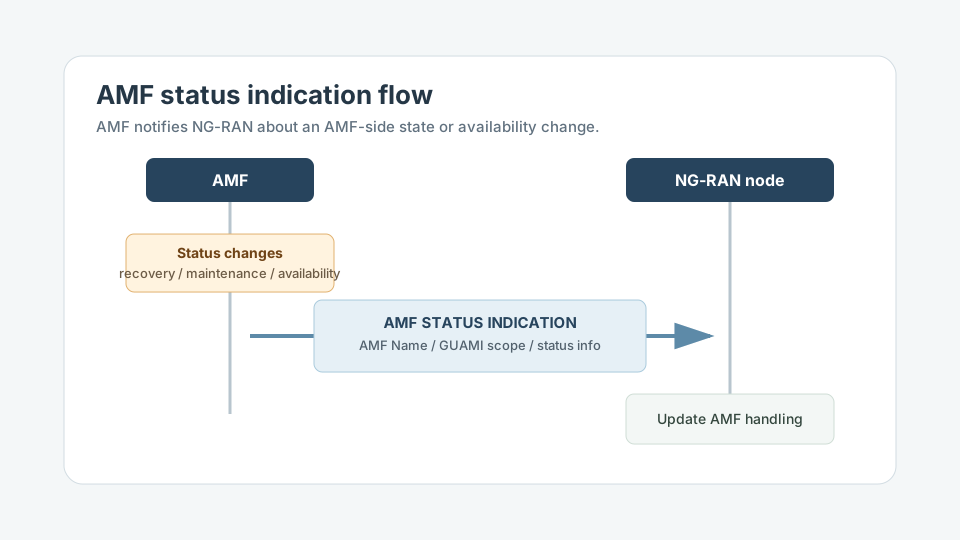
AMF Status Indication is the NGAP interface-management message sent by the AMF to NG-RAN to notify AMF status changes or availability updates affecting signalling and UE context handling.
AMF experiences an operational status change such as recovery, availability change, overload recovery, maintenance, restart, or internal handling update.
Main purpose
Notifies NG-RAN about AMF status changes, helps the NG-RAN update AMF selection and signalling behavior, supports recovery or maintenance scenarios, and provides AMF identity or status context when present.
AMF Status Reporting, Interface Management, AMF availability handling, AMF recovery handling, AMF selection and signalling routing
What is AMF Status Indication in simple terms?
AMF Status Indication is the NGAP interface-management message sent by the AMF to NG-RAN to notify AMF status changes or availability updates affecting signalling and UE context handling.
Notifies NG-RAN about AMF status changes, helps the NG-RAN update AMF selection and signalling behavior, supports recovery or maintenance scenarios, and provides AMF identity or status context when present.
Why this message matters
AMF Status Indication is the AMF telling the gNB that its AMF-side state has changed. It helps NG-RAN keep AMF selection and signalling behavior aligned with current AMF conditions.
Where this message appears in the call flow
AMF Status Reporting
AMF notifies NG-RAN about a status change so the RAN can update local AMF state and signalling behavior.
Call flow position: AMF sends this non-UE-associated initiatingMessage to inform NG-RAN about AMF status changes.
Typical state: NG-RAN updates locally stored AMF state and uses the information for signalling behavior or AMF selection decisions.
Preconditions:
The AMF and NG-RAN have an NGAP signalling association.
The AMF has status information worth notifying to NG-RAN.
Affected AMF identity information is decodable when present.
Next likely message: Adjusted NG-RAN AMF selection or signalling handling
AMF identity impact
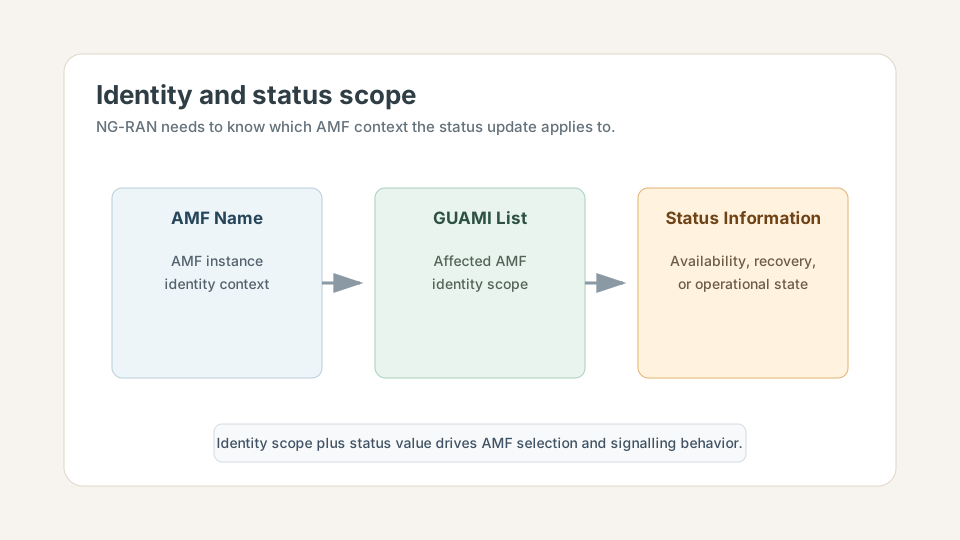
Identity and scope fields tell NG-RAN which AMF context the status update applies to.
Call flow position: AMF Name and GUAMI List can identify which AMF instance or AMF identities are affected.
Typical state: NG-RAN maps the status information to the correct AMF identity scope.
Preconditions:
AMF Name or GUAMI List is present when the status is scoped to specific AMF identities.
The NG-RAN has matching AMF identity context.
Next likely message: Updated AMF mapping
Overload and recovery distinction
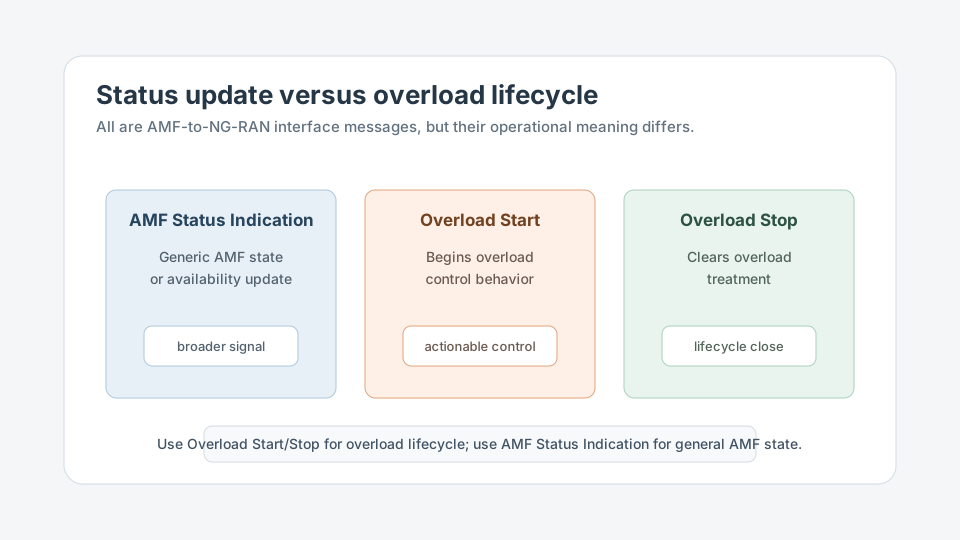
AMF Status Indication is a generic AMF state update; Overload Start and Stop are the overload-control lifecycle messages.
Call flow position: AMF Status Indication is adjacent to overload procedures but is broader than Overload Start or Overload Stop.
Typical state: Trace analysis treats AMF Status Indication as a generic status update unless an overload-specific procedure is present.
Preconditions:
Procedure name and status contents are checked.
Overload Start or Overload Stop messages are correlated separately when present.
Next likely message: Correct interface-management interpretation
Call flow position
Previous message(s): AMF status, availability, maintenance, or recovery event, Existing NGAP association between AMF and NG-RAN
Next message(s):NG-RAN updates AMF state, NG-RAN adjusts AMF selection, signalling routing, or UE context handling
Transport / encapsulation: NGAP over SCTP/IP between AMF and NG-RAN
Security context: AMF Status Indication does not create UE-specific security context. It is node-level AMF status signalling that can affect how NG-RAN treats AMF selection, routing, and UE context procedures.
Message Structure Overview
AMF Status Indication is an AMF-to-NG-RAN non-UE-associated initiatingMessage.
AMF Name can identify the AMF instance sending or affected by the status update.
GUAMI List can scope the update to affected AMF identities.
Status Information carries the operational meaning of the AMF status change when present.
The message is broader than overload lifecycle messages and should be correlated with Overload Start or Overload Stop only when those procedures are present.
ASN.1 for 5G NGAP - AMF Status Indication
AMFStatusIndication ::= SEQUENCE {
  protocolIEs ProtocolIE-Container { {AMFStatusIndication-IEs} },
  ...
}

AMFStatusIndication-IEs NGAP-PROTOCOL-IES ::= {
  { ID id-AMFName            CRITICALITY ignore TYPE AMFName            PRESENCE optional } |
  { ID id-GUAMIList          CRITICALITY ignore TYPE GUAMIList          PRESENCE optional } |
  { ID id-StatusInformation  CRITICALITY ignore TYPE StatusInformation  PRESENCE optional },
  ...
}
How to read this ASN.1
Decode AMF identity and status scope first. Treat the ASN.1 shown here as a compact teaching view of the page fields, and confirm exact IE naming against the applicable TS 38.413 release when implementing a decoder.
Treat this as a teaching example based on the expected message purpose, not as a captured network trace.
AMF Name and GUAMI List define the identity scope when present.
Status Information gives the operational meaning of the status update.
Important Information Elements
IE
Presence
Description
Message Type
Mandatory
Identifies the NGAP PDU as AMF STATUS INDICATION.
AMF Name
Optional
Optional AMF instance name associated with the status update.
GUAMI List
Optional
Optional list of affected AMF identities.
Status Information
Optional
Optional AMF condition or state information, such as availability, recovery, or operational state.
Detailed field explanation
Message Type
Identifies the NGAP PDU as AMF STATUS INDICATION.
Presence: Mandatory
In practice: In practice, compare this field with the original request and with any later release-dependent optional fields so you can see whether the network accepted the same service model the UE asked for.
AMF Name
Optional AMF instance name associated with the status update.
Presence: Optional
In practice: In practice, compare this field with the original request and with any later release-dependent optional fields so you can see whether the network accepted the same service model the UE asked for.
GUAMI List
Optional list of affected AMF identities.
Presence: Optional
In practice: In practice, compare this field with the original request and with any later release-dependent optional fields so you can see whether the network accepted the same service model the UE asked for.
Status Information
Optional AMF condition or state information, such as availability, recovery, or operational state.
Presence: Optional
In practice: In practice, compare this field with the original request and with any later release-dependent optional fields so you can see whether the network accepted the same service model the UE asked for.
What to check in logs and traces
Confirm direction is AMF to NG-RAN.
Confirm the message is non-UE-associated.
Decode AMF Name when present.
Decode GUAMI List and compare it with the NG-RAN AMF mapping.
Decode Status Information and correlate it with the network event.
Check whether separate Overload Start or Overload Stop messages are also present.
Verify NG-RAN AMF selection or signalling behavior changes accordingly.
Common Issues and Troubleshooting
NG-RAN continues using stale AMF state.
Likely cause: AMF Status Indication may be missing, delayed, or not processed by the NG-RAN.
What to inspect: Check whether the indication reached all relevant NG-RAN nodes and whether SCTP/NGAP association state was healthy.
Next step: Confirm status propagation and NG-RAN state update logic.
Status update affects the wrong AMF identity.
Likely cause: AMF Name or GUAMI List may be wrong, stale, or mis-correlated.
What to inspect: Compare AMF Name, GUAMI List, NG Setup information, and AMF Configuration Update history.
Next step: Correct AMF identity mapping before judging routing behavior.
AMF overload behavior does not match the trace.
Likely cause: AMF Status Indication may be confused with Overload Start or Overload Stop.
What to inspect: Check for overload-specific messages and their payloads separately from the status indication.
Next step: Use Overload Start/Stop for overload lifecycle and AMF Status Indication for generic status interpretation.
Load balancing decisions look inconsistent.
Likely cause: NG-RAN may not have updated AMF availability or identity state consistently across nodes.
What to inspect: Compare AMF Status Indication reception across NG-RAN nodes and correlate with AMF selection decisions.
Next step: Align AMF state distribution and routing policies.
Status information does not match the maintenance event.
Likely cause: The status event, AMF instance, or GUAMI scope may be mismatched.
What to inspect: Correlate timestamp, AMF Name, GUAMI List, and maintenance/recovery logs.
Next step: Fix the event-to-identity mapping and validate new status updates.
LTE / 5G / Variant Comparison
Compared with Overload Start
Overload Start actively begins overload-control behavior and may carry reduction instructions. AMF Status Indication is a broader AMF state update.
Compared with Overload Stop
Overload Stop clears a specific overload condition. AMF Status Indication can report more general AMF state, recovery, or availability changes.
Compared with AMF Configuration Update
AMF Configuration Update changes AMF configuration information and expects an acknowledgement or failure. AMF Status Indication is a status notification.
FAQ
What is AMF Status Indication in NGAP?
It is an AMF-to-NG-RAN interface-management message used to notify AMF status changes or availability updates.
Who sends AMF Status Indication?
The AMF sends AMF Status Indication to the NG-RAN node.
Is this message UE-associated?
No. AMF Status Indication is a non-UE-associated NGAP interface-management message.
How is it different from Overload Start and Overload Stop?
Overload Start and Overload Stop specifically control overload behavior. AMF Status Indication is broader and reports general AMF state or availability changes.
When does AMF send this message?
It may be sent when the AMF has a status change such as recovery, availability change, maintenance, restart, overload recovery, or internal handling update.
What happens if NG-RAN does not receive it?
NG-RAN may keep stale AMF state, which can affect AMF selection, signalling routing, or UE context handling decisions.
How does it affect AMF selection?
NG-RAN can use the status information, AMF Name, and GUAMI scope to update which AMF identities should receive signalling or be selected for future procedures.
Decode this message with the 3GPP Decoder, inspect the related message database, or open the matching call flow to see where this signaling step fits in the full procedure.